
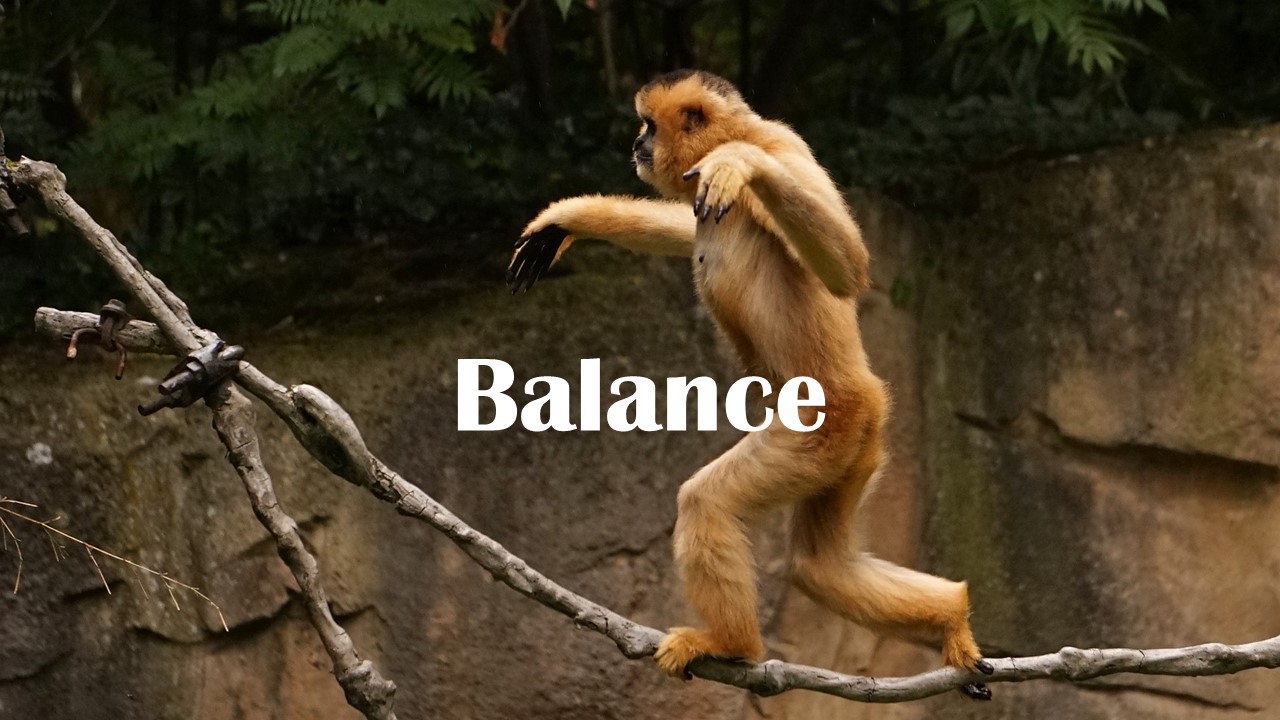
Keeping your life in balance

stay in balance

Keeping your life in balance.
Photo courtesy of Pixabay.com

Keeping your life in balance

By David Joel Miller, MS, Licensed Therapist & Counselor.

There’s more to a balanced life than your work-life balance.

I read and hear a lot about people struggling to maintain a work-life balance. I know it’s getting increasingly difficult to have both. But when we look deeper, there’s a lot more that needs balancing than just work and personal life.

When I first started out in counseling, we were taught a model of a balanced life that is sometimes called the grapefruit or the pie of life. There are also scads of whole-person models. What they all have in common is the idea that your life is divided into segments or activities, and since the total number of hours each week is fixed, time or resources added to one segment must be taken away from another part of your life.

I think of this like those antique bicycles that had a limited number of spokes on the front wheel. You have probably seen pictures of bicycles with one huge front wheel and two smaller back wheels. If some of those spokes are longer than others, then you have a very bumpy ride. Life is like that. If one part of your life gets too much emphasis, all the other parts shrink, and your life becomes extremely unpleasant.

Here are some of the segments of your life that may need attention if you are to achieve a good life balance.

Financial relationships.

This includes work and your other sources of income, as well as how you relate to money. Some people are spenders, some are savers, and some manage their money. If you have a lot of debt, you may feel that money is managing you.

Work or other sources of income.

Most people either have a job or a partner who has a job. The idea that most people would prefer to be on welfare seems untrue to me. If you’ve ever needed public assistance, you might’ve found that the paperwork and the time you spend waiting for workers is more challenging than showing up for a job if you can find it.

Social relationships.

This segment of your pie of life includes family, friends, and your close sexual and romantic relationships. The topic of intimate relationships is too complicated to go into much detail here. The short part of this is that your relationships probably need more attention than they are getting.

Physical health.

Getting and staying healthy is a lifelong challenge. Diet, exercise, and medical care are all factors in how well you maintain your physical body. Having a chronic illness or disability affects every other part of your life.

Mental health.

How we measure and evaluate mental health has become increasingly complicated. There are over 400 recognized mental illnesses and 400 more “conditions for further study.” But those recognized conditions don’t begin to encompass all of the problems of living that so many people face each day.

Your emotional life.

Beyond the problem of mental health and mental illness are those emotional conditions that are not formal diagnoses of a mental illness but are significant challenges for many people. Anger is a common emotional issue that destroys families and friendships. Loneliness has recently been recognized as a problem that affects both mental and physical health. The impact of loneliness on physical health is as significant as smoking fifteen cigarettes a day.

Religious or spiritual life aspects.

A lot of the popular accounts of religion are oversimplified to the point of being misleading. It’s easy to classify countries as either Christian or Muslim, but there’s ample evidence that Sunnis fight Shiites and Protestants have had wars with Catholics. Because of the almost infinite range of denominations and sects, it’s hard to understand the role religion may play in our society. Increasingly, we see people who say that they are spiritual but not religious. Regardless of how we classify all these things, it’s clear that humans need to believe there is something beyond our species that matters. Having some kind of connection to a higher power is an ingredient in a flourishing life.

The need for self-actualization.

Humans seem to inherently feel a drive or need for such things as creativity, meaning and purpose in their lives, mastery, knowledge, learning, and some level of control over their lives. These self-actualization values often get overlooked in the quest for the basics. When you’re struggling to find food, clothing, and shelter, it’s easy to forget that anything else might matter.

But we see plenty of cases in the world where people will do without food and water and work in adverse conditions through pain and suffering because they believe in a cause or value that they find more important than their own lives.

Does David Joel Miller see clients for counseling and coaching?

Yes, I do. I can see private pay clients if they live in California, where I am licensed. If you’re interested in information about that, please email me or use the contact me form.

Staying in touch with David Joel Miller.

Want the latest blog posts as they are published? Subscribe to this blog.

For more information about my writing journey, my books, and other creative activities, please subscribe to my blog at davidjoelmillerwriter.com

Seven David Joel Miller Books are available on Amazon now! And more are on the way.

For more about my books, please visit my Amazon Author Page – David Joel Miller

For information about my work in mental health, substance abuse, and having a happy life, please check out https://counselorssoapbox.com

For videos, see: Counselorssoapbox YouTube Video Channel

How healthy is your pie of life?

By David Joel Miller, MS, Licensed Therapist & Licensed Counselor.

Life pie

Healthy Pie of Life.
Photo courtesy of Pixabay.com

A healthy, balanced life is made up of many “slices” they all need to be healthy.

Recovery programs, whether they are mental health or substance use programs, frequently have clients fill out a form sometimes called a “pie of life” or a “grapefruit diagram.”

Your life is made up of many separate components. Each of these portions needs to be in balance for you to have a healthy emotional life. Periodically, it is useful to look at each of these life domains and see which requires improvement.

Social Relationships support good mental health.

One of the four criteria for diagnosing a problem as a mental illness is when it interferes with your ability to have healthy relationships. These relationships can be primary sexual relationships, or they might be family or friends. The problems involved in getting together and breaking up bring a lot of people to counseling so do conflicts with relatives. Today, in America, more than fifty percent of all marriages end in divorce, and there are lots of families who are not speaking to each other.

One reason for the high divorce rate is a failure to develop and maintain a good couple’s relationship. In the early stages of a couple’s relationship, loneliness and sexual urges drive people together. Failure to develop deep friendship dooms many couple’s relationships.

Whether you’re an introvert or extrovert, humans need support from other people. Failure to develop social skills can impair your mental health. People in early recovery are encouraged to work on their friend-making skills and to develop a support system of at least five friends, where possible family members may meet that need.

Another part of social relationships is your relationship to society in general. Dealing with legal issues, staying inside the law, is a part of recovery. Ask yourself how healthy is your relationship to society in general.

Work and meaning impact your emotional health.

Work provides more than just economic advantages. People who enjoy what they do each day are more mentally healthy. Work Burnout is a major source of emotional distress. People who feel that what they do for a living makes a difference are more emotionally stable.

Beyond simply working for the money, finding meaning and purpose in life will positively affect your mental health.

Your physical world impacts your emotional health.

Part of having a happy, healthy, and successful life is getting your body and physical environment into the best shape possible. Many people face serious physical and environmental challenges. Making the best of the situation you’re in can help to bring your life into emotional balance.

Manage your physical health to maximize your emotional health and your recovery. Good physical health starts with getting adequate sleep. You don’t have to become a healthy diet fanatic to eat a healthier diet. Make small changes and maintain them. Eat more healthy items and reduce the amount of unhealthy foods you consume.

Get some physical activity each day. Exercise is an important part of keeping your body healthy, and a healthy body has a positive effect on your emotional health. Even people with significant physical disabilities can still find ways to improve physical activity. People who are bedridden can be given physical exercises which they can do in bed. Talk with your medical doctor about ways you can increase your physical activity. Stand if you can, walk more each day when possible. Whatever you do, don’t give up. Each day, strive to take the best care of your body possible and your physical health will help care for your mental health.

Safety and security are also parts of caring for your physical health. If you’re in a dangerous situation, work on making it safer. Whatever you can do to make the place you stay feel comfortable and safe will improve your emotional health.

Intellectual growth encourages emotional growth.

A day where you don’t learn something new is a wasted day. Pursue hobbies, read books, and take classes whenever possible. If your mental illness or substance use disorder interfered with your education get back on track. Part of recovery is learning new things. Continue to challenge yourself.

Spiritual and religious practices support recovery.

Part of the process of growing up is deciding what you believe. If you have a religious or spiritual tradition, be sure you are following it. People with strong beliefs and a commitment to follow those beliefs find their faith will support their mental health. Be careful about falling into the need to make everyone else follow your religion. If you’re comfortable in your own faith, you are less likely to need to force others to agree with you.

Emotional and Psychological health, thinking, feeling, behaving.

Make friends with your feelings; they are valuable sources of information. Learn to regulate your emotions rather than letting them control you. If you have recurring thoughts or feelings that are causing your life to stay out of balance get professional help. If your behavior frequently brings you into conflict with others study anger management.

Financial health supports emotional health.

How much money you make, or how much you have, does not determine your financial health. When you are trying to get by on a very small income, it can be a struggle. But having lots of money does not guarantee emotional health. It’s possible to have a happy life despite having a very small income. Some very miserable people live in mansions.

The secret to financial health is to spend less than your income. What makes people unhappy is the gap between what they have and what they want. A large part of the world now owes more than they own. The fastest way to become financially unhealthy is to spend beyond your income and finance that gap on short-term credit card debt.

Part of your recovery may well be getting your financial life in order. Look for ways to increase your income. Invest in yourself by getting more education or job training. Look for ways to reduce your spending. Start a beginner’s savings account and then begin paying off your debts.

The downturn in 2008 resulted in a lot of people having to do some drastic belt-tightening. One lesson many learned was that when forced to do so they could live on a lot less income than they previously thought possible. For maximum financial health get your finances in order as soon as possible and don’t wait for a crisis to begin paying off bills and saving for a rainy day.

Some of these categories could be split or combined, but they are a starting point for taking an inventory of your life and deciding what most needs improvement. Getting your life in balance is an important part of recovery from whatever you may call your challenges.

David Joel Miller MS is a Licensed Marriage and Family Therapist (LMFT) and a Licensed Professional Clinical Counselor (LPCC.)  Mr. Miller provides supervision for beginning counselors and therapists and teaches at the local college in the Substance Abuse Counseling program.

Staying connected with David Joel Miller

Seven David Joel Miller Books are available now!

My newest book is now available. It was my opportunity to try on a new genre. I’ve been working on this book for several years, but now seem like the right time to publish it.

Story Bureau.

Story Bureau is a thrilling Dystopian Post-Apocalyptic adventure in the Surviving the Apocalypse series.

Baldwin struggles to survive life in a post-apocalyptic world where the government controls everything.

As society collapses and his family gets plunged into poverty, Baldwin takes a job in the capital city, working for a government agency called the Story Bureau. He discovers the Story Bureau is not a benign news outlet but a sinister government plot to manipulate society.

Bumps on the Road of Life. Whether you struggle with anxiety, depression, low motivation, or addiction, you can recover. Bumps on the Road of Life is the story of how people get off track and how to get your life out of the ditch.

Dark Family Secrets: Doris wants to get her life back, but small-town prejudice could shatter her dreams.

Casino Robbery Arthur Mitchell escapes the trauma of watching his girlfriend die. But the killers know he’s a witness and want him dead.

Planned Accidents  The second Arthur Mitchell and Plutus mystery.

Letters from the Dead: The third in the Arthur Mitchell mystery series.

What would you do if you found a letter to a detective describing a crime and you knew the writer and detective were dead, and you could be next?

Sasquatch. Three things about us, you should know. One, we have seen the past. Two, we’re trapped there. Three, I don’t know if we’ll ever get back to our own time.

For these and my upcoming books; please visit my Author Page – David Joel Miller

Want the latest blog posts as they publish? Subscribe to this blog.

For videos, see: Counselorssoapbox YouTube Video Channel

Is your life out of balance?

By David Joel Miller, MS, Licensed Therapist & Licensed Counselor.

stay in balance

Balance.
Photo courtesy of Pixabay.com

Ways to get your life back in balance.

It is easy to get stressed out. Getting ahead is getting more and more difficult. People tell me all the time that they are overwhelmed and that they just can’t keep up anymore. In the quest to be successful at work or competitive activities, one of the first things to suffer is your work-life balance.

Trying to be and do more results in relationships that get neglected. In extreme cases, people find they have neglected self-care and their physical and mental health have suffered. If you find your life has gotten way out of balance here are some tips on how to get that out of balance life back in balance.

Try doing less for a more balanced life.

The first step in a balanced life is to review the things on your plate and decide which are really necessary. There are plenty of things you could do but just because you can, does not mean you should.

Set a bedtime for a more balanced life.

There are times you can cut corners and squeeze a little more out, but giving up sleep time in the quest for success is a really bad idea. You can only get so many miles out of an unmaintained vehicle and the human body will not function well without adequate rest. Try cutting corners on sleep and you will find you will begin to make really bad decisions.

Make up a daily schedule to maintain balance.

Having a daily schedule all written out helps you chart a course for your day just like a road map will help you get to your destination. Writing out your day’s schedule will point to the times you have more to do than you could possibly be accomplished. A schedule can also help you see that you need to be across town two minutes after you started a meeting with your boss. Use the schedule to even out the workflow.

Reviewing that daily schedule at the end of the day may help you spot where you filled time with a water cooler session or a video game binge. It is those diversions that drag on and on which rob your day of a lot of potentially productive hours.

Allow adequate meal times to keep yourself healthy.

You can’t run your car on an empty tank nor can you run your body on substandard nutrition. Rushing through meals results in eating fewer healthy foods and more of those over-processed ones.

Investing more time in yourself keeps all aspects of your life balanced.

If you are too busy to learn a new skill then you are far too busy. Invest in your body and mind and they will still be serviceable when you reach the rewards of your life. Do you want to be one of those people who worked hard to have enough in retirement and find you are too sick to enjoy it? If you work yourself to death someone else can enjoy the fruits of your efforts.

Include social – friend time in the schedule for better work and life balance.

Humans are social creatures. You need positive supportive people in your life. Investing in friendships and socializing for the sake of enjoyment are not wastes of productive time. Having a good social life is the asset that will get you through those tough times in life.

Break up big tasks – chunking.

Life gets off-kilter rapidly when you throw yourself at a task that is too big to complete all at once and you stay with it beyond the point of making progress. An occasional all-night work binge may be part of life in this millennium but if taking on huge tasks and wearing yourself out in the process is your modus operandi try breaking that task up into smaller sub-tasks and doing one of these tasks each day.

Start accepting what is.

One of the biggest time sucks and a waste of energy is time spent on complaining about what is, should be, and so on. Do not squander time saying something should not have happened or looking for whose fault it was.

Invest your energy in accepting the current situation as it exists and then focus on how to change it. Hint here. The solution probably consists of changing you and what you do rather than in trying to change other’s behavior to suit you.

Set time limits on tasks to prevent their expanding.

Ever had a fifteen-minute task take four hours? Work can expand to fill the time allotted. So can diversions. Set limits and if you are not done in the allotted time move on down your list. When you create your plan for the next day or revise today’s, try being more realistic about how much time this supposed fifteen-minute task will take.

Invest time in goal setting and planning.

Creating a specific goal and planning the steps to get you there is not a waste of time. Having clear goals can give your project and your life a focus. Developing a clear plan with periodic review points can keep you headed in the right direction. Good plans also prevent leaving out steps and then having to start the project all over again.

Make lists.

Make lists. Make lots of lists. Do what is most important to them and ignore the maybe’s. A list of materials needed can help you avoid having to stop partway through because you are out of “stuff.” Lists that include rest and relaxation can keep you from being the machine that breaks down unexpectedly.

Prioritize – what should you be doing not what you can do.

A lot of time can get flushed away on all the things that you could be doing and result in little or no time for the big major jobs that were the real heart of the project. Let someone else do the optional tasks or delete them from your list altogether.

Was this post helpful? You might also want to check out these other counselorssoapbox posts.     Life Hacks     Self-improvement     Success

Staying connected with David Joel Miller

Seven David Joel Miller Books are available now!

My newest book is now available. It was my opportunity to try on a new genre. I’ve been working on this book for several years, but now seem like the right time to publish it.

Story Bureau.

Story Bureau is a thrilling Dystopian Post-Apocalyptic adventure in the Surviving the Apocalypse series.

Baldwin struggles to survive life in a post-apocalyptic world where the government controls everything.

As society collapses and his family gets plunged into poverty, Baldwin takes a job in the capital city, working for a government agency called the Story Bureau. He discovers the Story Bureau is not a benign news outlet but a sinister government plot to manipulate society.

Bumps on the Road of Life. Whether you struggle with anxiety, depression, low motivation, or addiction, you can recover. Bumps on the Road of Life is the story of how people get off track and how to get your life out of the ditch.

Dark Family Secrets: Doris wants to get her life back, but small-town prejudice could shatter her dreams.

Casino Robbery Arthur Mitchell escapes the trauma of watching his girlfriend die. But the killers know he’s a witness and want him dead.

Planned Accidents  The second Arthur Mitchell and Plutus mystery.

Letters from the Dead: The third in the Arthur Mitchell mystery series.

What would you do if you found a letter to a detective describing a crime and you knew the writer and detective were dead, and you could be next?

Sasquatch. Three things about us, you should know. One, we have seen the past. Two, we’re trapped there. Three, I don’t know if we’ll ever get back to our own time.

For these and my upcoming books; please visit my Author Page – David Joel Miller

Want the latest blog posts as they publish? Subscribe to this blog.

For videos, see: Counselorssoapbox YouTube Video Channel