Did Maslow get it wrong, or did we?


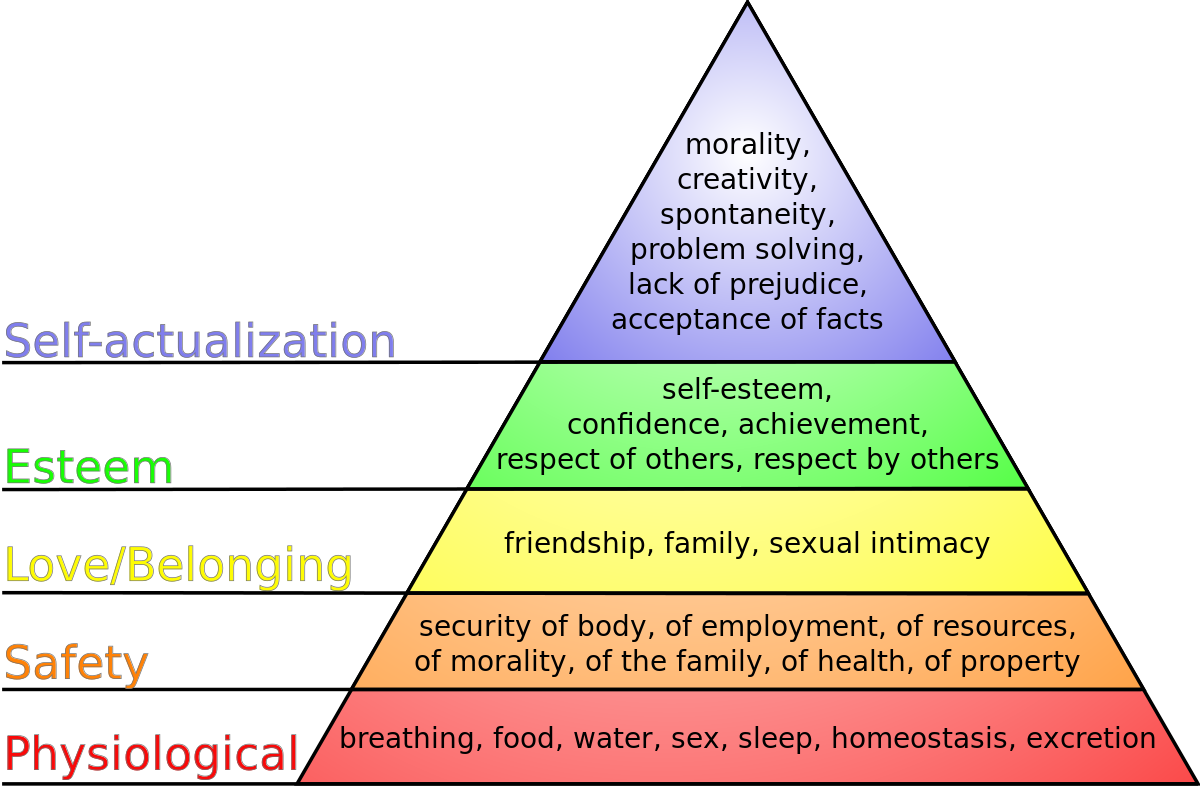
Maslow’s pyramid?
Courtesy of Wikimedia Commons

Did Maslow get it wrong, or did we?

By David Joel Miller, MS, Licensed Therapist & Counselor.

Does Maslow’s hierarchy of needs make sense today?

If you took a class in beginning psychology, you probably were taught about Maslow’s hierarchy of needs. It’s been a long time since I took that class, and I’m not sure if I remember what we were taught accurately, but I am starting to question some of the basic principles as I remember them. Some of the books I’ve been reading recently have made me think maybe that way of looking at things isn’t the final authority.

I first encountered these ideas back in the 1960s. When I went to college, I wasn’t sure what a major was, let alone what I should major in. My experiences as a professor at the local community college since 2008 have led me to believe that fuzzy majors continue to be a problem today.

I took some psychology and some sociology classes in my first year at the community college. Seems like everybody was a psychology major at some point in that decade. Psychology seemed to offer so much promise for helping you decide what the correct choices to make were. Unfortunately, classical psychology was primarily based on research on rats and female college sophomores. That research didn’t actually help most people figure out how to solve their problems. Or how to avoid mental illnesses that counselors and therapists are trained to treat.

Remember that Maslow wrote about a hierarchy of needs during World War II and directly after. His ideas and how psychology professors interpreted them were heavily influenced by their life experiences. Many of our teachers in school in the 1960s had lived through the Great Depression and then World War II. Some of my teachers came home from Europe or Asia and then went to school on the G.I. Bill. Those who taught us had to live through some pretty grim times.

We were taught that physiological needs come first.

Considering what Maslow and those who taught us his hierarchy of needs had lived through, the idea that meeting their physiological needs should come first and that people wouldn’t pay attention to those other “higher” needs would come later makes sense. There may be some reasons to question this notion.

Now I’m not saying that things are any less challenging today, at least for some people. I just think that the challenges the majority of Americans face are different. People who had to live with the possibility of imminent death or who went without food, shelter, or basic necessities of life were affected both physically and mentally by those struggles.

Many parents and grandparents, possibly great-grandparents of people reading this blog, concluded that what mattered in life was a secure job with a good enough paycheck that you would always have food to eat, clothes to wear, and a house to live in. If meeting your physiological and safety needs is what matters, why are there so many people who are depressed, anxious, and about to give up hope?

Is there a shortage of food, water, and shelter today?

Despite the phenomenal creation of wealth since World War II and our emphasis on having the latest technology at our fingertips, the truth is that there are still a lot of people in American society who worry about where their next meal will come from and whether their children will receive adequate healthcare. Our welfare programs and government subsidies provide some relief from the harsh realities, but we still have our homeless, our underfed, and those who can’t get reliable medical care.

From that perspective, Maslow’s hierarchy of needs makes some sense.

The way I understand his theory is that humans have certain basic needs. We need air to breathe, preferably healthy, unpolluted air. The human body needs food and water, but given the chance, most humans consume unhealthy food and water. The hierarchy of needs tells us that we need sleep, but more than one productivity guru tells us we can sleep less and produce more, as if more were beneficial.

S,o how come highly paid tech people have so much anxiety and depression?

Meeting your physiological and safety needs does not result in happy people. Many people with a lot of material possessions are saying that life is meaningless and the money they are earning isn’t meeting their emotional needs.

Without meaning, purpose, and a sense of mastery, the rest doesn’t matter.

What I hear repeatedly from clients is that depression, anxiety, and other mental health challenges rarely come from a lack of food, water, or even adequate housing. Instead, what’s missing in so many people’s lives is a sense that their life has meaning.

Victor Frankel described this in his book Man’s Search for Meaning. His experience in the concentration camp convinced him that having meaning and purpose in your life was far more important than food, clothing, or other physical necessities. People who had a sense of purpose survived camps despite horrific conditions.

Today in a land that’s richer than probably any in the history of the world, we still have a lot of people who can’t find anything that gives their life meaning and purpose. When you’re overweight, more food won’t help. It’s very easy to be lonely in a house with dozens of bedrooms.

How come people are willing to trade sleep for video game time?

The primary benefit derived from playing video games is a sense of mastery. As we move farther and farther into an economy where work is disconnected from physical objects is harder to experience mastery. The inherent thing that video games can give people is a chance to master an environment, albeit an artificial one. In the video game, every time you achieve mastery, you level up and have new challenges to face.

Maybe it’s not the physiological and safety needs that are the foundation of the human hierarchy of needs. People short of food and safety can find abstract principles they’re willing to fight and die for. People with lots of physical possessions may think of suicide and self-harm because they lack meaning, purpose, and a sense of mastery.

I’ve come to think that those things we learned as being necessary only after the baser needs were met are, in fact, the foundation needs that we all are looking for.

Maslow’s hierarchy of needs was not a pyramid.

Just as a by the way. When we say Maslow, most people think of Maslow’s hierarchy of needs as a pyramid. I came across an article about Maslow’s pyramid, which tells us that Maslow didn’t write about his hierarchy of needs as a pyramid. Nowhere that we have been able to find in his writing does that pyramid diagram appear. Where that came from, we can’t be sure.

But I think teaching Maslow’s hierarchy of needs as if it were a pyramid makes those abstract principles seem far less important and places too much emphasis on the needs of the body rather than the emotional needs of the person.

Recommended Mental Health Books

David Miller at counselorssoapbox.com is an Amazon Affiliate and may receive a small Commission if you purchase a book or product using the link on this page. Using the link will not increase the cost to you.

Does David Joel Miller see clients for counseling and coaching?

Yes, I do. I can see private pay clients if they live in California, where I am licensed. If you’re interested in information about that, please email me or use the contact me form.

Staying in touch with David Joel Miller.

Want the latest blog posts as they publish? Subscribe to this blog.

For more information about my writing journey, my books, and other creative activities, please subscribe to my blog at davidjoelmillerwriter.com

Seven David Joel Miller Books are available on Amazon now! And more are on the way.

For these and my upcoming books, please visit my Amazon Author Page – David Joel Miller

For information about my work in mental health, substance abuse, and having a happy life, please check out counselorssoapbox.com

For videos, see: Counselorssoapbox YouTube Video Channel

Happy Labor Day.

Happy Labor Day.

Labor Day sign

Happy Labor Day.
Photo courtesy of Pixabay.com

Today here in the United States it is Labor Day.

Can any of you history buffs tell me why?

Common Challenges Remote Workers Face

Remote Worker
Source: Unsplash.com | By: Yasmina H. | Rights: Free to use under the Unsplash License

Over 4.3 million people in the U.S. work remotely. While many thrive in the new work-from-home space, some still struggle with the various psychological challenges that present themselves in remote work. These challenges not only inhibit the productivity of workers but also play a key role in the mental and physical well-being of employees. 

Below are some of the most common challenges remote workers face and strategies to help overcome them. 

Overworking Yourself

In 2021, unplugging was the most common challenge faced by remote workers and continues to be the number one challenge in 2022 as well. It can be easy to forget to take a break or overwork yourself when working from home. However, not taking breaks or forgetting to unplug when the work day is over can lead to feelings of fatigue, stress, and burnout. 

Remember, it’s okay to take breaks and allow yourself to reset once in a while. Productive breaks are important during the work day both at home and in the office. It allows you to concentrate better, maintain your energy, stay motivated, and keep you mentally refreshed.

If you struggle with taking breaks, try out the Pomodoro Technique. The method advocates working in chunks and taking often, but brief, breaks throughout the day. This time management strategy can be a great way to encourage breaks, increase focus, and allow you to optimize your productivity without feeling overwhelmed

Along with breaks, it’s important to set a hard start and end time or goal each day; so you know when to stop working. When working remotely, it can be easy to stay on the clock even throughout the night. When your work day is over, shut down your computer and silence your work notifications. This will allow you to truly unplug and enjoy your personal time. 

Separating Personal and Professional Life

When you work where you live, it can be hard to separate your personal and professional life. This can increase feelings of anxiety, stress, and frustration. As a remote worker, it’s important to maintain a barrier between work and personal life. 

A great way to separate the two is by having your own dedicated workspace. Create an office separate from where you sleep. It’s important to avoid doing work in your bedroom to help practice sleep therapy, maintain your room’s relaxing nature, and have a physical barrier between your personal and professional life.

To maintain that division, try renting a coworking space or working in a coffee shop. However, if you want to avoid paying fees or having to purchase coffee daily, create your own office space right at home. If you own a home, consider using a home equity loan to construct an optimal covid safe office. This will give you the divide you need while also increasing the value of your home. Constructing an office space is especially advantageous if you have others in your household who work from home, you have kids that need parental supervision, or if you have conditions that don’t allow you to leave your home. Having this space will allow you to create that needed divide, while still being able to enjoy the advantages of working at home. Regardless of what you chose, having a physical separation will clearly define your work and personal life, allowing both to coexist without interfering with each other.

Feeling Isolated

Another major psychological challenge remote workers face is feelings of isolation. It can be easy to forget to leave your house when working remotely. Additionally, not having the typical social interactions from a traditional workplace can make working from home a lonely experience.

To help avoid feelings of loneliness, make an effort to leave your house. Take the time to go for a walk or do an activity outside of your workspace to get your daily dose of sunlight. If possible, take one day a week to work outside your home. This could be as easy as working from your porch or backyard. If you have friends or coworkers in your city, consider meeting up at a coffee shop, public university, or library to do work together. Leaving your home office will help you to feel less isolated, and working with others will help mitigate feelings of loneliness. 

Making Meaningful Connections

Making friends is tough when you enter the workplace, especially when you never got the chance to meet with your coworkers in person. Because of this, it can be difficult for remote workers to feel like they belong and are connected to the company.

In a traditional workspace, conversation happens naturally, but with remote work, it takes a little more effort. Take the extra step to meet your fellow remote workers in a virtual one-on-one to get to know them better and help foster that meaningful connection. Whether it be a casual hello, a shoutout for good work, or starting a conversation, don’t be afraid to speak up in the communication channels you have set up. If allowed, start same-interest group chats, like a music group chat or a movies chat. This will connect you with like-minded people and stimulate fun and more personal conversations.

Along with reaching out to fellow employees, there are also little things that you can do to help create a deeper connection. When possible, have your camera turned on. Seeing a face rather than a still image will create a more personal connection with your teammates. Likewise, participate in video and chat discussions to establish your presence. This will make people more comfortable reaching out to you and allow you to open up to others more. 

Staying Motivated

There are many distractions at home that can make you lose focus and motivation. When working from home, regardless of your position, you become more of your own manager. Since there isn’t anyone watching over your shoulder or coworkers present to keep you motivated, you have to find ways to self-motivate. For some, this may be easy, but for others finding motivation is a difficult task. 

Having a dedicated workspace away from the noise is always a great start. But what’s perhaps more important is having a morning routine. Just like how a nighttime routine gets you ready for bed, a morning routine can give you an energized start to the day and allow you to stay motivated to accomplish your goals. Start your day with food and an energizing beverage. Create daily goals and a schedule to keep you guided while working from home. Rather than working in silence, play music, or, if it’s not too distracting, a podcast. If allowed, put away your phone or have it on do not disturb during the work day. All of this will mitigate common work from home distractions and keep you focused on the task at hand. 

Another way to help you stay motivated is by having virtual study halls with teammates. If you’re the type of person to be motivated by others, hosting virtual study halls is a great way to work alongside your coworkers remotely. As mentioned earlier, remember to take breaks when needed. Try going on a walk to get some fresh air and a clear mind. Energizing breaks like these can be the perfect reset and give you more balance during your work day. 

Memorial Day.

Post by David Joel Miller.

Veterans.

Memorial Day.
Photo courtesy of Pixabay.com

Memorial Day.

“As a nation, we began by declaring that ‘all men are created equal.’ We now practically read it ‘all men are created equal, except negroes.’ When the Know-Nothings get control, it will read ‘all men are created equal, except negroes, and foreigners, and Catholics.’ When it comes to this I should prefer emigrating to some country where they make no pretense of loving liberty – to Russia, for instance, where despotism can be taken pure, and without the base alloy of hypocrisy.”

― Abraham Lincoln, Lincoln Letters

“America will never be destroyed from the outside. If we falter and lose our freedoms, it will be because we destroyed ourselves.”

― Abraham Lincoln

“Those who deny freedom to others, deserve it not for themselves”

― Abraham Lincoln, Complete Works – Volume XII

Wanted to share some inspirational quotes with you.  Today seemed like a good time to do this. If any of these quotes strike a chord with you, please share them.

Look at these related posts for more on this topic and other feelings.

Emotions and Feelings.                      Inspiration

Staying in touch with David Joel Miller.

For more information about my writing journey, my books, and other creative activities, please subscribe to my blog at davidjoelmillerwriter.com

Seven David Joel Miller Books are available on Amazon now! And more are on the way.

For these and my upcoming books, visit my Amazon Author Page – David Joel Miller

For information about my work in mental health, substance abuse, and having a happy life, Please check out counselorssoapbox.com

For videos, see: Counselorssoapbox YouTube Video Channel

Economy.

Economy.
Photo courtesy of Pixabay.com.

Economy.

Sunday Inspiration.     Post by David Joel Miller.

“There’s class warfare, all right, but it’s my class, the rich class, that’s making war, and we’re winning.”

― Warren Buffett

“If you owe your bank a hundred pounds, you have a problem. But if you owe a million, it has.”

― John Maynard Keynes

“The only function of economic forecasting is to make astrology look respectable.”

― John Kenneth Galbraith

Wanted to share some inspirational quotes with you.  Today seemed like a good time to do this. There are an estimated 100,000 words in the English language that are feelings related. Some emotions are pleasant, and some are unpleasant, but all feelings can provide useful information. If any of these quotes strike a chord with you, please share them.

Look at these related posts for more on this topic and other feelings.

Emotions and Feelings.                      Inspiration

Staying in touch with David Joel Miller.

For more information about my writing journey, my books, and other creative activities, please subscribe to my blog at davidjoelmillerwriter.com

Seven David Joel Miller Books are available on Amazon now! And more are on the way.

For these and my upcoming books, visit my Amazon Author Page – David Joel Miller

For information about my work in mental health, substance abuse, and having a happy life, Please check out counselorssoapbox.com

For videos, see: Counselorssoapbox YouTube Video Channel

Daylight Savings.

Sunday Inspiration.     Post by David Joel Miller.

Daylight Savings.
Photo courtesy of Pixabay.com

My calendar tells me today is the day we enter daylight savings time. Hopefully, you’ve already changed your clocks. With all the years of my life, that I’ve saved this time; I wonder what happened all those extra hours. Here are some thoughts about daylight savings time. While this is not exactly a feeling, the change is sure to create feelings in most of us.

“Out of the effort to cut back on civilian use of fuel, it was the Federal Fuel Administration that first introduced daylight saving time a year later, in 1918.”

― Arthur Herman, 1917: Vladimir Lenin, Woodrow Wilson, and the Year That Created the Modern Age

“There are very few things in the world I hate more than Daylight Savings Time. It is the grand lie of time, the scourge of science, the blight on biological understanding.”

― Michelle Franklin

“I object to being told that I am saving daylight when my reason tells me that I am doing nothing of the kind… At the back of the Daylight Saving scheme, I detect the bony, blue-fingered hand of Puritanism, eager to push people into bed earlier, and get them up earlier, to make them healthy, wealthy, and wise in spite of themselves.”

― Robertson Davies, The Papers of Samuel Marchbanks

I wanted to share some inspirational quotes with you.  Today seemed like a good time to do this. There are an estimated 100,000 words in the English language that are feelings related. Some emotions are pleasant, and some are unpleasant, but all feelings can provide useful information. If any of these quotes strike a chord with you, please share them.

Look at these related posts for more on this topic and other feelings.

Emotions and Feelings.                      Inspiration

Staying in touch with David Joel Miller.

For more information about my writing journey, my books, and other creative activities, please subscribe to my blog at davidjoelmillerwriter.com

Seven David Joel Miller Books are available on Amazon now! And more are on the way.

For these and my upcoming books, visit my Amazon Author Page – David Joel Miller

For information about my work in mental health, substance abuse, and having a happy life, Please check out counselorssoapbox.com

For videos, see: Counselorssoapbox YouTube Video Channel
What would George Washington think?

What would George Washington think?

George Washington.
Photo courtesy of Pixabay.com

By David Joel Miller, MS, Licensed Therapist & Licensed Counselor.

What would George say about that?

My calendar tells me that today is George Washington’s birthday. The world has certainly changed since George Washington was president. Today seemed like a good time to share some quotes from 1 of the founding fathers.

“Knowledge is in every country the surest basis of public happiness.”

FIRST ANNUAL ADDRESS | FRIDAY, JANUARY 08, 1790

“Still I hope I shall always possess firmness and virtue enough to maintain (what I consider the most enviable of all titles) the character of an honest man.”

GEORGE WASHINGTON TO ALEXANDER HAMILTON | THURSDAY, AUGUST 28, 1788

“a good moral character is the first essential in a man? It is therefore highly important that you should endeavor not only to be learned but virtuous.”

TO GEORGE STEPTOE WASHINGTON | SUNDAY, DECEMBER 05, 1790

“Arbitrary power is most easily established on the ruins of liberty abused to licentiousness.” “CIRCULAR TO THE STATES” | SUNDAY, JUNE 08, 1783

“For happily the Government of the United States, which gives to bigotry no sanction, to persecution no assistance requires only that they who live under its protection should demean themselves as good…

FROM GEORGE WASHINGTON TO THE HEBREW CONGREGATION IN NEWPORT, RHODE ISLAND | WEDNESDAY, AUGUST 18, 1790

Staying connected with David Joel Miller

Seven David Joel Miller Books are available now!

My newest book is now available. It was my opportunity to try on a new genre. I’ve been working on this book for several years, but now seem like the right time to publish it.

Story Bureau.

Story Bureau is a thrilling Dystopian Post-Apocalyptic adventure in the Surviving the Apocalypse series.

Baldwin struggles to survive life in a post-apocalyptic world where the government controls everything.

As society collapses and his family gets plunged into poverty, Baldwin takes a job in the capital city, working for a government agency called the Story Bureau. He discovers the Story Bureau is not a benign news outlet but a sinister government plot to manipulate society.

Bumps on the Road of Life. Whether you struggle with anxiety, depression, low motivation, or addiction, you can recover. Bumps on the Road of Life is the story of how people get off track and how to get your life out of the ditch.

Dark Family Secrets: Doris wants to get her life back, but small-town prejudice could shatter her dreams.

Casino Robbery Arthur Mitchell escapes the trauma of watching his girlfriend die. But the killers know he’s a witness and want him dead.

Planned Accidents  The second Arthur Mitchell and Plutus mystery.

Letters from the Dead: The third in the Arthur Mitchell mystery series.

What would you do if you found a letter to a detective describing a crime and you knew the writer and detective were dead, and you could be next?

Sasquatch. Three things about us, you should know. One, we have seen the past. Two, we’re trapped there. Three, I don’t know if we’ll ever get back to our own time.

For these and my upcoming books; please visit my Author Page – David Joel Miller

Want the latest blog posts as they publish? Subscribe to this blog.

For videos, see: Counselorssoapbox YouTube Video Channel

A New Year is Dawning.

Inspiration for a new year     Post By David Joel Miller.

The New Year

New Year Dawning.

Happy New Year
Photo courtesy of Pixabay.com

“Cheers to a new year and another chance for us to get it right.”

― Oprah Winfrey

“We will open the book. Its pages are blank. We are going to put words on them ourselves. The book is called Opportunity and its first chapter is New Year’s Day.”

― Edith Lovejoy Pierce

Wanted to share some inspirational quotes with you.  Today seemed like a good time to do this. If any of these quotes strike a chord with you please share them.

It’s been a challenging couple of years

Challenging.
Photo courtesy of Pixabay.com

It’s been a challenging couple of years

By David Joel Miller, MS, Licensed Therapist & Licensed Counselor.

The last two years have been a time of overwhelming change.

As the end of 2021 rapidly approaches, I think it’s a good time to look back at all the things we’ve been through. I’m not a big believer in New Year’s resolutions, but I do think the holiday season is a good time to reflect on what’s happened over the last year and what direction I want to take for the year to come.

I lump the last two years together because 2020 and 2021 have been a blur in my head. I suspect these two years will blend together as we move forward. A lot of the things I think of as the sixties actually happened in the early nineteen seventies.

The pandemic certainly has affected everyone, regardless of their feelings about Covid or the vaccine. What we have been through has changed a lot of people and changed the way we do things.

I’ve become convinced that some of those changes are likely to be permanent. I’ve made many changes in my life over the last two years. Some were because of Covid, and some for other reasons. Many of these changes were already in the works even before the pandemic. I want to summarize those events briefly here. Some of these I’ll write about in more detail in future blog posts.

Online education has become a viable option.

Over the years, I have taught five separate classes at two different colleges. Over the last two years, I have taught online classes for both colleges. Moving in-class material into an online format turned out to be quite a bit of work. Some students struggled with the online instruction. But a great many of them reported that it was preferable to the way we used to do it. I taught all but one of my online classes as an asynchronous class. Many said that they benefited from being able to do the work on their own schedule.

The feedback I’ve gotten from teachers who are working at the lower grade levels has been more mixed than my experience at the college level. Some students worked enthusiastically on their own and completed more assignments in less time than they would have in class. Other students struggled with discipline and fell behind. I’ve also heard multiple reports that students with anxiety disorders frequently turn off their cameras or refuse to attend online classes if they must be on camera. It will be interesting to see how the shift to distance education plays out.

I am now certified as an online teacher.

The early shift to online education was a rapid movement out of necessity. Then, as it continued over a longer time, the colleges began to emphasize distance education. Over the last two years, I have taken a series of classes and become fully certified to teach online courses. Personally, I prefer teaching online classes. It takes me a lot more work to create the materials. Still, it allows both the students and myself to go online and work on things whenever we have the time available, rather than all of us having to make the long commute and fight for parking spots in order to be in a small classroom for the same three hours each week.

Both faculty and administration seem to be divided over whether we should continue to offer classes in the online distance education format. While some students will continue to benefit from the discipline of studying while a teacher stands over them, I think most college students would greatly benefit from the online format.

Counselorssoapbox is now a YouTube channel.

Part of the shift to teaching an online class was converting my PowerPoints and lecture material into a series of videos. I’ve learned a lot, and the quality of my videos continues to improve. One of the things I want to do in the coming year is become even more proficient at creating videos for the counselorssoapbox YouTube channel.

Some of my in-person trainings may become online classes.

In addition to academic classes of the last few years, I’ve done several in-person trainings for various groups. Putting on a training involves a lot of travel and leaves me tired for a week after. I have become increasingly aware of the number of online trainings or classes people are taking, many of which are taken for the knowledge rather than for college units or CE’s.

Over the last two years, readership on my blog has declined, while viewership on my YouTube videos has continued to increase. While I’ve been a lifelong reader, I find myself watching more and more videos. If there’s a topic you think I should cover in a video, please leave a comment.

The way we do therapy is changing.

When I first became a counselor, there was one predominant paradigm. Therapy should be done with one therapist and one client in their room behind a closed door. Many people avoided therapy, believing that it was only for the seriously mentally ill. Today, more and more people are going to see therapists for help with solving life’s problems.

Those who read my blog in the past are probably aware that I am engaged in a great many activities. For example, I do group supervision for a local nonprofit. Because of Covid, group supervision was moved to an online format. Although a few of the trainees reported missing the human interaction we had when we met in person, most reported they prefer the online format for supervision. While a few long for a return to the days when we met in person, most enthusiastically want to continue meeting remotely.

It has been interesting to see the various reactions that beginning counselors and therapists have had to see clients online. While I think we were all initially skeptical, most of us have developed the skills to work effectively using distance methods. For some clients, talking to their therapist over the Internet or by phone has made therapy more effective and more readily available.

More people are interested in mental health than in mental illness.

During the pandemic, I’ve done some work for several online counseling and therapy companies. This online practice of counseling seems to be moving in two separate directions. First, therapy that is paid for by an insurance company is becoming more medicalized. There’s an increasing emphasis on making sure the client meets the full criteria for a mental disease. I’m seeing more of an emphasis on having the therapist talks the client into taking medication. Insurance companies are also trying to reduce the number of therapy sessions the client may have unless they have been diagnosed by a psychiatrist or medical doctor and are on medications.

People who self-pay are more interested in reaching their goals.

To get treatment by a counselor or therapist paid for by an insurance company, you pretty much need to have been diagnosed with a mental illness. Most of the people who voluntarily seek counseling are looking at solving the problems of everyday living.

Several counselors have asked me whether it is okay to continue seeing the client who no longer meets the criteria for a particular mental illness but just really needs someone to talk to. My answer is that it’s not okay to bill medical insurance if the client no longer has a mental illness. However, I believe it is okay for a counselor to talk to a client each week if the client is paying and finding the sessions helpful. Sometimes this gets close to being coaching rather than counseling.

There’s a difference between being discouraged and being depressed.

They are having a problem finding a job; they would like to be more productive or better at reaching their goals. Medical insurance pays to treat someone who is depressed until they’re not depressed. Unfortunately, there’s a whole lot of distance between being not depressed and having a fulfilling, happy, or contented life. As a result of working with clients who are not mentally ill but do want to have a more fulfilling life, I’ve shifted away from taking on more insurance clients and seeing more clients who are willing to pay for private counseling. If you live in California and think that talking with me might be helpful, don’t hesitate to get in touch with me. Besides being licensed in California as a Licensed Professional Clinical Counselor (LPCC) and a Licensed Marriage and Family Therapist (LMFT.) I recently took a class to get certified as a life coach. In future posts, I want to talk more about the differences in what those three professions do.

I’ve concluded there’s too much focus on illness and not enough on happiness.

Over the last ten years, I’ve written over 1900 blog posts. Many, but not all, of those posts have focused on specific diagnosable mental illnesses and their treatment. I’ve also written a lot about substance use disorders and how those interact with mental illnesses, a condition known as co-occurring disorders or dual diagnoses. In future posts, I want to focus more on how to have a better, more productive life. If there’s a topic that you would like to see covered, please email me using the contact me form.

Were you wondering what happened to my fiction books?

Getting through the pandemic and making this career pivot derailed my plans for writing more novels. I have one nonfiction book and six fiction books, which continue to be available from Amazon. I’ve taken a couple of classes in fiction writing over the last two years and hope to get back to a series of novels I had planned to write, which got crowded out by learning to be an online teacher, learning to make videos, and all the other skills I’ve been developing over the last two years.

Increasing my emphasis on personal relationships.

Over the last two years, I have spent less time in the classroom, office, and consulting room. Instead, I have found it important to put more time and effort into maintaining my friendships and close relationships. As I have gotten older, a handful of close personal relationships have become increasingly important to me. I hope that all of you are putting effort into maintaining your relationships with those who are the most important in your life.

Sorry for the long post. Stay tuned for more to come.

Emotions and Feelings.                      Inspiration

Recommended Mental Health Books

David Miller at counselorssoapbox.com is an Amazon Affiliate and may receive a small Commission if you purchase a book or product using the link on this page. Using the link will not increase the cost to you.

Staying in touch with David Joel Miller.

For more information about my writing journey, my books, and other creative activities, please subscribe to my blog at davidjoelmillerwriter.com

Seven David Joel Miller Books are available on Amazon now! And more are on the way.

For these and my upcoming books, visit my Amazon Author Page – David Joel Miller

For information about my work in mental health, substance abuse, and having a happy life, Please check out counselorssoapbox.com

For videos, see: Counselorssoapbox YouTube Video Channel

Starting Over in a New City: Practical Tips for Rising From Your Low Point

Starting over in a new city. Photo courtesy of pexels

Starting Over in a New City: Practical Tips for Rising From Your Low Point

Guest post by Jennifer Scott.

Are you ready for a fresh start? Have you been struggling with substance abuse, mental illness, emotional challenges, or any combination of these issues?

Here’s the good news: Whatever your journey, you can come out of this low point and build a happy life for yourself. One way many people do that is by packing up their lives and moving to a new city. If you’re ready to reinvent yourself and start over in a new place, consider these practical tips from counselorsoapbox.com:

Consider Your Career     

One of the most effective ways of getting a new start is to shift your career path. If you are unfulfilled at your current job, or if your workload is contributing to the detriment of your mental or emotional health, then it might be time for a change.

Think through your options. Factor in your interests and passions, your current skills and expertise, and things that you need to learn and develop. Take time to brainstorm ideas, whether it is looking for jobs in your current industry, finding a job in a completely different field, or starting your own business.

However you choose to change your career, you will need to acquire the education and training necessary to succeed. For some people, this means going back to school. Thankfully, there are accredited online universities that allow you to take courses and earn a degree without setting foot on campus. For instance, you can get a business degree while still working a full-time job, tending to family responsibilities, and having time for any other activities you may have.

Take Time to Choose a City

The first step of moving to a new city is figuring out which one you will move to. There are many factors to consider, but it comes down to finding a location that you believe will allow you to regain your footing and flourish.

For example, do you picture yourself in a small town or big city? Do you prefer moderate weather, or would you rather live in an area that is warmer or cooler year-round?

Next, think about the lifestyle you hope to create for yourself. Would you be working from home, and do you want to be near essential establishments like grocery stores, pharmacies, restaurants, and medical facilities?

Also, decide whether entertainment and culture are important aspects to be present in your new city. And of course, if you have a family, you will need to choose a place with quality schools nearby.

Research the Housing Market    

Once you have a location nailed down, it’s time to research the housing market to see what options you are working with. Cost of living, as well as home layouts and amenities, should be your priority. Using sites like Redfin and Zillow can prove useful to get a feel for home prices when you are buying. If you plan to move to an apartment, look to sites like Rent.com and ApartmentGuide.

Get Connected in the Community   

Finally, after you find your new home and get settled in, you will need to be intentional about getting to know your new community. The last thing you want is to isolate yourself, which can exacerbate the substance abuse, mental illness, or emotional challenges you may be battling.

Get outside and explore your new area. Try local restaurants, coffee shops, and community events. Become a volunteer at a local organization to socialize and help those in need. And look for hobby groups, book clubs, or any other opportunities to meet people with shared interests.

If you need a fresh start, moving to a new city is a great way to accomplish it. Think about whether it’s time for a career change and take any steps necessary to put it in motion. Carefully consider which city you should move to, and research the housing market to find a suitable home within your budget. And as soon as you arrive in your new area, be intentional about connecting with your community. Along the way, remember that this low point in your life can make you stronger as you build a brighter future for yourself.

If you would like to read more helpful content about counseling, therapy, recovery, and living a happy life, visit counselorsoapbox.com today!