
Don’t confuse social anxiety with being an introvert.

Anxious woman

Social Anxiety
Photo courtesy of Pixabay.

Don’t confuse social anxiety with being an introvert.

By David Joel Miller, MS, Licensed Therapist & Counselor.

Having social anxiety does not make you an introvert.

Many people seem to be mistaking social anxiety for being an introvert. Several people have told me they think they are introverts because they are shy and anxious in social settings. I believe their problems are much more likely to be social anxiety than to be happening because they are introverts.

Social anxiety is a whole other thing. It’s my belief that social anxiety can occur in people who are introverts or extroverts with similar frequency. Let’s look at the difference between introverts and extroverts and what qualifies someone as socially anxious.

What’s the difference between being an introvert and an extrovert?

Introversion and extroversion are concepts from psychology. As with many traits that psychology attempts to measure, they exist on a continuum. Some people are incredibly introverted, some only a little, some are mildly extroverted, and others extremely extroverted.

A simple definition of the difference between introversion and extroversion is what activity energizes you. Introverts are energized by their time alone. While they may occasionally like socializing and may even have many friends, a real introvert needs time alone regularly to think, relax, and prepare for their next social activity.

Introverts are drawn to occupations where they work alone. They are much happier in their little cubicle than in a noisy, crowded situation.

Extroverts are energized by the time they spend with others. While they can tolerate small periods alone, extroverts, by their nature, are constantly seeking out others. Their time with groups interacting with others energizes them and is a part of having a flourishing life.

Some people are Ambiverts.

There are a lot of people who are in the middle between introverts and extroverts. The people who like a happy balance between their time alone and their time with others. I see more and more authors calling this substantial number of people who lie toward the middle of the continuum of introversion and extroversion Ambiverts.

Often, but not always, performers are extroverts. Many musicians love the opportunity to do a live show. Some of their most outstanding work is done while performing in front of a large audience. Cheers and applause give their lives meaning and purpose.

Occasionally, you’ll encounter a performer who has studied extensively and developed their talent, either as a musician, a singer, or some other specialty, and who becomes extremely anxious before each performance. While their talent may bring them praise and success, they dread those times when they must appear live on stage.

Being socially anxious has specific characteristics.

According to the latest copy of the diagnostic and statistical manual, the DSM-V TR, there are 6 specific characteristics of social anxiety. This book also includes a description of 5 other things that have to be ruled out to ensure that the person’s problems are actually caused by social anxiety and not something else. Diagnosing and treating social anxiety is a specialized area. Social anxiety may also look different in children than it does in adults. Please look at some of the other posts I’ve written on anxiety disorders. Here are some of the high points.

Being socially anxious is the fear of being negatively evaluated.

People with social anxiety are afraid of what other people may think of them, and they are terrified of being evaluated when they must interact with others. Something as simple as having a conversation, meeting new and unfamiliar people, or being watched while eating or drinking can be overwhelming for people with social anxiety.

Many people with social anxiety want to be more outgoing and have more friends. Socially anxious people are frequently lonely and wish they had more human contact. While introverts may have many friends, they just value their alone time. On the other hand, socially anxious people may desperately want to make new friends but are terrified that the other person will evaluate them negatively.

One of the great fears of the socially anxious is that their anxiety symptoms will show, and then they will be judged for being anxious. Their fear of being embarrassed or humiliated leads them to avoid others and to be extremely sensitive to the threat of rejection. Socially anxious people fear doing things or saying things that might offend others.

People with social anxiety almost always experience fear and anxiety in a variety of social situations.

There are treatments for social anxiety.

While being an introvert or an extrovert is a personality characteristic, there is no right or wrong way to be. Therapy can help overcome social anxiety. If you’re an introvert, enjoy your time alone, but try to balance it with time with family and friends. But if you’re socially anxious, get help to overcome this debilitating disorder.

Does David Joel Miller see clients for counseling and coaching?

Yes, I do. I can see private pay clients if they live in California, where I am licensed. If you’re interested in information about that, please email me or use the contact me form.

Recently, I began working with a telehealth company called Grow Therapy. If you’d like to make an appointment to work with me, contact them, and they can do the required paperwork and show you my available appointments. The link for making an appointment to talk with me is David Joel Miller, LMFT, LPCC. 

Life coaching clients must be working toward a specific problem-solving goal. Coaching is not appropriate if you have a diagnosable mental health problem. Also, life coaching is not covered by insurance. If you think coaching for creativity or other life goals might be right for you, contact me directly.

Staying in touch with David Joel Miller.

Want the latest blog posts as they are published? Subscribe to this blog.

For more information about my writing journey, my books, and other creative activities, please subscribe to my blog at davidjoelmillerwriter.com

Seven David Joel Miller Books are available on Amazon now! And more are on the way.

For more about my books, please visit my Amazon Author Page – David Joel Miller.

For information about my work in mental health, substance abuse, and having a happy life, please check out https://counselorssoapbox.com

For videos, see Counselorssoapbox YouTube Video Channel

Ease Your Mind: Proactive Strategies to Prevent Anxiety Attacks

Unlock valuable insights and guidance for navigating life’s challenges by visiting counselorssoapbox.com, where licensed therapist David Joel Miller shares his expert reflections.

Ease Your Mind:
Proactive Strategies to Prevent Anxiety Attacks
Illustration by Freepik

Ease Your Mind:
Proactive Strategies to Prevent Anxiety Attacks

In the hustle and bustle of our daily lives, anxiety often lurks in the shadows, ready to pounce when we least expect it. The unpredictable nature of anxiety attacks can be overwhelming, leaving us feeling vulnerable and out of control. However, understanding the triggers and implementing effective strategies can empower us to take charge and prevent these sudden episodes. This article delves into practical tips and holistic approaches that can help you build resilience and maintain calm amidst the storm, ensuring that anxiety doesn’t dictate your life’s narrative.

Put Your Thoughts on Paper

Writing down your thoughts and feelings can serve as a powerful therapeutic tool, allowing you to process emotions in a structured manner. This practice provides a safe space to express yourself freely, helping to release pent-up feelings and reduce internal stress. By regularly journaling, you can gain valuable insights into your emotional patterns and triggers, fostering greater self-awareness. Over time, this increased understanding can lead to better emotional management and a clearer perspective on your life’s challenges.

Simplify Your Life Through Scheduling

Organizing your daily and weekly tasks via a scheduling system can eliminate the chaos of a cluttered mind. Whether it’s a digital app or a classic planner, find a system that resonates with your lifestyle and use it to keep track of your obligations and appointments, ensuring nothing slips through the cracks. A well-maintained schedule can reduce anxiety by making your responsibilities more manageable.

Consider an Emotional Support Pet

Recognize the emotional support a pet can offer. Animals such as dogs and cats provide unconditional love and a comforting presence that can dramatically decrease feelings of anxiety. Their need for regular care and interaction also establishes a rewarding routine that can help stabilize your day-to-day life. Pets not only offer companionship but also encourage physical activity, which is beneficial for managing anxiety.

Alternative Anxiety Support

When traditional methods don’t align with your preferences, alternative modalities can be an excellent way to manage anxiety before moving toward medication. Consider these options:

  • Try acupuncture: This ancient technique is known for its ability to balance the body’s energy and reduce stress, and it’s shown to have fewer side effects than medication.
  • Utilize essential oils: Aromatherapy using lavender or chamomile can create a calming atmosphere in your home.
  • Look to ashwagandha: Ashwagandha, an adaptogenic herb, is known for its ability to reduce anxiety by lowering cortisol levels and promoting a sense of calm and overall well-being.
  • Explore the benefits of THCa: This non-psychoactive cannabinoid is reputed for its anti-anxiety properties without the high associated with THC. A THCa cartridge can be a practical way to utilize this substance.

Build a Positive Mindset

Learning to frame your experiences positively can transform challenges into opportunities. Instead of viewing a busy week as a source of stress, consider it a chance to advance your projects and goals. This mindset shift can significantly lessen the impact of potential anxiety triggers. Viewing life’s hurdles as growth opportunities fosters resilience against anxiety. By consistently practicing positive reframing, you begin to cultivate a more optimistic outlook that naturally buffers against the pressures of daily life.

Seek Supportive Relationships

Establishing a robust support system is crucial. Surround yourself with friends, family, or community members who understand your experiences with anxiety and are ready to help when needed. Knowing you have a dependable support network can provide immense comfort and a sense of security. They can offer a different perspective or help you through tough moments, reinforcing your ability to manage anxiety.

Engage in Deep Breathing Techniques

Deep breathing is a powerful tool for managing anxiety in the moment. Practice techniques like the 4-7-8 breathing method, which involves breathing in for four seconds, holding the breath for seven seconds, and exhaling for eight seconds. This practice can help control panic and bring immediate relief during anxiety peaks. Consistent practice can make this a go-to strategy during stressful situations.

Embracing these strategies marks the beginning of a transformative journey toward a more serene and controlled life. Each technique offers practical solutions and contributes to a foundational shift in how you experience and manage anxiety. As you integrate these methods, the cumulative effect can profoundly alter your daily interactions and reactions, leading to a sustained enhancement of your mental well-being.

Illustration by Freepik

Guest post courtesy of Jennifer Scott.

Being socially anxious may be a good thing.

Anxious woman

Social Anxiety
Photo courtesy of Pixabay.

Being socially anxious may be a good thing.

By David Joel Miller, MS, Licensed Therapist & Counselor.

Recently, many of the people I’ve been talking to report that they are suffering from social anxiety. They become so anxious that they are afraid to leave their house or be around others. Some of this may be a residual effect from what we were calling the Covid pandemic. But I think it goes deeper and has been around a lot longer than just our experience with the Covid virus.

Western culture emphasizes rugged individualism.

During my lifetime, there has been a lot of discussion about the value of being an individual, charting your own course, and being your own man or woman. There are certainly some advantages to individuality. I don’t think living in a world where all the songs sounded the same would be very enjoyable. Sometimes, it’s worthwhile to follow your own path and do your own thing, but I think there’s also something to be said in praise of the value of a certain level of conformity.

Social anxiety may well have started out as an evolutionary advantage.

Think about living in a preindustrial society with no modern weapons or houses. One person going out into the forest or jungle alone, even if they had a sharp stick, was at risk of being killed and eaten by a mountain lion or a tiger or bear. But a group of 10 men, all with spears, can fight off that predator. When you go hunting in a group, it’s better if they all like you. If you’re the one being attacked by the mountain lion, you don’t want the other saying, “I’m not going to risk my life for him!”

All societies have rules.

I hear many people saying that they shouldn’t have to follow certain rules, but I think they’re not conscious of how often they actually follow them and how offended they would be if others didn’t. Parents who are separated will tell me that the problem with their children is that when they visit their other parent, there are no rules. I find that hard to believe. The rules may be different in different places, but I think most people, children included, can learn that there are different rules in different settings.

Most people are pretty good about going in the bathroom to do their business. You don’t see people defecating and urinating next to their table at the restaurant. I think we all would agree that in most places, people don’t walk into stores without wearing clothing. The point here is that we all seem to, at some level, think certain rules should be understood without having to be posted and reiterated.

I get that many of these rules were learned early in childhood, but that’s what parents, the extended family, and your village or society are all for.

The need for social conformity is less than it was.

When you live in very small groups with other people, you have to follow the rules or risk their wrath. In this modern society, more and more people live alone, as childless couples, or with relatively few people in their homes. Aside from a few legal exceptions, what you do in the privacy of your own home is your business. But as soon as you leave that house, it’s a good idea not to offend too many people. Particularly the people who are called law enforcement.

So, how do you keep social anxiety in its proper place?

People need to develop social intelligence. Performers and politicians might refer to this as “reading the room.” Remember, there are certain fundamental rules; people won’t like you if you don’t follow them. An essential part of this skill is a characteristic we call emotional intelligence. If you spend some time learning and appreciating the variety of emotions people might be having, you’re more likely to interact with them in a positive way and less likely to provoke a conflict.

What’s the problem with social anxiety?

People with social anxiety go too far down the road of trying to please everyone rather than realizing what they need to do or the need to follow social conventions. You’re off base if you constantly worry about what others think of you and how they judge you. But you should ask yourself if you are doing the right or acceptable thing. Beyond that, whether other people like you or don’t like you, whether they think you’re wearing the correct brand of clothing or not, is probably none of your business.

Being different isn’t always safe.

Sometimes, being different sets you apart. Entertainers, celebrities, and influencers all want to be different and unique. But being too different can make other people anxious, and people who are high in anxiety or provoked can do some pretty dangerous things. While our society encourages people to be individuals, each one of those individuals should recognize that not everyone will like your brand of individuality. Social anxiety warns us that sometimes going against the crowd has its price.

How about you? Do you think of yourself as an individual? Are you highly in social anxiety and constantly worrying about what other people think about you? How do you balance your needs with the need to not provoke others? Let me know what you think about social anxiety’s disadvantages and benefits.

Does David Joel Miller see clients for counseling and coaching?

Yes, I do. I can see private pay clients if they live in California, where I am licensed. If you’re interested in information about that, please email me or use the contact me form.

Staying in touch with David Joel Miller.

Want the latest blog posts as they are published? Subscribe to this blog.

For more information about my writing journey, my books, and other creative activities, please subscribe to my blog at davidjoelmillerwriter.com

Seven David Joel Miller Books are available on Amazon now! And more are on the way.

For more about my books, please visit my Amazon Author Page – David Joel Miller

For information about my work in mental health, substance abuse, and having a happy life, please check out https://counselorssoapbox.com

For videos, see: Counselorssoapbox YouTube Video Channel
Ordeal therapy – experiences can change you

Can drugs cure your depression in a single dose?
Photo courtesy of Pixabay.com

Ordeal therapy – experiences can change you.

By David Joel Miller, MS, Licensed Therapist & Counselor.

Can drugs cure your depression in a single dose?

People have been asking me recently what I think of using psilocybin, Ketamine, and other psychoactive drugs as a treatment for anxiety and depression. I have seen some remarkable results. On the other hand, my years working in substance abuse counseling tell me that the magic pill, which is supposed to cure all your ills, often takes you to some nasty places.

Most people who develop alcoholism or an addiction begin by thinking that those substances could help them cope with the challenges of living. What started as the solution to their problems eventually morphed into yet another source of problems.

So why is it that sometimes taking a psychoactive drug can have a profound effect on someone, and other times it leads them deeper into the tangle of problems they began with while trying to cure their problems in the first place?

This may be a special case of ordeal therapy.

While the literature on ordeal therapy is not always easy to find, it goes back a very long way. There are plenty of examples of people who undertake a quest or journey that changes their perspective and life forever. I suppose this is the origin of the hero’s journey.

Sometimes, it’s as simple as setting yourself a task and proving to yourself that you can do it. Now, this doesn’t work for everyone, but when it does work, it’s remarkable. I remember reading several accounts of people who took off a summer and hiked the Appalachian Trail or the John Muir Trail here in California. That experience of living by yourself, struggling along the trail, careful of every morsel of food and water, can result in a radically new perspective on life.

When you get away from all the gadgets and the technology and life is stripped down to its barest essentials, most of the things we worry about and pursue every day have much less meaning.

Another example of ordeal therapy is those people who build a boat and then sail across the ocean to Hawaii or some other unusual destination. Setting yourself a challenge and proving to yourself that you can do this can be a very growth-promoting experience. Talk to someone who has trained diligently to run a marathon or compete in a bicycle race. Even if they finish far from the front, the sense of accomplishment changes their view of themselves.

I remember a story about a Native American tribe that lived up on the rim of the Grand Canyon. I hope that I have gotten this story correctly. Young men who wanted to prove that they were ready to transition into manhood would climb down the side of the Grand Canyon and seek out a cave with salt deposits. They would fill a bag with salt and climb back up to the men waiting for them at the top. Those who survived the ordeal had demonstrated that they were capable of acting like a man.

There was a time when many families would send their young men off to enlist in the military, believing that the experience of being separated from their family and having to rely on themselves to make the grade would “make a man out of them.”

It seems that there are fewer and fewer ways these days that someone can prove to themselves their worth as a person. Something about facing the demon in the blackened cave that gives you an altered perception of yourself and the world around you.

College degrees aren’t always enough of an ordeal to change people.

I strongly believe in education; love of learning is one of my core values. I read the reports that half of the people who obtain college degrees never work in the field they majored in. I also know that many students drop out of college, often saddled with large amounts of student loan debt, without ever completing their education.

Certainly, having a college degree increases your potential lifetime earnings. Still, it’s not enough for most people to be able to say that having completed that degree, they feel satisfied with themselves. In fact, many of the clients I talked with feel cheated. They went to school and got that degree, believing it was the magical cure to them feeling accomplished, but that sought-after job never materialized, and the wages they earned were not enough to pay back the loan. Thinking that getting a particular degree is the magic key to happiness has proved to be an illusion.

Climbing that metaphorical mountain may be a disappointment.

Undergoing an ordeal may prove to yourself what you’re made of and are capable of, but be aware that no matter how successful you are at climbing that mountain, that does not create a permanent success. Life is filled with challenges. There will be more mountains to climb. The lessons you learned by undergoing an ordeal may be valuable, but there will be more lessons to learn. One of the keys here is to appreciate what you’ve been through and accomplished, but don’t think that what you learned about yourself will be the end of the story. While what you did matters to you but, to others, you’re only as important as your most recent success. There will always be more mountains to climb and more ordeals to endure.

Does David Joel Miller see clients for counseling and coaching?

Yes, I do. I can see private pay clients if they live in California, where I am licensed. If you’re interested in information about that, please email me or use the contact me form.

Staying in touch with David Joel Miller.

Want the latest blog posts as they are published? Subscribe to this blog.

For more information about my writing journey, my books, and other creative activities, please subscribe to my blog at davidjoelmillerwriter.com

Seven David Joel Miller Books are available on Amazon now! And more are on the way.

For more about my books, please visit my Amazon Author Page – David Joel Miller

For information about my work in mental health, substance abuse, and having a happy life, please check out https://counselorssoapbox.com

For videos, see: Counselorssoapbox YouTube Video Channel
Did Maslow get it wrong, or did we?


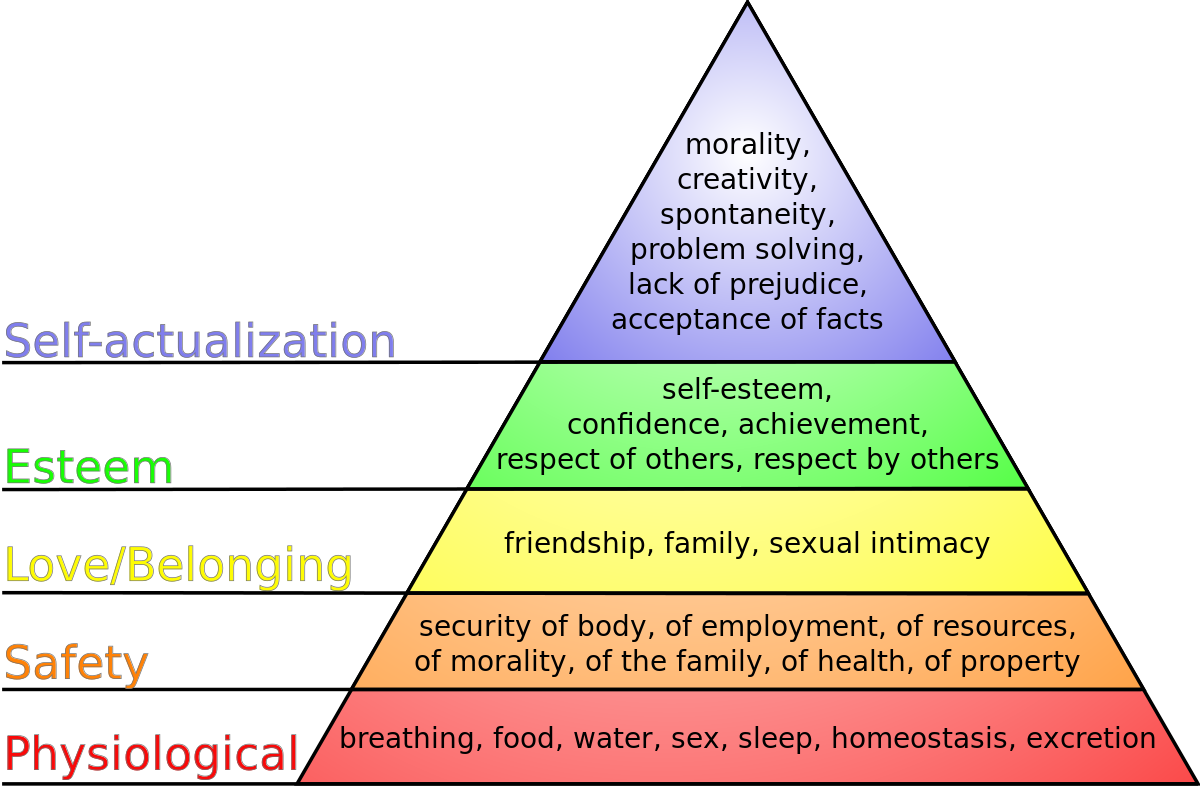
Maslow’s pyramid?
Courtesy of Wikimedia Commons

Did Maslow get it wrong, or did we?

By David Joel Miller, MS, Licensed Therapist & Counselor.

Does Maslow’s hierarchy of needs make sense today?

If you took a class in beginning psychology, you probably were taught about Maslow’s hierarchy of needs. It’s been a long time since I took that class, and I’m not sure if I remember what we were taught accurately, but I am starting to question some of the basic principles as I remember them. Some of the books I’ve been reading recently have made me think maybe that way of looking at things isn’t the final authority.

I first encountered these ideas back in the 1960s. When I went to college, I wasn’t sure what a major was, let alone what I should major in. My experiences as a professor at the local community college since 2008 have led me to believe that fuzzy majors continue to be a problem today.

I took some psychology and some sociology classes in my first year at the community college. Seems like everybody was a psychology major at some point in that decade. Psychology seemed to offer so much promise for helping you decide what the correct choices to make were. Unfortunately, classical psychology was primarily based on research on rats and female college sophomores. That research didn’t actually help most people figure out how to solve their problems. Or how to avoid mental illnesses that counselors and therapists are trained to treat.

Remember that Maslow wrote about a hierarchy of needs during World War II and directly after. His ideas and how psychology professors interpreted them were heavily influenced by their life experiences. Many of our teachers in school in the 1960s had lived through the Great Depression and then World War II. Some of my teachers can home from Europe or Asia and then went to school on the G.I. Bill. Those who taught us had to live through some pretty grim times.

We were taught that physiological needs come first.

Considering what Maslow and those who taught us his hierarchy of needs had lived through, the idea that meeting their physiological needs should come first and that people wouldn’t pay attention to those other “higher” needs would come later makes sense. There may be some reasons to question this notion.

Now I’m not saying that things are any less challenging today, at least for some people. I just think that the challenges the majority of Americans face are different. People who had to live with the possibility of imminent death or who went without food, shelter, or basic necessities of life were affected both physically and mentally by those struggles.

Many parents and grandparents, possibly great-grandparents of people reading this blog, concluded that what mattered in life was a secure job with a good enough paycheck that you would always have food to eat, clothes to wear, and a house to live in. If meeting your physiological and safety needs is what matters, why are there so many people who are depressed, anxious, and about to give up hope?

Is there a shortage of food, water, and shelter today?

Despite the phenomenal creation of wealth since World War II and our emphasis on having the latest technology at our fingertips, the truth is that there are still a lot of people in American society who worry about where their next meal will come from and whether their children will receive adequate healthcare. Our welfare programs and government subsidies provide some relief from the harsh realities, but we still have our homeless, our underfed, and those who can’t get reliable medical care.

From that perspective, Maslow’s hierarchy of needs makes some sense.

The way I understand his theory is that humans have certain basic needs. We need air to breathe, preferably healthy, unpolluted air. The human body needs food and water, but given the chance, most humans consume unhealthy food and water. The hierarchy of needs tells us that we need sleep, but more than one productivity guru tells us we can sleep less and produce more as if more were beneficial.

So how come highly paid tech people have so much anxiety and depression?

Meeting your physiological and safety needs does not result in happy people. Many people with a lot of material possessions are saying that life is meaningless and the money they are earning isn’t meeting their emotional needs.

Without meaning, purpose, and a sense of mastery, the rest doesn’t matter.

What I hear repeatedly from clients is if they are depression, anxiety, and other mental health challenges rarely come from a lack of food, water, or even adequate housing. Instead, what’s missing and so many people’s lives is a sense that their life has meaning.

Victor Frankel described this in his book Man’s Search for Meaning. His experience in the concentration camp convinced him that having meaning and purpose in your life was far more important than food, clothing, or other physical necessities. People who had a sense of purpose survived camps despite horrific conditions.

Today in a land that’s richer than probably any in the history of the world, we still have a lot of people who can’t find anything that gives their life meaning and purpose. When you’re overweight, more food won’t help. It’s very easy to be lonely in a house with dozens of bedrooms.

How come people are willing to trade sleep for video game time?

The primary benefit derived from playing video games is a sense of mastery. As we move farther and farther into an economy where work is disconnected from physical objects is harder to experience mastery. The inherent thing that video games can give people is a chance to master an environment, albeit an artificial one. In the videogame, every time you achieve mastery, you level up and have new challenges to face.

Maybe it’s not the physiological and safety needs that are the foundation of the human hierarchy of needs. People short of food and safety can find abstract principles they’re willing to fight and die for. People with lots of physical possessions may think of suicide and self-harm because they lack meaning, purpose, and a sense of mastery.

I’ve come to think that those things we learned as being necessary only after the baser needs were met are, in fact, the foundation needs that we all are looking for.

Maslow’s hierarchy of needs was not a pyramid.

Just as a by the way. When we say Maslow, most people think of Maslow’s hierarchy of needs as a pyramid. I came across an article about Maslow’s pyramid, which tells us that Maslow didn’t write about his hierarchy of needs as a pyramid. Nowhere that we have been able to find in his writing does that pyramid diagram appear. Where that came from, we can’t be sure.

But I think teaching Maslow’s hierarchy of needs as if it were a pyramid makes those abstract principles seem far less important and places too much emphasis on the needs of the body rather than the emotional needs of the person.

Does David Joel Miller see clients for counseling and coaching?

Yes, I do. I can see private pay clients if they live in California, where I am licensed. If you’re interested in information about that, please email me or use the contact me form.

Staying in touch with David Joel Miller.

Want the latest blog posts as they publish? Subscribe to this blog.

For more information about my writing journey, my books, and other creative activities, please subscribe to my blog at davidjoelmillerwriter.com

Seven David Joel Miller Books are available on Amazon now! And more are on the way.

For these and my upcoming books, please visit my Amazon Author Page – David Joel Miller

For information about my work in mental health, substance abuse, and having a happy life, please check out counselorssoapbox.com

For videos, see: Counselorssoapbox YouTube Video Channel

4 Steps to Take After Relapse

4 Steps to Take After Relapse

4 Steps to Take After Relapse.
Photo Credit: Pexels

4 Steps to Take After Relapse.

By: Jennifer Scott

No one wants to relapse. After all the hard work it took to get sober, the last thing you want is to go back to your old ways. However, relapsing is not all that uncommon. Actually, more recovering addicts relapse than not. And the odds are that you will relapse at some point on your recovery journey.

A significant reason for this is brain chemistry. Using addictive substances releases dopamine, a “feel-good” chemical, in the brain. This chemical can cause the brain to prioritize the drug over other necessities, which commonly leads to relapse.

Another reason involves stress and coping mechanisms. Many people use addictive substances to cope with external pressure. If new, healthier coping strategies aren’t developed, many recovering addicts can find themselves back using their old coping mechanism – drugs and alcohol.

If you’re stressed and feel anxiety at work, not only can it make you less productive, but it’s also linked to relapse. Without the correct coping mechanisms to deal with this stress, it is easy to fall back into drug abuse. Ways to cope could include starting a satisfying exercise routine, finding a hobby that helps occupy your mind in a healthy way, or boosting your mood at home by removing clutter and letting in more natural light.

Luckily, no matter what the underlying cause of relapse is, it is not a sign of failure. For many people, relapsing is merely a part of the recovery journey. There are some actions you should take after relapse, though, to get you back on the right track.

Contact a Professional

It’s important that you contact a professional. This step is essential for two reasons.

First, a professional can help you get back on the right track, whether that means changing your treatment program or help in developing healthy coping strategies. It is imperative that your doctors know about your relapse so they can adjust your treatment accordingly.

Secondly, relapse is dangerous. When you regularly use drugs or alcohol, your body develops a resistance to it. This development then causes you to use more and more of the substance to get the same effect.

When you stop using that drug for a while, your body’s resistance drops. If you suddenly begin using the substance in the same amounts as before, dangerous things can happen because you no longer have the same amount of tolerance.

Discuss It with Close Family and Friends

While it may not be easy, you’ll need to tell your family and close friends about the relapse. They need to know where you are on your recovery journey so that they can help you get back on your feet. Your family and friends can be critical individuals to lean on in this difficult time.

It can be painful and disappointing for your family members to hear about your relapse. But, it is vital that they know so that they can help you.

If you’re worried about their reaction, consider bringing them to therapy with you so they can understand just how common relapse is.

Forgive Yourself and Continue Forward

Remember, relapse is common.

Just because you relapsed doesn’t mean your recovery is doomed. You must forgive yourself so you can continue forward. By completing the steps outlined here, you can get yourself back on the right path to recovery. Complete recovery is possible, especially if you keep making the effort.

Adjust Your Strategy

Relapsing can be a sign that you need to adjust your treatment strategy.

This is not always the case; help from your doctors and your family members can help you decide if adjusting your strategy is a step you need to take.

If you do need to adjust your strategy, remember that there are many treatment options out there. There are usually many treatment options available in any given area. It might even be useful to combine different options to find just the right combination that works for you.

Relapse can be heartbreaking for everyone involved. But it is not the end of the world. The important thing is to take the necessary steps after a relapse to reorient yourself onto the path to recovery.

Photo Credit: Pexels

Jennifer Scott is a lifelong sufferer of anxiety and depression.  A single mom, she writes about the ups and downs of her mental illness on SpiritFinder.org. The blog serves as both a source of information for people with mental illness and a forum where those living with anxiety and depression can come together to discuss their experiences.

Does drinking alcohol to cope help?

Bottles of alcohol.

Alcoholic Beverages.
Photo courtesy of Pixabay.com

By David Joel Miller, MS, Licensed Therapist & Licensed Counselor.

Have you ever told yourself, “I need a drink?”

I’m sure you’ve heard the expression a million times, more or less. When someone has had a rough day and is feeling anxious or depressed, their first reaction is often to reach for a drink of alcohol to cope. Humans have been saying this and doing it ever since alcohol was first packaged so it could be saved for later use.

People who use alcohol to cope rarely ask themselves if the alcohol is really helping. Most people simply assume it is helpful. If you’ve developed a problem with alcohol or if you’re one of those who work in the counseling field, you probably have a strong opinion about the dangers of using alcohol to cope with stressful situations. But until recently, there’s been very little scientific research into when alcohol is helpful and for what problems.

Now we have evidence about drinking to relieve stress.

A recent study by Andrea M Wycoff at the University of Missouri-Columbia, US, looked at the use of alcohol for coping and concluded that not only is it not helpful, but it can also make your symptoms worse.

The study compared two populations, the group drawn from the general population and another group who had been diagnosed with Borderline Personality Disorder (BPD). People with borderline personality disorder are known to be more likely to develop drinking problems. Some of the people with BPD had also been diagnosed with an alcohol use disorder.

One problem with other research of this nature has been the strong tendency to exclude from the research anyone with a substance use disorder diagnosis. Some studies also exclude anyone with a previous mental health diagnosis. Eliminating people who have developed an alcohol use problem from a study on alcohol use problems results in a study that doesn’t inform us much about the connection between using alcohol and the subsequent development of problems.

How were the effects of alcohol on stress measured?

During this study, participants were given an electronic journal. They received periodic prompts to write down in their journal what they were doing, any alcohol consumption, and what they were feeling. They were specifically prompted to report on negative, sometimes called unhelpful feelings.

Whenever someone reported using alcohol, they were asked if they had done this to reduce negative feelings such as anxiety and depression or to increase positive feelings such as feeling calm or relaxed.

Did the alcohol help reduce anxiety and depression?

People who reported drinking to reduce their anxiety, depression, or both did report that they were doing it to reduce those negative emotions. In addition, after drinking, those people were more likely to report that they felt the drink had relieved their anxiety or depression. Initially, the researchers took this as confirmation that drinking alcohol did relieve the discomfort of anxiety and depression.

The facts didn’t confirm the feelings.

Feelings are difficult to measure. There aren’t medical instruments that can directly measure how anxious or how depressed someone is. What researchers resort to are paper and pencil questionnaires. These assessment instruments ask a series of questions about anxiety or depression. Using the same scale at different points in time helps measure increases or decreases in someone’s anxiety or depression.

While many people expected the drink to reduce their feelings of anxiety and or depression, that’s not what happened. Scores on an anxiety inventory did not decline. Instead, scores on depression inventories actually went up, meaning that people who drink to cope with depression end up more depressed, not less.

Drinking to relieve anxiety and depression affects alcoholics more than others.

Even more striking is that many people with an alcohol use disorder, especially those who would call themselves an alcoholic, found that their scores for depression rose even higher than the scores for those without an alcohol use disorder.

Some of the likely conclusions from this research are that repeatedly drinking to control anxiety and depression can result in an alcohol use disorder and that those people with that disorder will find drinking alcohol makes the problem worse, not better. The ability of alcohol to help you cope with anxiety, depression, and stress declines the more you use alcohol and eventually reaches a point where another drink will make your anxiety or depression worse.

An even more important conclusion is that using alcohol to cope with anxiety or depression increases the risk of becoming an alcoholic.

We need to know more about drinking when anxious or depressed.

There are some limitations of this study. It wasn’t a huge sample. It might be possible to find people who were an exception to these results. The sample also had a large percentage of women. Much of the literature about alcoholism and how it develops tells us that women are more likely to develop alcoholism and develop it more rapidly than men if they drink heavily.

The authors note that previous studies limited to men tell us that men are more likely to drink to cope with negative emotions and more likely to develop alcohol problems than women. Presumably, a study of men only would have resulted in an even stronger connection between using alcohol to cope with negative emotions and a subsequent increase in anxiety, depression, and an alcohol use disorder.

What about alcohol and the mentally ill?

The sample had a large number of participants who had been diagnosed with Borderline Personality Disorder, which should underscore an extra warning for those people with BPD to avoid the use of alcohol to regulate their emotions. It’s extremely likely that people with other specific mental health diagnoses would see a similar or an even larger effect.

I’ll be on the lookout for research that studies the effects of using alcohol to cope on subjects who have other diagnoses. From my experiences working in the drug and alcohol counseling field, I would expect to see very similar results among clients diagnosed with mood disorders, anxiety, PTSD, and those suffering from the aftereffects of early childhood trauma. All of this tells me that the more someone believes they need to have a drink to cope with negative emotions, the more likely it is that drinking will lead to more severe and longer-lasting problems.

The takeaway from all this?

Drinking alcohol to cope with negative emotions and stress may feel like it’s working in the moment, but it is likely to make your problems worse.

For more on this topic, please see:

Wycoff, A. M., Carpenter, R. W., Hepp, J., Piasecki, T. M., & Trull, T. J. (2021). Real-time reports of drinking to cope: Associations with subjective relief from alcohol and changes in negative affect. Journal of Abnormal Psychology, 130(6), 641–650. https://doi.org/10.1037/abn0000684

Staying connected with David Joel Miller

Seven David Joel Miller Books are available now! And more are on the way.

For these and my upcoming books, please visit my Author Page – David Joel Miller

Want the latest blog posts as they publish? Subscribe to this blog.

For videos, see: Counselorssoapbox YouTube Video Channel

Seasonal OCD characteristics.

Anxious woman

Seasonal OCD?
Photo courtesy of Pixabay.

By David Joel Miller, MS, Licensed Therapist & Licensed Counselor.

The seasons affect humans in a lot of different ways.

As the seasons change, their effects on humans change also. Most people are familiar with seasonal affective disorder, also known as the winter blues. While not all experts agree on the causes or significance of winter blues, if you’re one of those people who experience them, you’re probably convinced.

Changing weather also affects people in very predictable physical ways. You may suffer from seasonal allergies, and your mood may vary depending on whether you’re stuck inside, developing cabin fever, or spending more time outdoors in the sunshine.

What’s less known and less studied is the phenomenon of seasonal anxiety and seasonal increases in OCD symptoms.

People with OCD are especially sensitive to the seasons.

An article in Psychiatry Research titled. Seasonal mood changes in patients with obsessive-compulsive disorder looked at this connection.

Both depression and OCD appear to be connected to the levels of serotonin in the brain. The same treatments that are used for depression have also been used to treat OCD with varying results.

OCD is more likely to be prevalent in the fall.

People with OCD are more likely to experience symptoms during the cold winter months. The severity of the OCD compulsions is worse on the shorter days, and where there is less daylight. Seasonal changes in mood often co-occur with seasonal variations in OCD symptoms and intensity.

Changes in behavior as a result of seasonal changes are significant.

Both people with seasonal depression and an increase in seasonal OCD may see their symptoms get worse during the winter months. That doesn’t necessarily mean that the treatment for both should be the same.

For people with seasonal affective disorder or seasonal depressive symptoms, some of the behavioral changes that maintain their depressive symptoms can be treated by being more active. Walking or an increase in physical activity improves mood. Making a deliberate effort to stay connected to your support system can also help manage the symptoms of seasonal affective disorder.

Treatment for OCD is different from that for depression.

The behaviors that maintain OCD are the giving into the compulsions in performing the ritual. While some people have reported that medication is helpful, the overwhelming body of evidence tells us that the treatment of choice for OCD is Exposure and Response Prevention Therapy. Every time the person with OCD gives in to the urges to perform the ritual, they reinforce not only their symptoms but the disease.

The importance of relapse prevention.

An important part of treatment for substance use disorders is relapse prevention, and an important part of that relapse prevention is learning that cravings, no matter how severe they are, can be temporary. Giving in to those cravings even occasionally reinforces the addiction. People in recovery from addictions, both chemical and behavioral addictions, learn that if they can surf the urges, not giving in when the urges are high, eventually those urges dissipate.

Exposure and response prevention for OCD works similarly. Whenever you are exposed to an anxiety-provoking situation, and you can avoid doing your ritual, the symptoms of OCD will decline. In the early stages resisting those urges can be extremely difficult. Regardless of what time of year you experience OCD, know that the more you can resist those urges, and the more you learn to dismiss those unhelpful thoughts, the less your disorder can control you.

I’d love to hear from you.

If you suffer from seasonal disorders, whether it’s a seasonal increase in OCD symptoms, seasonal anxiety, or seasonal affective disorder, I’d appreciate hearing from you. Let me know how these seasonal disorders have affected you and what you have found that works. I’d also like to know what doesn’t work for treating your condition. You can either leave a comment below or use the contact me form. Getting through the winter season this year is likely to be even more difficult than past years, and sharing your experiences may help you and others.

Staying connected with David Joel Miller

Seven David Joel Miller Books are available now!

My newest book is now available. It was my opportunity to try on a new genre. I’ve been working on this book for several years, but now seem like the right time to publish it.

Story Bureau.

Story Bureau is a thrilling Dystopian Post-Apocalyptic adventure in the Surviving the Apocalypse series.

Baldwin struggles to survive life in a post-apocalyptic world where the government controls everything.

As society collapses and his family gets plunged into poverty, Baldwin takes a job in the capital city, working for a government agency called the Story Bureau. He discovers the Story Bureau is not a benign news outlet but a sinister government plot to manipulate society.

Bumps on the Road of Life. Whether you struggle with anxiety, depression, low motivation, or addiction, you can recover. Bumps on the Road of Life is the story of how people get off track and how to get your life out of the ditch.

Dark Family Secrets: Doris wants to get her life back, but small-town prejudice could shatter her dreams.

Casino Robbery Arthur Mitchell escapes the trauma of watching his girlfriend die. But the killers know he’s a witness and want him dead.

Planned Accidents  The second Arthur Mitchell and Plutus mystery.

Letters from the Dead: The third in the Arthur Mitchell mystery series.

What would you do if you found a letter to a detective describing a crime and you knew the writer and detective were dead, and you could be next?

Sasquatch. Three things about us, you should know. One, we have seen the past. Two, we’re trapped there. Three, I don’t know if we’ll ever get back to our own time.

For these and my upcoming books; please visit my Author Page – David Joel Miller

Want the latest blog posts as they publish? Subscribe to this blog.

For videos, see: Counselorssoapbox YouTube Video Channel
Surviving uncertainty during these trying times.

anxiety

Uncertainty.
Photo courtesy of Pixabay.com

By David Joel Miller, MS, Licensed Therapist & Licensed Counselor.

Life is full of uncertainties.

Life always has its uncertainties, but this year everyone has experienced a lot more challenges than usual. The coronavirus and its sudden spread around the world, has been on everyone’s minds. Some people have chosen to ignore the virus, while others have stayed home, hoping they can hide from the virus. The uncertainty isn’t limited to whether you will catch Corvid-19, but also how ill you will become. Death from infections is a very real possibility.

You may be one of the people who has had to work despite the risks. Or possibly you’re one of the people who were laid off. You don’t know when or if you’ll be called back to work, and if you are, what are the risks you are taking. Some people have been able to work from home, which potentially reduces their risk of the disease. But working from home has its uncertainties.

The pandemic has affected most people’s physical health, relationships, finances, and mental health. If they find drugs to treat this illness, or if there’s a vaccine that works, the uncertainty surrounding the coronavirus may diminish. But that’s far from certain.

Your attitude towards uncertainty matters.

Life seems more manageable when things move along in a predictable pattern. Everyone needs a certain amount of security. A few unexpected events can be the spice in your life. But too much uncertainty can take you into survival mode. Some people see uncertainty as scary, while other people look to these new times as an opportunity for personal growth and learning new skills.

How can you cope with uncertainty?

Don’t get bogged down in your fear of uncertainty. Look for ways that you can cope with the current challenges.

Accept that uncertainty is a part of life.

What you can’t change, you need to learn to accept. Uncertainty is a part of everyone’s life, and the surest path towards peace and contentment is the one of radical acceptance. Many recovering people have adopted the serenity prayer as a guide to life. The wisdom in life is learning which things you can change and which things you can’t. Those things you can change are where you should apply your efforts. The things that are out of your control, and often that is most everything in your life, those are the things you need to learn to accept. Spending a lot of time insisting that things must be the way you want them takes you away from doing the things you can do.

Learn to manage your worry.

Limit your worrying to the things that may be within your control. Restrict your worry to a limited number of likely possibilities. Do everything you can to prepare for these things. Don’t waste time trying to worry about every possible outcome. The idea that worrying about things can somehow protect you from them is one of the great fallacies of life. Preparation protects you. Stop worrying and start doing the things you need to do.

When uncertain devoid getting into fear.

Fear is not necessarily either a good or bad emotion. It’s how you interpret fear. Fear should tell you there’s a danger, and you need to do something about that danger. Don’t let your fears take control of you. Bravery is feeling the fear but moving forward anyway.

Most fear is based on faulty assumptions. People become afraid that they won’t get something they want. But the reality is that you won’t know whether what you wanted was a good thing until you got it. Another significant cause of fear is the fear of losing something you have. Unfortunately, nothing is permanent, and everything will pass away eventually. Don’t waste the time you have worrying about losing something.

Get into action to overcome uncertainty.

As you move into action, you have less need to worry about things that are out of your control. Take action on the things you can. In times of uncertainty, you need to prepare yourself for what may lie ahead. Learn new skills. Improve your relationships and your social support systems. Work on improving yourself so you will be better prepared for whatever might happen.

Improve your resiliency.

Everyone faces setbacks. Some people seem to get knocked down more often than others. Resiliency is the skill to bounce back from adversity. Don’t lose hope. Cultivate the ability to bounce back regardless of what happens to you. It’s not how many times you are knocked down; it’s how many times you get back up that matters.

How are you coping with uncertainty? Have you discovered any positive coping skills? Please feel free to leave a comment below.

Staying connected with David Joel Miller

Seven David Joel Miller Books are available now!

My newest book is now available. It was my opportunity to try on a new genre. I’ve been working on this book for several years, but now seem like the right time to publish it.

Story Bureau.

Story Bureau is a thrilling Dystopian Post-Apocalyptic adventure in the Surviving the Apocalypse series.

Baldwin struggles to survive life in a post-apocalyptic world where the government controls everything.

As society collapses and his family gets plunged into poverty, Baldwin takes a job in the capital city, working for a government agency called the Story Bureau. He discovers the Story Bureau is not a benign news outlet but a sinister government plot to manipulate society.

Bumps on the Road of Life. Whether you struggle with anxiety, depression, low motivation, or addiction, you can recover. Bumps on the Road of Life is the story of how people get off track and how to get your life out of the ditch.

Dark Family Secrets: Doris wants to get her life back, but small-town prejudice could shatter her dreams.

Casino Robbery Arthur Mitchell escapes the trauma of watching his girlfriend die. But the killers know he’s a witness and want him dead.

Planned Accidents  The second Arthur Mitchell and Plutus mystery.

Letters from the Dead: The third in the Arthur Mitchell mystery series.

What would you do if you found a letter to a detective describing a crime and you knew the writer and detective were dead, and you could be next?

Sasquatch. Three things about us, you should know. One, we have seen the past. Two, we’re trapped there. Three, I don’t know if we’ll ever get back to our own time.

For these and my upcoming books; please visit my Author Page – David Joel Miller

Want the latest blog posts as they publish? Subscribe to this blog.

For videos, see: Counselorssoapbox YouTube Video Channel
Anxious.

Sunday Inspiration.     Post by David Joel Miller.

Anxious.
Photo courtesy of Pixabay.com

“If you are depressed you are living in the past.

If you are anxious you are living in the future.

If you are at peace you are living in the present.”

― Lao Tzu

“True love is not so much a matter of romance as it is a matter of anxious concern for the well-being of one’s companion.”

― Gordon B. Hinckley, Stand a Little Taller

“But life is very short and anxious for those who forget the past, neglect the present, and fear the future.”

― Seneca, On the Shortness of Life

Wanted to share some inspirational quotes with you.  Today seemed like a good time to do this. There are an estimated 100,000 words in the English language that are feelings related. Some emotions are pleasant, and some are unpleasant, but all feelings can provide useful information. If any of these quotes strike a chord with you, please share them.

Look at these related posts for more on this topic and other feelings.

Emotions and Feelings.

Inspiration