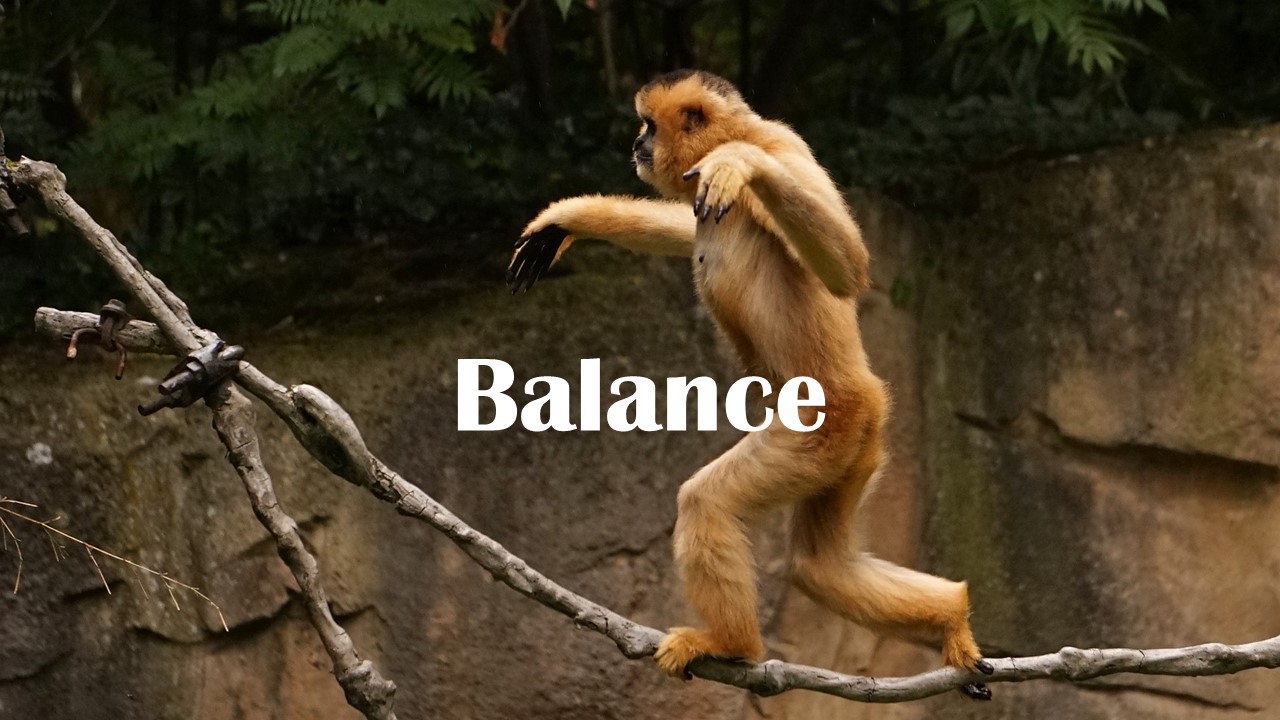
Keeping your life in balance

stay in balance

Keeping your life in balance.
Photo courtesy of Pixabay.com

Keeping your life in balance

By David Joel Miller, MS, Licensed Therapist & Counselor.

There’s more to a balanced life than your work-life balance.

I read and hear a lot about people struggling to maintain a work-life balance. I know it’s getting increasingly difficult to have both. But when we look deeper, there’s a lot more that needs balancing than just work and personal life.

When I first started out in counseling, we were taught a model of a balanced life that is sometimes called the grapefruit or the pie of life. There are also scads of whole-person models. What they all have in common is the idea that your life is divided into segments or activities, and since the total number of hours each week is fixed, time or resources added to one segment must be taken away from another part of your life.

I think of this like those antique bicycles that had a limited number of spokes on the front wheel. You have probably seen pictures of bicycles with one huge front wheel and two smaller back wheels. If some of those spokes are longer than others, then you have a very bumpy ride. Life is like that. If one part of your life gets too much emphasis, all the other parts shrink, and your life becomes extremely unpleasant.

Here are some of the segments of your life that may need attention if you are to achieve a good life balance.

Financial relationships.

This includes work and your other sources of income, as well as how you relate to money. Some people are spenders, some are savers, and some manage their money. If you have a lot of debt, you may feel that money is managing you.

Work or other sources of income.

Most people either have a job or a partner who has a job. The idea that most people would prefer to be on welfare seems untrue to me. If you’ve ever needed public assistance, you might have found that the paperwork and the time you spend waiting for workers is more challenging than showing up for a job if you can find one.

Social relationships.

This segment of your pie of life includes family, friends, and your close sexual and romantic relationships. The topic of intimate relationships is too complicated to go into much detail here. The short part of this is that your relationships probably need more attention than they are getting.

Physical health.

Getting and staying healthy is a lifelong challenge. Diet, exercise, and medical care are all factors in how well you maintain your physical body. Having a chronic illness or disability affects every other part of your life.

Mental health.

How we measure and evaluate mental health has become increasingly complicated. There are over 400 recognized mental illnesses and 400 more “conditions for further study.” But those recognized conditions don’t begin to encompass all of the problems of living that so many people face each day.

Your emotional life.

Beyond the problem of mental health and mental illness are those emotional conditions that are not formal diagnoses of a mental illness but are significant challenges for many people. Anger is a common emotional issue that destroys families and friendships. Loneliness has recently been recognized as a problem that affects both mental and physical health. The impact of loneliness on physical health is as significant as smoking fifteen cigarettes a day.

Religious or spiritual life aspects.

A lot of the popular accounts of religion are oversimplified to the point of being misleading. It’s easy to classify countries as either Christian or Muslim, but there’s ample evidence that Sunnis fight Shiites and Protestants have had wars with Catholics. Because of the almost infinite range of denominations and sects, it’s hard to understand the role religion may play in our society. Increasingly, we see people who say that they are spiritual but not religious. Regardless of how we classify all these things, it’s clear that humans need to believe there is something beyond our species that matters. Having some kind of connection to a higher power is an ingredient in a flourishing life.

The need for self-actualization.

Humans seem to inherently feel a drive or need for such things as creativity, meaning and purpose in their lives, mastery, knowledge, learning, and some level of control over their lives. These self-actualization values often get overlooked in the quest for the basics. When you’re struggling to find food, clothing, and shelter, it’s easy to forget that anything else might matter.

But we see plenty of cases in the world where people will do without food and water and work in adverse conditions through pain and suffering because they believe in a cause or value that they find more important than their own lives.

Recommended Mental Health Books

David Miller at counselorssoapbox.com is an Amazon Affiliate and may receive a small Commission if you purchase a book or product using the link on this page. Using the link will not increase the cost to you.

Does David Joel Miller see clients for counseling and coaching?

Yes, I do. I can see private pay clients if they live in California, where I am licensed. If you’re interested in information about that, please email me or use the contact me form.

Staying in touch with David Joel Miller.

Want the latest blog posts as they are published? Subscribe to this blog.

For more information about my writing journey, my books, and other creative activities, please subscribe to my blog at davidjoelmillerwriter.com

Seven David Joel Miller Books are available on Amazon now! And more are on the way.

For more about my books, please visit my Amazon Author Page – David Joel Miller

For information about my work in mental health, substance abuse, and having a happy life, please check out https://counselorssoapbox.com

For videos, see: Counselorssoapbox YouTube Video Channel

Mastery

Mastery
Photo courtesy of Pixabay.com

Mastery

Sunday Inspiration.     Post by David Joel Miller.

“Courage is resistance to fear, mastery of fear – not absence of fear.”

― Mark Twain

“The secret of joy is the mastery of pain.”

― Anais Nin

“One can have no smaller or greater mastery than mastery of oneself.”

― Leonardo da Vinci

Wanted to share some inspirational quotes with you. Today seemed like a good time to do this. There are an estimated 100,000 words in the English language that are feelings related. Some emotions are pleasant, and some are unpleasant, but all feelings can provide useful information. I’ve also included some words related to strengths and values since the line between what we think and what we feel may vary from person to person. If any of these quotes strike a chord with you, please share them.

Look at these related posts for more on this topic and other feelings, strengths, and values.

Emotions and Feelings.                      Inspiration

Staying in touch with David Joel Miller.

For more information about my writing journey, my books, and other creative activities, please subscribe to my blog at davidjoelmillerwriter.com

Seven David Joel Miller Books are available on Amazon now! And more are on the way.

For these and my upcoming books, please visit my Amazon Author Page – David Joel Miller

For information about my work in mental health, substance abuse, and having a happy life, Please check out counselorssoapbox.com

For videos, see: Counselorssoapbox YouTube Video Channel

March

March
Photo courtesy of Pixabay.com

Inspiration.      Post by David Joel Miller.

March

“It was one of those March days when the sun shines hot and the wind blows cold: when it is summer in the light, and winter in the shade.”

― Charles Dickens, Great Expectations

“Take some more tea,” the March Hare said to Alice, very earnestly.

“I’ve had nothing yet,” Alice replied in an offended tone, “so I can’t take more.”

“You mean you can’t take less,” said the Hatter: “It’s very easy to take more than nothing.”

“Nobody asked your opinion,” said Alice.”

― Lewis Carroll, Alice in Wonderland

“March is such a fickle month. It is the seam between winter and spring—though seam suggests an even hem, and March is more like a rough line of stitches sewn by an unsteady hand, swinging wildly between January gusts and June greens. You don’t know what you’ll find, until you step outside.”

― V.E. Schwab, The Invisible Life of Addie LaRue

What makes March special?

Spring Arrival: March marks the official arrival of spring in the northern hemisphere. After a long and often cold winter, people look forward to the warmer temperatures, blossoming flowers, and longer days that come with the onset of this season.

Daylight Saving Time: In many regions, March is when Daylight Saving Time begins. This means that evenings become brighter and longer, allowing for more outdoor activities and extended daylight hours.

Renewal and Rebirth: March symbolizes renewal and rebirth in nature. Trees start to bud, flowers begin to bloom, and the landscape transforms into a vibrant and colorful scenery. It’s a time when nature comes back to life after the dormant winter months.

Celebration of International Women’s Day: March 8th is celebrated as International Women’s Day, a global day recognizing the achievements and contributions of women throughout history. It’s a time to promote gender equality and advocate for women’s rights.

St. Patrick’s Day: Celebrated on March 17th, St. Patrick’s Day is a cultural and religious holiday honoring St. Patrick, the patron saint of Ireland. It’s widely celebrated with parades, wearing green attire, and enjoying Irish food and music.

March Madness: In the world of sports, March is synonymous with “March Madness,” referring to the NCAA Men’s Basketball Tournament in the United States. It’s a highly anticipated event that captivates sports fans and sparks excitement around college basketball.

National Reading Month: March is designated as National Reading Month in the United States, encouraging people, especially children, to develop a love for reading. Various literacy-related events and initiatives take place to promote the joy of reading.

World Water Day: March 22nd is observed as World Water Day, focusing on the importance of freshwater and advocating for the sustainable management of water resources globally. It’s a day to raise awareness about water-related issues and promote water conservation.

Meteorological Transition: March signifies a transition in weather patterns, moving from winter to milder conditions. It’s a time when people can start enjoying outdoor activities, such as hiking, biking, and picnics, as the weather becomes more favorable.

Cultural and Religious Observances: Many cultures and religions have significant events, festivals, or observances in March. For example, the Hindu festival of Holi, celebrating the arrival of spring with vibrant colors, is often held in March.

These reasons collectively make March a special and dynamic month, marked by the changing seasons, cultural celebrations, and various events that bring people together.

Why is March special to you?

Since time is such an important part of human existence, humans being finite after all, the passage of time on planet Earth has affected our customs and our thinking. After writing a series of posts about various feelings and, character strengths, and values, I thought it might be worth exploring the connection between the seasons and our experiences and emotions.

Because planet Earth is tilted, the seasons in the northern and southern hemispheres are opposite. How you experience Mother Earth and our changing weather depends on where you’re situated on this planet. My apologies to those who might read this who live in the southern hemisphere, but since I am much more familiar with the weather and the seasons in the northern hemisphere, I’ll am following that system.

Our current calendar is heavily weighted toward the Roman calendar. Originally, there were only ten months with the stormy times after New Year’s left out. Eventually, two more months had to be added to cover what we now call January and February. The Irish calendar, sometimes called the Celtic calendar, begins each of the seasons one month earlier, probably due to the difference in the weather farther north. I hope you find some of these thoughts worthwhile.

Emotions and Feelings.                      Inspiration

Staying in touch with David Joel Miller.

For more information about my writing journey, my books, and other creative activities, please subscribe to my blog at davidjoelmillerwriter.com

Seven David Joel Miller Books are available on Amazon now! And more are on the way.

For these and my upcoming books, visit my Amazon Author Page – David Joel Miller

For information about my work in mental health, substance abuse, and having a happy life, Please check out counselorssoapbox.com

For videos, see: Counselorssoapbox YouTube Video Channel

Marveling

Marveling
Photo courtesy of Pixabay.com

Marveling

Sunday Inspiration.     Post by David Joel Miller.

I am so thirsty for the marvelous that only the marvelous has power over me. Anything I can not transform into something marvelous, I let go.

― Anais Nin

“Instinct is a marvelous thing. It can neither be explained nor ignored.”

― Agatha Christie, The Mysterious Affair at Styles

“How marvelous books are, crossing worlds and centuries, defeating ignorance and, finally, cruel time itself.”

― Gore Vidal, Julian

“Keep reading. It’s one of the most marvelous adventures that anyone can have.”

― Lloyd Alexander

Wanted to share some inspirational quotes with you. Today seemed like a good time to do this. There are an estimated 100,000 words in the English language that are feelings related. Some emotions are pleasant, and some are unpleasant, but all feelings can provide useful information. I’ve also included some words related to strengths and values since the line between what we think and what we feel may vary from person to person. If any of these quotes strike a chord with you, please share them.

Look at these related posts for more on this topic and other feelings, strengths, and values.

Emotions and Feelings.                      Inspiration

Staying in touch with David Joel Miller.

For more information about my writing journey, my books, and other creative activities, please subscribe to my blog at davidjoelmillerwriter.com

Seven David Joel Miller Books are available on Amazon now! And more are on the way.

For these and my upcoming books, visit my Amazon Author Page – David Joel Miller

For information about my work in mental health, substance abuse, and having a happy life, Please check out counselorssoapbox.com

For videos, see: Counselorssoapbox YouTube Video Channel

Loyalty

Loyalty
Photo courtesy of Pixabay.com

Loyalty

Sunday Inspiration.     Post by David Joel Miller.

“What’s most important in a friendship? Tolerance and loyalty.”

― J.K. Rowling

“One of the things that makes me who I am is the loyalty I have to people I hold close to my heart.”

― Simone Elkeles, Perfect Chemistry

“Toto did not really care whether he was in Kansas or the Land of Oz so long as Dorothy was with him; but he knew the little girl was unhappy, and that made him unhappy too.”

― L. Frank Baum, The Wonderful Wizard of Oz

Wanted to share some inspirational quotes with you. Today seemed like a good time to do this. There are an estimated 100,000 words in the English language that are feelings related. Some emotions are pleasant, and some are unpleasant, but all feelings can provide useful information. I’ve also included some words related to strengths and values since the line between what we think and what we feel may vary from person to person. If any of these quotes strike a chord with you, please share them.

Look at these related posts for more on this topic and other feelings, strengths, and values.

Emotions and Feelings.                      Inspiration

Staying in touch with David Joel Miller.

For more information about my writing journey, my books, and other creative activities, please subscribe to my blog at davidjoelmillerwriter.com

Seven David Joel Miller Books are available on Amazon now! And more are on the way.

For these and my upcoming books, visit my Amazon Author Page – David Joel Miller

For information about my work in mental health, substance abuse, and having a happy life, Please check out counselorssoapbox.com

For videos, see: Counselorssoapbox YouTube Video Channel

Overcome sadness by collecting special moments.

Special Moment
Photo courtesy of Pixabay.com

Overcome sadness by collecting special moments.

By David Joel Miller, MS, Licensed Therapist & Counselor.

The human brain has a negativity bias.

The human brain has a preference for remembering the negative and forgetting the positive. Whether that’s by design or the result of experience through millions of years of evolution, I will leave it to others to decide. But I can see how this negativity bias could benefit human survival and how it is causing a lot of pain and suffering today. Let me try to illustrate this with a couple of hypothetical stories.

Please hang with me to the end of these parables when I explain how you can overcome negativity bias and become a happier, more positive person by collecting special moments.

The story of the red berries.

Imagine, if you can, being a human living in the forest or jungle before the advent of electricity, refrigerators, canned goods, or any practical way to store food through the winter. You might’ve figured out how to dry certain seeds, but drying berries was very impractical.

One day, you’re walking through the jungle and find some bushes covered with bright red berries. You try a few, and they are tasty. So, you eat as many as you can. Imagine the time before the Industrial Revolution and modern civilization when humans typically went hungry through most of the winter. Hence, the preference in earlier times was for women with a little meat on their bones who might survive the lean times and be able to care for the children.

As an aside here, I read somewhere once that the human brain has twenty-two circuits to tell us we are hungry. When hungry, we get headaches, our stomach growls, we may feel weak, and so on. As I remember it, we only have eight circuits, which feedback to tell the brain we have had enough to eat. Hence, humans tend to continue to gain weight whenever food is available and only lose it when there is famine. Not a terribly adaptive quality in this modern industrial era.

The following day, you are walking again through the hypothetical jungle again. There’s no need to remember what the berries looked like because while they were tasty, you ate them all, and there are no more to be had. Hence, we tend to forget many positive experiences which may be challenging to repeat.

But, in our hypothetical tale, let’s say that you became violently ill, threw up those berries, and almost died. Can you see now why you might, having had a negative experience, remember those berries for the rest of your life? This negativity bias carries over into many other human activities where we remember one unpleasant event but forget large numbers of positive events.

What color were the flowers?

I was working at an agency that saw many children. Often, their parents showed up wanting to know how the child was doing. I noticed a definite negativity bias on the part of the parents toward the whole process. But I wasn’t quite sure how to overcome that bias.

One day, on my way to work, I noticed as I walked in the front door that the landscapers had replaced flowers in front of the building with some new plants that were in bright bloom. I hurried in and got to work, knowing the first family would be there to see the child in minutes.

Partway into the conversation, I realized that these parents could tell me everything the child did wrong, as well as what the teacher and the professionals were doing wrong, but had difficulty describing anything about the situation that was good or right. And then it struck me. I suffered from that same negativity bias. I had seen those brightly colored flowers when I came to work that morning, but now caught up in the problems of the day, I couldn’t remember what those flowers looked like or what color they were.

During my lunch hour, I went outside and looked at those flowers again. I spent anywhere from thirty seconds to several minutes examining each one. I discovered that thirty seconds of looking at something positive was the bare minimum for me to remember it later. And the longer I looked at a particular flowering plant, the more likely I was to remember it hours, days, even years later.

The way you overcome negativity bias is to pay more attention to the positive.

Whenever something good happens in your life, spend some time consciously looking at it, staring at it, and committing it to memory. So many of life’s special moments go by unnoticed. Become a collector of those special moments, and the whole nature of your life will become more positive and filled with special moments.

This technique is especially useful with children and partners.

One simple rule of parenting is to always “catch your child doing something right.” The more you notice the positive things your child does and compliment them on it, the more likely they are to repeat that behavior. When children are doing something you don’t like, ignoring it whenever possible is likely to extinguish the behavior. It’s worth noticing that some children who will only get attention when they do something wrong behave badly more often simply to get that extra attention.

If you want a happy, more satisfying life full of contentment, become a collector of special moments. Consider writing them down. The more attention you pay to the positive in life, the more you will realize that positive things are happening all around you every day. If only you would collect that positivity and save it up against the next rainy day.

Does David Joel Miller see clients for counseling and coaching?

Yes, I do. I can see private pay clients if they live in California, where I am licensed. If you’re interested in information about that, please email me or use the contact me form.

Staying in touch with David Joel Miller.

Want the latest blog posts as they are published? Subscribe to this blog.

For more information about my writing journey, my books, and other creative activities, please subscribe to my blog at davidjoelmillerwriter.com

Seven David Joel Miller Books are available on Amazon now! And more are on the way.

For more about my books, please visit my Amazon Author Page – David Joel Miller

For information about my work in mental health, substance abuse, and having a happy life, please check out https://counselorssoapbox.com

Judgmental

Judgmental
Photo courtesy of Pixabay.com

Judgmental

Sunday Inspiration.     Post by David Joel Miller.

“Love is the absence of judgment.”

― Dalai Lama XIV

“More smiling, less worrying. More compassion, less judgment. More blessed, less stressed. More love, less hate.”

― Roy T. Bennett, The Light in the Heart

“Be curious, not judgmental.”

― Walt Whitman

Wanted to share some inspirational quotes with you. Today seemed like a good time to do this. There are an estimated 100,000 words in the English language that are feelings related. Some emotions are pleasant, and some are unpleasant, but all feelings can provide useful information. I’ve also included some words related to strengths and values since the line between what we think and what we feel may vary from person to person. If any of these quotes strike a chord with you, please share them.

Look at these related posts for more on this topic and other feelings, strengths, and values.

Emotions and Feelings.                      Inspiration

Staying in touch with David Joel Miller.

For more information about my writing journey, my books, and other creative activities, please subscribe to my blog at davidjoelmillerwriter.com

Seven David Joel Miller Books are available on Amazon now! And more are on the way.

For these and my upcoming books, visit my Amazon Author Page – David Joel Miller

For information about my work in mental health, substance abuse, and having a happy life, Please check out counselorssoapbox.com

For videos, see: Counselorssoapbox YouTube Video Channel

Why you can’t find happiness

Road

Road to a happy life.
Photo courtesy of Pixabay.com

Why you can’t find happiness.

By David Joel Miller, MS, Licensed Therapist & Counselor.

Has happiness eluded you?

Trying to find happiness in modern-day America, and probably in all the industrial world, is the equivalent of looking for snow snakes and going into the forest to hunt Snipe. So many people equate happiness with pleasure that the coin of happiness has become severely tarnished.

In a country with such a high material standard of living, why are so many people chronically unhappy. We could argue that income distribution plays a role in this problem, but that’s not the point I’m pursuing. Not having enough money to pay for food and housing can undoubtedly lead to a less happy life. But I see people who are happy living in very modest settings.

I remember an old proverb that says that happiness is like a butterfly. You can chase it all over and never catch it. But if you sit quietly, the butterfly of happiness just might come and land on you. I think there’s a lot of wisdom in that idea. Pursuing happiness doesn’t get you closer to it. The best way to achieve happiness is to be happy as you go through your day-to-day activities. During the year 2024, I want to explore the idea that happiness can be within the reach of almost anyone if they know the techniques to find it. Happiness is about being, not about doing or having.

Why are so many middle-class and wealthy people chronically unhappy?

Pick up any tabloid at the grocery store, and you’ll find article after article about the woes and miseries of the rich and famous. While more money doesn’t make you unhappy, having wealth doesn’t seem to automatically guarantee happiness. Above a certain income level, the connection between money and happiness appears to be either negative or nonexistent.

Some people try to increase their happiness by spending. They get a sudden rush of excitement and pleasure when they buy something. That pleasure fades quickly. They’re not getting their joy out of having and using the item they purchased. To a chronic shopaholic, the pleasure ends as soon as the purchases are placed in the trunk of their car. I knew one chronic overspender who sold their car and never cleaned out the trunk. The purchaser found it full of impulse buys that had never made it into the overspender’s house.

Trying to buy your way into happiness results in lots of debt. The pleasure of the purchase fades quickly, but the pain of that credit card bill coming due each month goes on almost forever.

Fame doesn’t seem to bring happiness either.

I think we can all remember a great variety of famous people who lived unhappy lives and died unhappy deaths. If fame doesn’t bring happiness to those few who achieve it, how are the rest of us supposed to ever become happy?

I’ve told my students in the chemical dependency class that I think America needs a museum dedicated to famous debt junkies. The list of famous musicians, actors, and politicians who developed severe alcohol or drug use disorders goes on and on. Getting high leads to suffering, not happiness.

Perhaps we are chasing the wrong animal.

You don’t go deer hunting 20 miles off the California coast. And you can’t catch a shark in the middle of the Mojave Desert. You might find a skeleton there, but you won’t find a live fish of any significant size in the desert. The same is true of pursuing pleasure, thinking it will bring happiness.

When you ask most people about pursuing happiness, they think about the things that produce large rushes of adrenaline, dopamine, and serotonin. Ask most people about being happy, and they will think about having fun. The road to happiness is supposed to lead through all the hedonic pleasures. Want more happiness? Drink more liquor, do more drugs, have more sex, gamble at the casino, and take up thrill-seeking like riding roller coasters and jumping out of airplanes.

If money or fame brought happiness, why is it so many rich and famous people turn to drugs and alcohol seeking to find happiness and to ease their pain? I believe it’s because people mistake temporary pleasure for genuine happiness.

What should people look for when they’re seeking happiness?

The coin of happiness has two sides; one side looks bright and shiny, and people chase it, thinking they can buy happiness with that coin. But the other side of the coin of happiness doesn’t sparkle so brightly. The Greeks called the shiny path hedonics, the pursuit of hedonism. Those temporary bursts of pleasure fade quickly and leave the person less well-off than when they started.

The other path the Greeks called Eudaimonia or Eudemonics. It consists of all those calm, soothing experiences in life. The path to a long-term life of flourishing takes you by way of fields of satisfaction, lakes of contentment, the joys of doing for others, and the pleasure of self-improvement.

If you want to find this path, pay attention to the things that provide satisfaction, not the things you can never get enough of. Avoid temporary excitement and seek long-term contentment. Give up using others and, instead, look for ways to be of service to those around you.

If you take this path and create a flourishing life, you will find that the butterfly of happiness you couldn’t catch up with in the fast lane will come and sit on your shoulder as you bask in the rays of contentment and savor the joys of a life well lived.

Does David Joel Miller see clients for counseling and coaching?

Yes, I do. I can see private pay clients if they live in California, where I am licensed. If you’re interested in information about that, please email me or use the contact me form.

Staying in touch with David Joel Miller.

Want the latest blog posts as they are published? Subscribe to this blog.

For more information about my writing journey, my books, and other creative activities, please subscribe to my blog at davidjoelmillerwriter.com

Seven David Joel Miller Books are available on Amazon now! And more are on the way.

For more about my books, please visit my Amazon Author Page – David Joel Miller

For information about my work in mental health, substance abuse, and having a happy life, please check out https://counselorssoapbox.com

For videos, see: Counselorssoapbox YouTube Video Channel

Inhumane

Inhumane
Photo courtesy of Pixabay.com

Inhumane

Sunday Inspiration.     Post by David Joel Miller.

“It is inhumane, in my opinion, to force people who have a genuine medical need for coffee to wait in line behind people who apparently view it as some kind of recreational activity.”

― Dave Barry

“Of all the forms of inequality, injustice in health care is the most shocking and inhumane.”
― Martin Luther King Jr.

“Please try to remember that what they believe, as well as what they do and cause you to endure does not testify to your inferiority but to their inhumanity.”

― James Baldwin, The Fire Next Time

Wanted to share some inspirational quotes with you. Today seemed like a good time to do this. There are an estimated 100,000 words in the English language that are feelings related. Some emotions are pleasant, and some are unpleasant, but all feelings can provide useful information. I’ve also included some words related to strengths and values since the line between what we think and what we feel may vary from person to person. If any of these quotes strike a chord with you, please share them.

Look at these related posts for more on this topic and other feelings, strengths, and values.

Emotions and Feelings.                      Inspiration

Staying in touch with David Joel Miller.

For more information about my writing journey, my books, and other creative activities, please subscribe to my blog at davidjoelmillerwriter.com

Seven David Joel Miller Books are available on Amazon now! And more are on the way.

For these and my upcoming books, visit my Amazon Author Page – David Joel Miller

For information about my work in mental health, substance abuse, and having a happy life, Please check out counselorssoapbox.com

For videos, see: Counselorssoapbox YouTube Video Channel
February

February
Photo courtesy of Pixabay.com

February

Inspiration.      Post by David Joel Miller.

“April and May were painful, lonely months for me because I couldn’t talk to you. I never knew that spring could be so painful and lonely. Better to have three Februarys than a spring like this.”

― Haruki Murakami

“Like most New Englanders, she’d never outgrown a childlike anticipation of the season’s first snow. Of course, also like most New Englanders, what she wished for in December she’d come to loathe by February,”

― Lisa Genova, Still Alice

“Used to be, he recalled, that Menotaur would play house music on nights like tonight. Now, that was his groove. Now, it seemed like they only played house on the fifth week in February.”

― Casey Hamilton

Since time is such an important part of human existence, humans being finite after all, the passage of time on planet Earth has affected our customs and our thinking. After writing a series of posts about various feelings and, character strengths, and values, I thought it might be worth exploring the connection between the seasons and our experiences and emotions.

Because planet Earth is tilted, the seasons in the northern and southern hemispheres are opposite. How you experience Mother Earth and our changing weather depends on where you’re situated on this planet. My apologies to those who might read this who live in the southern hemisphere, but since I am much more familiar with the weather and the seasons in the northern hemisphere, I’ll am following that system.

Our current calendar is heavily weighted toward the Roman calendar. Originally, there were only ten months with the stormy times after New Year’s left out. Eventually, two more months had to be added to cover what we now call January and February. The Irish calendar, sometimes called the Celtic calendar, begins each of the seasons one month earlier, probably due to the difference in the weather farther north. I hope you find some of these thoughts worthwhile.

Emotions and Feelings.                      Inspiration

Staying in touch with David Joel Miller.

For more information about my writing journey, my books, and other creative activities, please subscribe to my blog at davidjoelmillerwriter.com

Seven David Joel Miller Books are available on Amazon now! And more are on the way.

For these and my upcoming books, visit my Amazon Author Page – David Joel Miller

For information about my work in mental health, substance abuse, and having a happy life, Please check out counselorssoapbox.com

For videos, see: Counselorssoapbox YouTube Video Channel