Merry Christmas – Happy Holidays

Christmas ornament

Merry Christmas. Happy Holidays.
Photo courtesy of Pixabay.com


Did Maslow get it wrong, or did we?


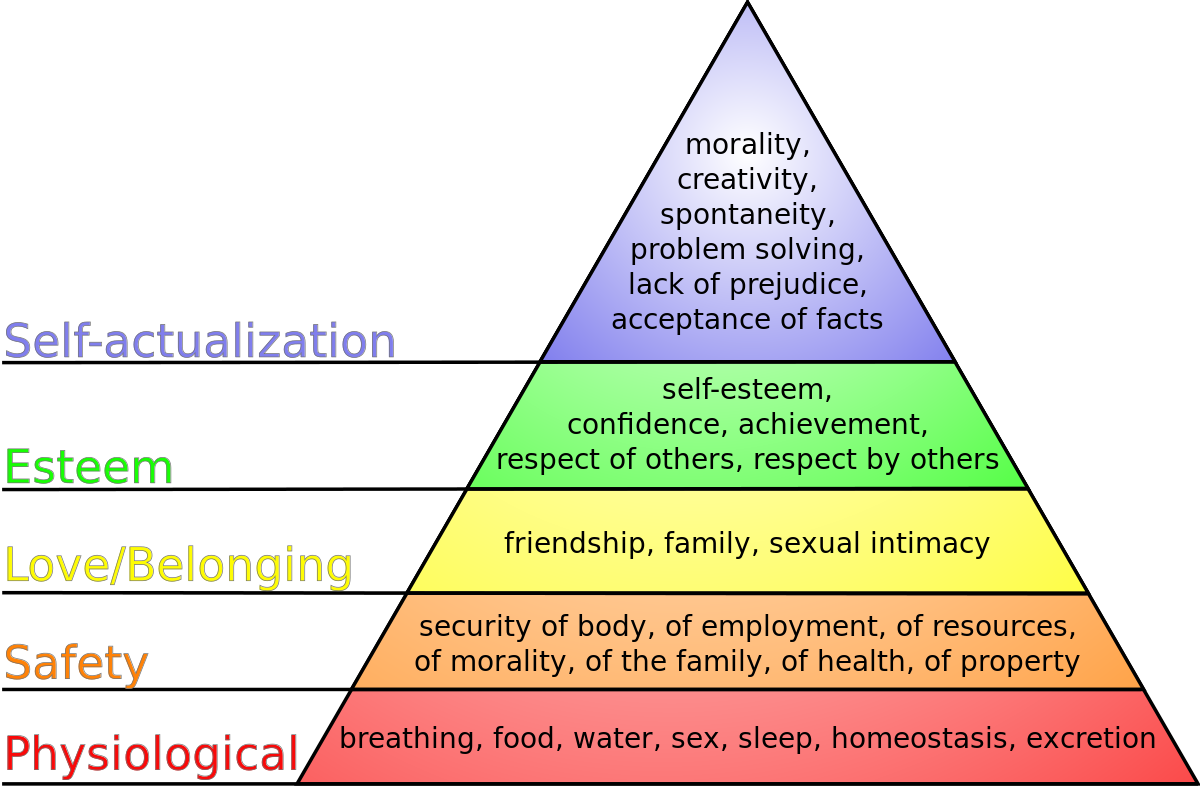
Maslow’s pyramid?
Courtesy of Wikimedia Commons

Did Maslow get it wrong, or did we?

By David Joel Miller, MS, Licensed Therapist & Counselor.

Does Maslow’s hierarchy of needs make sense today?

If you took a class in beginning psychology, you probably were taught about Maslow’s hierarchy of needs. It’s been a long time since I took that class, and I’m not sure if I remember what we were taught accurately, but I am starting to question some of the basic principles as I remember them. Some of the books I’ve been reading recently have made me think maybe that way of looking at things isn’t the final authority.

I first encountered these ideas back in the 1960s. When I went to college, I wasn’t sure what a major was, let alone what I should major in. My experiences as a professor at the local community college since 2008 have led me to believe that fuzzy majors continue to be a problem today.

I took some psychology and some sociology classes in my first year at the community college. Seems like everybody was a psychology major at some point in that decade. Psychology seemed to offer so much promise for helping you decide what the correct choices to make were. Unfortunately, classical psychology was primarily based on research on rats and female college sophomores. That research didn’t actually help most people figure out how to solve their problems. Or how to avoid mental illnesses that counselors and therapists are trained to treat.

Remember that Maslow wrote about a hierarchy of needs during World War II and directly after. His ideas and how psychology professors interpreted them were heavily influenced by their life experiences. Many of our teachers in school in the 1960s had lived through the Great Depression and then World War II. Some of my teachers came home from Europe or Asia and then went to school on the G.I. Bill. Those who taught us had to live through some pretty grim times.

We were taught that physiological needs come first.

Considering what Maslow and those who taught us his hierarchy of needs had lived through, the idea that meeting their physiological needs should come first and that people wouldn’t pay attention to those other “higher” needs would come later makes sense. There may be some reasons to question this notion.

Now I’m not saying that things are any less challenging today, at least for some people. I just think that the challenges the majority of Americans face are different. People who had to live with the possibility of imminent death or who went without food, shelter, or basic necessities of life were affected both physically and mentally by those struggles.

Many parents and grandparents, possibly great-grandparents of people reading this blog, concluded that what mattered in life was a secure job with a good enough paycheck that you would always have food to eat, clothes to wear, and a house to live in. If meeting your physiological and safety needs is what matters, why are there so many people who are depressed, anxious, and about to give up hope?

Is there a shortage of food, water, and shelter today?

Despite the phenomenal creation of wealth since World War II and our emphasis on having the latest technology at our fingertips, the truth is that there are still a lot of people in American society who worry about where their next meal will come from and whether their children will receive adequate healthcare. Our welfare programs and government subsidies provide some relief from the harsh realities, but we still have our homeless, our underfed, and those who can’t get reliable medical care.

From that perspective, Maslow’s hierarchy of needs makes some sense.

The way I understand his theory is that humans have certain basic needs. We need air to breathe, preferably healthy, unpolluted air. The human body needs food and water, but given the chance, most humans consume unhealthy food and water. The hierarchy of needs tells us that we need sleep, but more than one productivity guru tells us we can sleep less and produce more, as if more were beneficial.

S,o how come highly paid tech people have so much anxiety and depression?

Meeting your physiological and safety needs does not result in happy people. Many people with a lot of material possessions are saying that life is meaningless and the money they are earning isn’t meeting their emotional needs.

Without meaning, purpose, and a sense of mastery, the rest doesn’t matter.

What I hear repeatedly from clients is that depression, anxiety, and other mental health challenges rarely come from a lack of food, water, or even adequate housing. Instead, what’s missing in so many people’s lives is a sense that their life has meaning.

Victor Frankel described this in his book Man’s Search for Meaning. His experience in the concentration camp convinced him that having meaning and purpose in your life was far more important than food, clothing, or other physical necessities. People who had a sense of purpose survived camps despite horrific conditions.

Today in a land that’s richer than probably any in the history of the world, we still have a lot of people who can’t find anything that gives their life meaning and purpose. When you’re overweight, more food won’t help. It’s very easy to be lonely in a house with dozens of bedrooms.

How come people are willing to trade sleep for video game time?

The primary benefit derived from playing video games is a sense of mastery. As we move farther and farther into an economy where work is disconnected from physical objects is harder to experience mastery. The inherent thing that video games can give people is a chance to master an environment, albeit an artificial one. In the video game, every time you achieve mastery, you level up and have new challenges to face.

Maybe it’s not the physiological and safety needs that are the foundation of the human hierarchy of needs. People short of food and safety can find abstract principles they’re willing to fight and die for. People with lots of physical possessions may think of suicide and self-harm because they lack meaning, purpose, and a sense of mastery.

I’ve come to think that those things we learned as being necessary only after the baser needs were met are, in fact, the foundation needs that we all are looking for.

Maslow’s hierarchy of needs was not a pyramid.

Just as a by the way. When we say Maslow, most people think of Maslow’s hierarchy of needs as a pyramid. I came across an article about Maslow’s pyramid, which tells us that Maslow didn’t write about his hierarchy of needs as a pyramid. Nowhere that we have been able to find in his writing does that pyramid diagram appear. Where that came from, we can’t be sure.

But I think teaching Maslow’s hierarchy of needs as if it were a pyramid makes those abstract principles seem far less important and places too much emphasis on the needs of the body rather than the emotional needs of the person.

Recommended Mental Health Books

David Miller at counselorssoapbox.com is an Amazon Affiliate and may receive a small Commission if you purchase a book or product using the link on this page. Using the link will not increase the cost to you.

Does David Joel Miller see clients for counseling and coaching?

Yes, I do. I can see private pay clients if they live in California, where I am licensed. If you’re interested in information about that, please email me or use the contact me form.

Staying in touch with David Joel Miller.

Want the latest blog posts as they publish? Subscribe to this blog.

For more information about my writing journey, my books, and other creative activities, please subscribe to my blog at davidjoelmillerwriter.com

Seven David Joel Miller Books are available on Amazon now! And more are on the way.

For these and my upcoming books, please visit my Amazon Author Page – David Joel Miller

For information about my work in mental health, substance abuse, and having a happy life, please check out counselorssoapbox.com

For videos, see: Counselorssoapbox YouTube Video Channel

Innocent.

Innocent.
Photo courtesy of Pixabay.com

Innocent.

Sunday Inspiration.     Post by David Joel Miller.

“Travel is fatal to prejudice, bigotry, and narrow-mindedness, and many of our people need it sorely on these accounts. Broad, wholesome, charitable views of men and things cannot be acquired by vegetating in one little corner of the earth all one’s lifetime.”

― Mark Twain, The Innocents Abroad / Roughing It

“A library is a place where you can lose your innocence without losing your virginity.”

― Germaine Greer

“I am convinced that most people do not grow up…We marry and dare to have children and call that growing up. I think what we do is mostly grow old. We carry accumulation of years in our bodies, and on our faces, but generally our real selves, the children inside, are innocent and shy as magnolias.”

― Maya Angelou, Letter to My Daughter

Wanted to share some inspirational quotes with you.  Today seemed like a good time to do this. There are an estimated 100,000 words in the English language that are feelings related. Some emotions are pleasant, and some are unpleasant, but all feelings can provide useful information. If any of these quotes strike a chord with you, please share them.

Look at these related posts for more on this topic and other feelings.

Emotions and Feelings.

Inspiration

Negative symptoms matter a lot

Picture illustrating negative symptoms.

Negative symptoms.
Photo courtesy of Pixabay.com

Negative symptoms matter a lot.

By David Joel Miller, MS, Licensed Therapist & Counselor.

What’s the difference between negative symptoms and positive symptoms?

The terms negative symptoms and positive symptoms have a different meaning in mental health when applied to symptoms than in other contexts. Positive doesn’t mean good, and sometimes negative isn’t bad in this circumstance.

Positive symptoms are things someone experiences that we don’t expect other “normal” people to have. Experiencing hallucinations (all seven different kinds), delusions, or paranoia would all qualify as positive symptoms.

When someone starts hearing and seeing things others don’t, most people immediately think of schizophrenia. That’s not the only mental health diagnosis that involves hallucinations. But there are so many other possible causes of hallucinations, such as drugs, perception, or even religious experiences, that the presence of hallucinations alone does not always lead to a diagnosis in these cases.

Why negative symptoms matter.

Negative symptoms are identified when people begin to lose the skills they previously had. Those losses, or declining abilities, are more important for diagnosing some mental illnesses than any positive symptoms.

There are a lot more negative symptoms that a psychiatrist might consider that most people initially would recognize. Here’s a list of negative symptoms, most of which are prominent in schizophrenia and related psychotic disorders. The symptoms often come on gradually and may be hard to recognize until they have become severe.

A decrease in emotional expression.

There can be a lot of reasons why someone might become withdrawn and exhibit a narrow or decreasing range of emotional expression. Therapists and counselors would try to rule out things such as depression, anxiety, a reaction to trauma, or even a sudden change in environment. But if this declining emotional expression is prolonged or becomes more pervasive, it would be a good reason for referral to a psychiatrist. Here are some of the prominent signs of decreases in emotional expression.

Poor eye contact.

We must be careful with this symptom, particularly in young children or people with a history of being shy or introverted. Children may do this often, and anyone can develop poor eye contact in an anxiety-provoking situation. But if someone was previously outgoing but gradually withdraws within themselves and stops making good eye contact, especially with people they know, this needs further investigation.

Decreased emotional expression on the face.

The decrease in emotional expression that is seen in schizophrenia and other serious mental illnesses can sometimes be dramatic. In technical terms, it is sometimes described as a “flat affect.” Affect is the way that someone expresses their feelings or emotions. For example, when someone tells you that they are happy, but you can’t tell it from their face or behavior, think flat affect.

Speaking in a monotone.

When someone who previously had a range of intonations starts talking in a monotone, it’s reason for concern. We expect characteristic changes to happen to the patterns of speech when someone is happy, angry, or sad. When you can’t tell what someone is feeling from the way they are speaking, it warrants further investigation.

No longer using gestures to communicate.

A lot of human communication is nonverbal. However, even very reserved people still show some movement of hands, head, and face. If someone gradually gives up the use of gestures and you have no idea why, it warrants a referral to a mental health professional, probably both a therapist and a psychiatrist.

Avolition or low motivation.

Loss of interest in doing things that used to be pleasurable is a characteristic of depression. But when someone stops initiating all kinds of purposeful activities and begins to sit passively, it’s cause for concern. If you know they’re mad, or a child is pouting because they have been told no, that’s not what we are talking about here. The gradual onset of avolition, where the person you care about seems to be retreating into their shell, is a negative symptom that needs attention.

Loss of interest in work or social activities.

Some people lose interest in a hobby or give up an activity they used to enjoy. But when someone loses all interest in going to work or in children going to school and they previously had exhibited an interest in these activities, that’s a cause for concern. Of course, giving up one activity doesn’t constitute a pattern. But if someone gradually loses interest in all kinds of activities they used to participate in, it’s worth checking out.

Alogia – the loss of speech.

Another concerning negative symptom is a decline in speech output, using fewer words, responding less frequently, and having less content to the things they’re saying. Like the other negative symptoms I’ve suggested here, a mental health professional will first want to rule out common causes. If someone’s depressed, angry, or anxious, and that’s the cause of their not speaking, then we treat those conditions. But if they seem to be losing the desire and the ability to speak, that’s very concerning.

Anhedonia – when pleasure stops being pleasant.

Lots of pleasure is a characteristic of Depression. But except for the most severe forms of depression, most depressed people will still seek out pleasure. As a negative symptom of psychosis, pleasure-seeking behavior declines or disappears altogether.

Asociality

Not wanting to socialize can be a symptom of several mental health conditions. But the asociality we see in schizophrenia and related disorders is much more pervasive. It’s not simple anxiety or a reluctance to meet new people. It’s also stopping social contact with family and friends and preferring to be by yourself. This goes far beyond simply being an introvert.

What should you do if someone has these negative symptoms?

One or two of these symptoms, particularly in a mild form, might simply be someone’s personality or the experiences they’re undergoing right now. But if you see multiple negative symptoms or they are becoming more severe over time, this isn’t something to ignore. A screening by a mental health counselor or therapist might be helpful.

In young children, it’s even harder to be sure if these are really negative symptoms or if they are normal behavior for a child that age. I worry about the times when people, parents, teachers, and even medical doctors, adopt a let’s wait and see attitude. An early referral to a psychiatrist can alter the entire trajectory of a serious psychiatric illness.

So if you or someone in your family seems to be exhibiting negative symptoms, try to get an appointment with a therapist and a psychiatrist. For children, I suggest looking for a psychiatrist who specializes in working with children. I know they are hard to find and harder yet to get an appointment with. Still, it’s better to make that appointment now, even if it turns out it’s not a serious psychiatric illness, rather than wait until the symptoms are severe and the condition is harder to treat.

I hope you find this blog post helpful. I wrote it in response to a comment a reader left which made me realize I had not talked about negative symptoms in the past. If you have other suggestions for posts or questions for me, please leave a comment or use the contact me form.

Does David Joel Miller see clients for counseling and coaching?

Yes, I do. I can see private pay clients if they live in California, where I am licensed. If you’re interested in information about that, please email me or use the contact me form.

Staying in touch with David Joel Miller.

Want the latest blog posts as they publish? Subscribe to this blog.

For more information about my writing journey, my books, and other creative activities, please subscribe to my blog at davidjoelmillerwriter.com

Seven David Joel Miller Books are available on Amazon now! And more are on the way.

For these and my upcoming books, please visit my Amazon Author Page – David Joel Miller

For information about my work in mental health, substance abuse, and having a happy life, please check out counselorssoapbox.com

For videos, see: Counselorssoapbox YouTube Video Channel

Flourishing.

Flourishing.
Photo courtesy of Pixabay.com

Flourishing.

Sunday Inspiration.     Post by David Joel Miller.

“No society can surely be flourishing and happy of which by far the greater part of the numbers are poor and miserable.”

― Adam Smith

“Avoid the flourish. Do not be afraid to be weak. Do not be ashamed to be tired. You look good when you’re tired. You look like you could go on forever. Now come into my arms. You are the image of my beauty.”

― Leonard Cohen

“Are you going to allow the world around you to change while you remain stagnant? Make this the time you throw away old habits that have hindered your happiness and success and finally allow your greatest self to flourish.”

― Steve Maraboli, Life, the Truth, and Being Free

“Love is like a tree: it grows by itself, roots itself deeply in our being and continues to flourish over a heart in ruin. The inexplicable fact is that the blinder it is, the more tenacious it is. It is never stronger than when it is completely unreasonable.”

― Victor Hugo, The Hunchback of Notre-Dame

Wanted to share some inspirational quotes with you.  Today seemed like a good time to do this. There are an estimated 100,000 words in the English language that are feelings related. Some emotions are pleasant, and some are unpleasant, but all feelings can provide useful information. If any of these quotes strike a chord with you, please share them.

Look at these related posts for more on this topic and other feelings.

Emotions and Feelings.                      Inspiration

Staying in touch with David Joel Miller.

For more information about my writing journey, my books, and other creative activities, please subscribe to my blog at davidjoelmillerwriter.com

Seven David Joel Miller Books are available on Amazon now! And more are on the way.

For these and my upcoming books, visit my Amazon Author Page – David Joel Miller

For information about my work in mental health, substance abuse, and having a happy life, Please check out counselorssoapbox.com

For videos, see: Counselorssoapbox YouTube Video Channel

The Differences between Coaching, Mental Health Counseling, and Therapy

Counseling and therapy

Therapy, Counseling, or Coaching?
Photo courtesy of Pixabay.com

The Differences between Coaching, Mental Health Counseling, and Therapy.

By David Joel Miller, MS, Licensed Therapist & Counselor.

There are some significant differences between coaching, counseling, and therapy.

Therapists, along with clinical psychologists and social workers, all need to be licensed and can diagnose mental illnesses. As a result, they can bill insurance when someone has a diagnosable mental or emotional illness. Mental health counselors, or clinical counselors, as they are called in California, fall into this category. There are other types of counselors who may or may not be licensed but who do not diagnose or treat mental illness.

Coaches can have virtually any training or function. There’s a world of difference between coaching an athletic team, coaching a business executive to be more productive, or coaching someone through the process of discovering life’s meaning and purpose. While there are programs for training and credentialing some types of coaches, anyone who wants to describe themselves as a life or self-improvement coach can do so.

In the interest of full disclosure, I am licensed in California as a Marriage and Family Therapist and as a Professional Clinical Counselor. I’ve also completed a training to become a certified life coach.

Most mental illnesses are defined by their symptoms.

The process of diagnosing most mental illnesses involves counting up the number of mental, emotional, or behavioral symptoms the client experiences. There are a few exceptions, but generally, there is no requirement to discover the cause of the illness. Depression, for example, can be endogenous within the person and have no specific cause, or it can be reactive depression in which some particular life circumstance or problem has affected the client excessively.

For a group of symptoms to be defined as a mental illness, it must impair occupational functioning, social functioning, cause subjective distress, or impair another important area of functioning. Deciding if something is an impairment may be the judgment of the treating professional, or it may be because the client defines it as an impairment.

Problems of living aren’t always mental illnesses.

Towards the back of the Diagnostic and Statistical Manual of Mental Disorders (DSM-5–TR) or a list of problems that may be affecting someone’s mental health, but which are not specifically considered a mental illness. These can include such things as low income, failed school examinations, other housing problem, phase of life problem, problem related to living alone, parent-child relational problems, partner relational problems, and so on. Some people struggle with these problems without developing the symptoms of a serious mental illness, while other people may become severely depressed, anxious, or develop some other mental illness.

Some problems are treated by both therapists and coaches.

Many of these problems of living may be covered by a company’s employee assistance program. People with these issues are referred to licensed practitioners. Marriage and family therapists frequently work with couples or families. There are also frequent “couples relationship boot camps” or marriage encounter seminars conducted by coaches or even volunteers.

Therapists and coaches both use interventions.

Therapists, in their training, develop a theoretical orientation that tells them what they think caused the problem and, therefore, how they should go about correcting it. The corrective part involves using interventions.

A therapist might work on self-esteem issues to help the client with severe major depressive disorder. The coach might work on those very same self-esteem issues to help someone become more assertive at work or better able to conduct work-related trainings or seminars.

Two people might both have low-paid jobs and wish they had better career prospects. One might become seriously depressed and unable to get out of bed to go to work because of their working conditions. As a result, they have developed major depressive disorder.

The other might seek help from a coach to develop a career search strategy to take them to a better-paying job. There is a specialty among mental health counselors called “career counseling,” but many life coaches also spend time focused on developing a plan to help the client to land their ideal job.

The difference is not the intervention but the problem being addressed.

Treatment of mental illness doesn’t mean you will have a happy, productive life.

Mental health professionals often treat a client until the symptoms of depression or anxiety are reduced to the point that they no longer interfere with the client’s jobs, friendships, or keep the client from doing other things they would like to do. Once those symptoms are reduced and the client no longer meets the criteria for the illness, the treating therapist or mental health counselor can no longer bill medical insurance for treatment. There can be some benefits to continuing to work with the client even after symptoms disappear in order to build sufficient skills to prevent a relapse into depression or anxiety. Keeping a client out of the psychiatric hospital can be a legitimate goal of treatment even if the client no longer has enough symptoms to meet the full criteria for a particular mental illness.

Recommended Mental Health Books

David Miller at counselorssoapbox.com is an Amazon Affiliate and may receive a small Commission if you purchase a book or product using the link on this page. Using the link will not increase the cost to you.

Does David Joel Miller see clients for counseling and coaching?

Yes, I do. I can see private pay clients if they live in California, where I am licensed. If you’re interested in information about that, please email me or use the contact me form.

Staying in touch with David Joel Miller.

Want the latest blog posts as they publish? Subscribe to this blog.

For more information about my writing journey, my books, and other creative activities, please subscribe to my blog at davidjoelmillerwriter.com

Seven David Joel Miller Books are available on Amazon now! And more are on the way.

For these and my upcoming books, please visit my Amazon Author Page – David Joel Miller

For information about my work in mental health, substance abuse, and having a happy life, please check out counselorssoapbox.com

For videos, see: Counselorssoapbox YouTube Video Channel

Success.

Success

Success.
Photo courtesy of Pixabay.com

Success.

Sunday Inspiration.     Post by David Joel Miller.

“I can’t give you a sure-fire formula for success, but I can give you a formula for failure: try to please everybody all the time.”

― Herbert Bayard Swope

“Try not to become a man of success. Rather become a man of value.”

― Albert Einstein

“It is better to fail in originality than to succeed in imitation.”

― Herman Melville

Wanted to share some inspirational quotes with you.  Today seemed like a good time to do this. There are an estimated 100,000 words in the English language that are feelings related. Some emotions are pleasant, and some are unpleasant, but all feelings can provide useful information. If any of these quotes strike a chord with you, please share them.

Look at these related posts for more on this topic and other feelings.

Emotions and Feelings.                      Inspiration

Staying in touch with David Joel Miller.

For more information about my writing journey, my books, and other creative activities, please subscribe to my blog at davidjoelmillerwriter.com

Seven David Joel Miller Books are available on Amazon now! And more are on the way.

For these and my upcoming books, visit my Amazon Author Page – David Joel Miller

For information about my work in mental health, substance abuse, and having a happy life, Please check out counselorssoapbox.com

For videos, see: Counselorssoapbox YouTube Video Channel

Changes are picking up speed.

Changes are picking up speed.

Changes are picking up speed.

By David Joel Miller, MS, Licensed Therapist & Counselor.

There have been a lot of changes over the last three years.

Over the last three years, my life has felt like someone took everything I knew and everything I do, put it in a box, and tossed it up in the air. I’m still waiting to see where all the pieces fall. I suspect you’re feeling a little unsettled, also.

Regardless of how you feel about things politically or how you were affected by Covid and society’s effort to adjust to a new virus, this experience has changed a lot of the things we do and has fundamentally changed some of us.

We can’t go back to the past.

No matter how much you miss the “good old days,” once things change, we can’t put them back the way they used to be. Trying to cling to the past can rip your arm right out of the socket. I know many “old people” miss the good old days. I know that’s not a politically correct term, but I think I get to say that because I’m one of those “old people.” I can see my seventy-fifth birthday approaching with the speed of a flying bullet. While I can keep up with some of the young folks these days, my philosophy tells me the best way to stay ahead of the Grim Reaper is to keep moving forward.

I’m not sure the good old days were all that good.

A lot of people are talking about the good old days, by which they mean four years ago, before Covid happened. I’m old enough to remember when we didn’t have to deal with all this modern technology and its constant change. But then I remember using an outhouse instead of the bathroom and having television for only an hour or two in the evening if the weather was good. I also remember when getting polio meant paralysis or maybe the rest of your life in an iron lung.

You have to take the bad with the good.

Some days my cell phone can be a downright annoyance. People call me all day long. And there are those text messages, along with a trillion notifications about new emails. It can be frustrating. But I remember breaking down along the freeway and having to walk for several miles to find a phone. I sure like having a communicator device in my pocket when there’s an emergency. I just wish the technology people would stop changing things just for the sake of change.

Which direction is all this change going?

Predicting the future is never certain. I have a crystal ball, several of them, as a matter of fact. They look pretty, sitting on the shelf. But all of mine are far too cloudy to see much of anything, especially when it comes to the future. Still, I have some thoughts about what’s going to happen in the future. I’m going to briefly outline the changes I expect us to grapple with, but it’s also my intention to write some additional blog posts about these changes in more detail. My to-do list has been growing far faster than my ability to do.

The way we interact with other people will continue to change.

Across my lifespan, I have gone from a home with only one crank phone on the kitchen wall to a world where preschool kids are carrying around cell phones and tablets. The computer used to be a man in an office, down at the end of the hall, who added things up with a manual gear-driven adding machine. My first “modern” computer was one of those RadioShack TRS-80 model 2 with a whopping 64K of memory. Please don’t tell the technology police, but the desktop computer I’m using today, with its terabytes of external memory, may shortly be a candidate for a museum.

Does anyone besides me remember when you had to wait a week or maybe two for a letter to go from the Midwest to California? My mother would wait for a letter from my grandmother and then write a reply. We then had to take it to the post office and pay extra to have it sent “airmail.” Today, people in other countries all over the world can call you instantly. Unfortunately, the scam artists and the telemarketers can also call you at virtually any time of the day or night. The ease of communication comes with its challenges.

The world of work is changing.

The term “remote work” meant something totally different only a few short years ago. For example, remote work might have involved a news reporter or correspondent sending in his dispatches from another country. If the company wanted you to work remotely, they put you on a boat or, more recently, an airplane and sent you there. Because of Covid, many people are working remotely either by computer and email or virtual communication.

A warning here to “Zoom.” You’ve done such a good job of allowing people to do simultaneous video and audio communication, you’re in danger of the name of your company becoming a generic term for any video and audio conferencing platform. But then Coke had that problem when everyone wanted to refer to all soft drinks as a Coke. And I think most people still refer to all tissues as “Kleenex.”

The impact of Covid on the world of work has not ended.

I think we’re in for some struggles ahead. Some companies and people are embracing remote work. Some work sites are marching to the flag of “everyone needs to get back in the office.” The issue of remote work is likely to reshape not just the way we work but the kind of work we do.

I see the same thing going on in education. I teach at a couple of different colleges and had to go through the frantic move to online education, and now the move back. Some students and, more importantly, some schools, do better when education is delivered in the classroom. But some students do better when they learn online, and online schools are flourishing.

There’s also the question of whether remote work and learning impair people’s social skills or do they require us to develop a whole new set of social skills.

We need to address the problem of burnout.

When the concept of burnout was first explored, it was related to social work and was called “compassion fatigue.” We now know that it happens in a lot of other professions. If it’s caught in the early stages, burnout can be treatable. But most of the time, people simply soldier on until they can’t. I think we will see a loss of talent in several fields due to burnout from the stresses people experienced during Covid.

Creativity is changing.

The rapidly accelerating progress of technology is also impacting how we do many creative things. For example, video production and graphic design can be done far more easily from the kitchen table than they used to be done at commercial enterprises. The increase in e-books has opened the field of writing and publishing in ways we don’t yet even fully understand. And, of course, the chance to express your opinions by writing a blog, creating a podcast, or making a video is far more common than ever.

More to come.

Having said all this, I just wanted to let you know there will be more posts on these topics.

Also, I decided to separate my blog posts about mental health and having a happy life from the posts about my creative endeavors, including writing and making videos. You’ll see the links to my new writer blog (davidjoelmillerwriter.com) and my YouTube channel below. I am making all these changes in preparation for the rapidly approaching new year.

Best wishes, and please be happy and healthy.

Recommended Mental Health Books

David Miller at counselorssoapbox.com is an Amazon Affiliate and may receive a small Commission if you purchase a book or product using the link on this page. Using the link will not increase the cost to you.

Does David Joel Miller see clients for counseling and coaching?

Yes, I do. I can see private pay clients if they live in California, where I am licensed. If you’re interested in information about that, please email me or use the contact me form.

Staying in touch with David Joel Miller.

Want the latest blog posts as they publish? Subscribe to this blog.

For more information about my writing journey, my books, and other creative activities, please subscribe to my blog at davidjoelmillerwriter.com

Seven David Joel Miller Books are available on Amazon now! And more are on the way.

For these and my upcoming books, please visit my Amazon Author Page – David Joel Miller

For information about my work in mental health, substance abuse, and having a happy life, please check out counselorssoapbox.com

For videos, see: Counselorssoapbox YouTube Video Channel

Fervor.

Fervor.
Photo courtesy of Pixabay.com

Fervor.

Sunday Inspiration.     Post by David Joel Miller.

“The union of the mathematician with the poet, fervor with measure, passion with correctness, this surely is the ideal.”

― William James

“Passion is wholehearted devotion; it is fervor and agony; it is temper and zeal.”

― Rebecca Ross, The Queen’s Rising

“The rain fell with such fervor that the world disappeared.”

― David Guterson, East of the Mountains

Wanted to share some inspirational quotes with you.  Today seemed like a good time to do this. There are an estimated 100,000 words in the English language that are feelings related. Some emotions are pleasant, and some are unpleasant, but all feelings can provide useful information. If any of these quotes strike a chord with you, please share them.

Look at these related posts for more on this topic and other feelings.

Emotions and Feelings.                      Inspiration

Staying in touch with David Joel Miller.

For more information about my writing journey, my books, and other creative activities, please subscribe to my blog at davidjoelmillerwriter.com

Seven David Joel Miller Books are available on Amazon now! And more are on the way.

For these and my upcoming books, visit my Amazon Author Page – David Joel Miller

For information about my work in mental health, substance abuse, and having a happy life, Please check out counselorssoapbox.com

For videos, see: Counselorssoapbox YouTube Video Channel

Suggested self-help and self-improvement books

Suggested self-help and self-improvement books

By David Joel Miller, MS, Licensed Therapist & Counselor.

Adding bibliotherapy to counseling.

I often recommend books to my counseling and coaching clients. Here is a short list of some of the books I frequently recommend. I hope you will find some of them helpful.

All of these would make a great gift for someone on your holiday list or for yourself for that matter. Some of my fiction books are on sale right now. You can find them at David Joel Miller

The links are Amazon affiliate links and I earn a small commission if you buy one of these, but it doesn’t raise the cost you.

Self-improvement.

The Power of Habit. By Charles Duhigg.

Thinking fast and slow by Daniel Kahneman.

Authentic Happiness by Martin EP Seligman.

Learned Optimism by Martin E. P. Seligman.

Flourish by Martin EP Seligman.

What You Can Change and What You Can’t by Martin EP Seligman.

Flow by Mihaly Csikszentmihalyi.

What You Can Change and What You Can’t by Martin EP Seligman.

Flow by Mihaly Csikszentmihalyi.

Finding your meaning and purpose.

Man’s Search for Meaning by Victor Frankel

Start With Why by Simon Sinek.

Creativity.

Real artists don’t starve by Jeff Goins

Overcoming anxiety and depression.

Feeling good by David Burns

Relationship Books

The Relationship Cure by John Gottman.

The Seven Principles for Making Marriage Work. By John Gottman.

A Couple’s Guide to Communication by John Gottman et al.

Getting The Love You Want A Guide For Couples by Harville Hendricks.

Religion and spirituality.

The Myths and Gods of India: The Classic Work on Hindu Polytheism from the Princeton Bollingen Series (Princeton/Bollingen Paperbacks) Paperback – December 1, 1991

Substance Use Disorder and Addiction.

Drug Use and Abuse 8th Edition

by Stephen A. Maisto (Author), Mark Galizio (Author), Gerard J. Connors (Author)

Does David Joel Miller see clients for counseling and coaching?

Yes, I do. I can see private pay clients if they live in California, where I am licensed. If you’re interested in information about that, please email me or use the contact me form.

Staying in touch with David Joel Miller.

Want the latest blog posts as they publish? Subscribe to this blog.

For more information about my writing journey, my books and other creative activities please subscribe to my blog at davidjoelmillerwriter.com

Seven David Joel Miller Books are available on Amazon now! And more are on the way.

For these and my upcoming books, please visit my Amazon Author Page – David Joel Miller

For information about my work in mental health, substance abuse, and having a happy life please check out counselorssoapbox.com

For videos, see: Counselorssoapbox YouTube Video Channel

Talk with you again soon,

David Joel Miller, LMFT, LPCC.