
Preventing mental illness.

By David Joel Miller, MS, Licensed Therapist & Licensed Counselor.

Could you be mentally ill?

What Causes Mental Illness?

Is it possible to prevent mental illness?

There was a time when we, we as in society, thought there were two types of people, the normal ones, and then those others, the mentally ill.  Today we know it is a lot more complicated than that. There are things that can be done by professionals and by consumers that can make the impact of mental illness less difficult.

This tells us there are things that can be done early on before someone becomes sick, which can prevent the development of a mental illness or lessen the severity. People with a healthy physical lifestyle get physically ill less often. People who use certain wellness tools are less likely to be debilitated by a mental illness.

Prevention services can reduce the risk of developing an illness in both the physical and the mental health areas. It is easy to see the need for treating an illness once it develops but harder to get systems to offer treatment to prevent an illness. Some physical health systems offer preventative treatment. Unfortunately, the mental health systems are far behind the physical health systems in this area. If you want help for an emotional problem before it becomes a mental illness you probably need to seek help on your own.

Most of the things we now call a mental illness are the result of stress and trauma, injuries you accumulate in the process of living. Bad things happen to you. Maybe a lot of them and over time those events wear you down. At first, you become sad or discouraged, eventually, this sadness could deepen and reach the point of being an episode of Major Depressive Disorder.

People are exposed to trauma and stress, sometimes this develops into Posttraumatic Stress Disorder (PTSD), for other people this reaction to the stress of life lingers on as excess anxiety or persistent sadness. Those conditions may be severe enough to get diagnosed and treated by a professional. Lots of people spend major chunks of their life struggling with things the professionals and the insurance companies call “subclinical” cases of emotional issues.

What about people born with a problem, say Schizophrenia, you are asking. Aren’t mental illnesses hereditary things? This continues to be a problematic issue in the mental health field. Two siblings, identical twins, have a family history of schizophrenia, say mom has the disorder. They should both get it to right? Not always. Sometimes one will develop the disease and the other will have much milder symptoms of emotional issues. Why does this happen?

There is a lot of ongoing research in this field. Someday we may have the final answer to this question. Boy if you were a drug company and could develop a med that would keep people from “catching” schizophrenia you could make a lot of money. But for now, what we think is involved is that there are risk factors and protective factors.

If you were one of those twins you would likely be looking to add some of those protective factors to your life.

If you were doing a stressful job, you might go looking for ways to reduce the stress before it became overwhelming and developed a mental or emotional disorder. People who have a life that is less than they would like, they also might be looking for ways to make that life more fulfilling.

Not everyone who has a lot of stress or sadness in their life goes on to develop a severe mental illness. You may be one of those people who can just take a lot of stress and disappointment. Still, the statistics tell us that about half of the U. S. population at some point in their life will develop symptoms that should be treated. Wouldn’t it make sense to take a few doses of a preventative?

Anger management is another area where prevention is better than treatment. You can get help for your anger issues now or wait for the court-ordered 52-week program.

If you are under stress, have disappointments, or just find that you are irritable and angry a lot, maybe you are using alcohol or drugs to cope, what might you do to keep this from escalating? Do you need to run to see a counselor? That might help, getting a professional opinion can get you started on the right track. But here is a list of possibilities.

  1. Learn self-help skills and stress reduction skills

You will find a number of posts here on counselorssoapbox on stress reduction, self-help, and so on. There a lot of other good resources out there.

  1. Develop a personal wellness plan.

WRAP, wellness, and recovery action planning is a good one. There are free materials out there and the books are relatively inexpensive. You do not need to wait to develop a mental illness to create a wellness plan.

  1. Read self-help books.

I especially recommend books based on Cognitive Behavioral therapy. They can create the optimum benefit and in less time than many other therapies. David Burns’s book Feeling Good jumps to mind. There is also a list of recommended books over on the website for my private practice counselorfresno.com

  1. Try some non-medical counseling or life coaching

Many employee assistance plans offer a limited number of sessions, (three, six, maybe twelve sessions), with a counselor or therapist to work on general life issues. This is commonly called non-medical counseling. Stay tuned for a longer post on this topic.

If your child won’t mind, you have excess anger, you are stressed at work, or just not sure about what you want to do with your life, these non-medical counseling sessions can be helpful in clarifying where you are at and what you want to do.

Life coaching is a new and evolving field. There are some warnings about this one. Clients tell me that they want coaching not therapy because they are not “crazy” I tell them I agree they are not “crazy” by which I mean they do not have a diagnosable mental illness. Still, they could use some counseling. For them, it is easier to think of this as coaching.

Most professional counselors and some therapists do this sort of work. Helping you plan the life you want. Seeing them for preventive counseling or coaching is a good idea. A number of people recently are advertising as “life coaches.”  There are no set standards or licenses for coaches in most places. Some are well-trained with degrees in coaching psychology others just took their GED and rented an office expecting to make a lot of money coaching people. If your life coach does not also have a mental health license you need to be extra careful. More on the whole life coaching thing in an upcoming post.

Staying connected with David Joel Miller

Seven David Joel Miller Books are available now!

My newest book is now available. It was my opportunity to try on a new genre. I’ve been working on this book for several years, but now seem like the right time to publish it.

Story Bureau.

Story Bureau is a thrilling Dystopian Post-Apocalyptic adventure in the Surviving the Apocalypse series.

Baldwin struggles to survive life in a post-apocalyptic world where the government controls everything.

As society collapses and his family gets plunged into poverty, Baldwin takes a job in the capital city, working for a government agency called the Story Bureau. He discovers the Story Bureau is not a benign news outlet but a sinister government plot to manipulate society.

Bumps on the Road of Life. Whether you struggle with anxiety, depression, low motivation, or addiction, you can recover. Bumps on the Road of Life is the story of how people get off track and how to get your life out of the ditch.

Dark Family Secrets: Doris wants to get her life back, but small-town prejudice could shatter her dreams.

Casino Robbery Arthur Mitchell escapes the trauma of watching his girlfriend die. But the killers know he’s a witness and want him dead.

Planned Accidents  The second Arthur Mitchell and Plutus mystery.

Letters from the Dead: The third in the Arthur Mitchell mystery series.

What would you do if you found a letter to a detective describing a crime and you knew the writer and detective were dead, and you could be next?

Sasquatch. Three things about us, you should know. One, we have seen the past. Two, we’re trapped there. Three, I don’t know if we’ll ever get back to our own time.

For these and my upcoming books; please visit my Author Page – David Joel Miller

Want the latest blog posts as they publish? Subscribe to this blog.

For videos, see: Counselorssoapbox YouTube Video Channel

School is back in session.

By David Joel Miller, MS, Licensed Therapist & Licensed Counselor.

School classroom

School

School went back in session which means all things work-related have changed.

With school back in session, I find my schedule has gotten way busy just at the time readers are checking out the blog and leaving comments. I believe that because of the topics I write about, mental health, substance use disorders, and co-occurring disorders, more searches are happening just now on those topics. Some of this is school-related.

This time of year, at least here in the northern hemisphere where I live, people start abandoning their outside activities and return to their indoor life. This shifts the attention from fun activities to relationships, careers, and where their life is going. So more interest in the winter, indoor months, in happy life, self-help, self-improvement, and relationship issues.

As a result of this increased interest, my list of topics to write about has grown longer while my time to write has been reduced. My teaching and counseling work schedules are keeping me busy just now.

So please forgive me if it takes some extra time to respond to comments and questions and if occasionally there are some gaps in the publication schedule.

Counselorssoapbox.com is approaching one thousand posts and still growing. Thanks to all of you for reading and continuing to be supportive of this endeavor.

What is ahead for the coming months here on counselorssoapbox.com?

A new feature coming up will be a series of posts titled “What is.”  This started as a project for my beginning students and the masters level people I supervise. Knowing the vocabulary of mental health and recovery helps them think about what they will be doing and the issues in the field. These “What is” posts will be shorter than the regular long-form ones.

The field is changing, counselorssoapbox and the posts on it need to reflect those changes. We are looking at milder cases of issues and the topic of prevention. The old idea that the mentally ill, addicts, and alcoholics were fundamentally different from “normal people” has given way to seeing how anyone can at times have a substance use disorder when their drinking gets excessive and that you can move back and forth on a continuum of mental wellness.

The year ahead, academic not calendar year will need to include more posts on wellness and recovery, and some things called strength-based recovery. Parallel with those new ways of thinking is the emergence of non-medical counseling and coaching. All of these areas are fertile topics for thought and discussion.

Those who know me well, know that I love seeing clients, teaching, writing, and supervising new counselors, because I learn so much in the process of listening to all of you and researching the topics I will write about.

Hope you will all continue to follow counselorssoapbox and thanks for your continued support in all I do. Keep those comments and questions coming and I will do my best to share what I know or can find out about those topics.

Staying connected with David Joel Miller

Seven David Joel Miller Books are available now!

My newest book is now available. It was my opportunity to try on a new genre. I’ve been working on this book for several years, but now seem like the right time to publish it.

Story Bureau.

Story Bureau is a thrilling Dystopian Post-Apocalyptic adventure in the Surviving the Apocalypse series.

Baldwin struggles to survive life in a post-apocalyptic world where the government controls everything.

As society collapses and his family gets plunged into poverty, Baldwin takes a job in the capital city, working for a government agency called the Story Bureau. He discovers the Story Bureau is not a benign news outlet but a sinister government plot to manipulate society.

Bumps on the Road of Life. Whether you struggle with anxiety, depression, low motivation, or addiction, you can recover. Bumps on the Road of Life is the story of how people get off track and how to get your life out of the ditch.

Dark Family Secrets: Doris wants to get her life back, but small-town prejudice could shatter her dreams.

Casino Robbery Arthur Mitchell escapes the trauma of watching his girlfriend die. But the killers know he’s a witness and want him dead.

Planned Accidents  The second Arthur Mitchell and Plutus mystery.

Letters from the Dead: The third in the Arthur Mitchell mystery series.

What would you do if you found a letter to a detective describing a crime and you knew the writer and detective were dead, and you could be next?

Sasquatch. Three things about us, you should know. One, we have seen the past. Two, we’re trapped there. Three, I don’t know if we’ll ever get back to our own time.

For these and my upcoming books; please visit my Author Page – David Joel Miller

Want the latest blog posts as they publish? Subscribe to this blog.

For videos, see: Counselorssoapbox YouTube Video Channel

What should your tombstone say?

By David Joel Miller, MS, Licensed Therapist & Licensed Counselor.

What do you want your tombstone to say?
Photo courtesy of Pixabay.com

How do you want to be remembered?

This question of what we will be leaving behind does not occupy our thoughts very much, especially in our younger years. It is a topic older people think about more even when they may find it difficult to put into words.

When you are gone who will notice? What will they say about you? What do you wish they would say?

I am hoping that none of you are expecting or planning on quitting on life just yet. If you are please talk with someone, there is help available. Look for a suicide prevention line and call it or see a local professional.

One thing I have noticed from working in locked psychiatric facilities, frequently with suicidal people or people who have attempted suicide is that most often those who lived were glad for the second chance.

Those crisis moments when we almost die can put life in perspective. Those who have had near-death experiences describe them with a religious reverence as something which changed their way of seeing the world forever. Do you need to have that near-death experience to stop, pause, and think about what you want your existence on this planet to have meant?

What really matters to you? What do you want to leave behind?

Some of you, if they were to write your obituary – that piece would read something like

“They had a good time, but didn’t care who they hurt.”  Is that what you would want your obituary to say?

Or how about the person of whom it is said they “they sure were unhappy all the time, it was a downer just being around them.”

One way to gain perspective on your life is to try this simple exercise.

Write your obituary. What has your life been about, where have you traveled and what impact have you had on others. No one is ever too close to the end to rewrite their obituary. You can be that grumpy old person who hates everyone laying there in your bed in the hospital, the one that made life miserable for the staff at the nursing home or you can be the one who always had a smile and a thank you on their lips. You can choose to be miserable or a blessing.

Once you have finished that obituary, pause to reflect on it. What is the one most important thing you have said about you? Condense it down. What is the short sentence they will inscribe on your tombstone?

Now tuck that obit away and work on making the good things in it come true. Use whatever time you have left, a lot or a little, to create those things.

That positive saying for your tombstone, I suggest posting that somewhere where you can see it every day.

Live every day as if this is your last chance to make that saying you want on your tombstone to come true.

What do you want people to say about you when you are gone?

Staying connected with David Joel Miller

Seven David Joel Miller Books are available now!

My newest book is now available. It was my opportunity to try on a new genre. I’ve been working on this book for several years, but now seem like the right time to publish it.

Story Bureau.

Story Bureau is a thrilling Dystopian Post-Apocalyptic adventure in the Surviving the Apocalypse series.

Baldwin struggles to survive life in a post-apocalyptic world where the government controls everything.

As society collapses and his family gets plunged into poverty, Baldwin takes a job in the capital city, working for a government agency called the Story Bureau. He discovers the Story Bureau is not a benign news outlet but a sinister government plot to manipulate society.

Bumps on the Road of Life. Whether you struggle with anxiety, depression, low motivation, or addiction, you can recover. Bumps on the Road of Life is the story of how people get off track and how to get your life out of the ditch.

Dark Family Secrets: Doris wants to get her life back, but small-town prejudice could shatter her dreams.

Casino Robbery Arthur Mitchell escapes the trauma of watching his girlfriend die. But the killers know he’s a witness and want him dead.

Planned Accidents  The second Arthur Mitchell and Plutus mystery.

Letters from the Dead: The third in the Arthur Mitchell mystery series.

What would you do if you found a letter to a detective describing a crime and you knew the writer and detective were dead, and you could be next?

Sasquatch. Three things about us, you should know. One, we have seen the past. Two, we’re trapped there. Three, I don’t know if we’ll ever get back to our own time.

For these and my upcoming books; please visit my Author Page – David Joel Miller

Want the latest blog posts as they publish? Subscribe to this blog.

For videos, see: Counselorssoapbox YouTube Video Channel

Who broke you? Socialization and difficult children

By David Joel Miller, MS, Licensed Therapist & Licensed Counselor.

Feral cat.
Photo courtesy of Pixabay.com

As a baby did someone have to “break you?”

A ran across a passage in an older self-improvement book in which the author was talking about the need for children to be “broken.” Most of us today would be a bit taken back at the idea that children need to be “broken.”

This used to be a common term; I am inclined to think that the meaning has changed. People used to call it breaking an animal. Sometimes this was simply a way of referring to the process of training an animal to behave in the way we want it to. Snarling and biting are not acceptable behaviors for a dog so they need to be taught to not engage in this kind of activity.

Now by referring to the idea of “breaking” a small child I am in no way encouraging or condoning any form of cruelty. Even though the application of the term “breaking” is now largely confined to the training of horses, and applied to horses, I would hope, is the belief that this training of horses ought to be done in a humane manner.

But what about children? Should they be broken?

When you think of this process in a more modern way, we might say a child needs to be “socialized.” Why?

Because there are certain social norms we expect of people who live in our society. You should pay for the things you remove from a store. Some people do not seem to have learned this truth as children and are now surprised, even shocked when they are arrested for stealing.

Some people still have not gotten the message that there are things they just are not allowed to say and do. If you assert your right to do as you please, then I assert the right to call the police and have you arrested for that behavior. Calling the police might even be a mild response for some of the “unbroken” behaviors people are exhibiting these days.

So do parents have a duty to teach their children right and wrong?

Might that duty also include the duty to get their kid to stop doing socially unacceptable behaviors? If your child has developed an anti-social habit, I suggest that you as a parent have the duty, to yourself and the rest of society to “break” your child of this anti-social habit.

Now if no one taught you the difference between right and wrong. If you grew up in an environment where anything and everything goes, you may be forced to conduct some of this “breaking” activity on yourself.

One thing we learn as we get older is that if we are unable to control our lives the state is all too willing to appoint someone, a probation officer, or parole agent, to manage our lives.

Have you found that you have habits you wish you had never started? Do you do things that get you in trouble with the law and society?

Then you might not yet be “broken” or “fully socialized.”

In that case, you have some “breaking” to do for your own good. Learn to break those bad habits and to conform to social norms. And make sure to pass those things on to your children.

It is a lot less painful to learn the word “NO” from a parent at a young age than from a judge or prison guard later on.

Who “broke” or trained you in the skills you need for life?

If that hasn’t happened yet, find a good life skills trainer, and get to work. If your children embarrass you in public, if you get too many calls from the school about your child’s behavior, they may be sorely in need of some socialization and some “breaking” of bad habits. You owe it to yourself, your children, and society to discard those bad habits and develop some new socially acceptable ones.

People have difficulty developing new pro-social habits when they still have old bad habits in place. Out with the bad and in with the good. Break that old habit or behavior and create room for some new positive behaviors.

Here is wishing you the best at changing old bad habits and developing new ones that will speed you on your way to a happy life.

Staying connected with David Joel Miller

Seven David Joel Miller Books are available now!

My newest book is now available. It was my opportunity to try on a new genre. I’ve been working on this book for several years, but now seem like the right time to publish it.

Story Bureau.

Story Bureau is a thrilling Dystopian Post-Apocalyptic adventure in the Surviving the Apocalypse series.

Baldwin struggles to survive life in a post-apocalyptic world where the government controls everything.

As society collapses and his family gets plunged into poverty, Baldwin takes a job in the capital city, working for a government agency called the Story Bureau. He discovers the Story Bureau is not a benign news outlet but a sinister government plot to manipulate society.

Bumps on the Road of Life. Whether you struggle with anxiety, depression, low motivation, or addiction, you can recover. Bumps on the Road of Life is the story of how people get off track and how to get your life out of the ditch.

Dark Family Secrets: Doris wants to get her life back, but small-town prejudice could shatter her dreams.

Casino Robbery Arthur Mitchell escapes the trauma of watching his girlfriend die. But the killers know he’s a witness and want him dead.

Planned Accidents  The second Arthur Mitchell and Plutus mystery.

Letters from the Dead: The third in the Arthur Mitchell mystery series.

What would you do if you found a letter to a detective describing a crime and you knew the writer and detective were dead, and you could be next?

Sasquatch. Three things about us, you should know. One, we have seen the past. Two, we’re trapped there. Three, I don’t know if we’ll ever get back to our own time.

For these and my upcoming books; please visit my Author Page – David Joel Miller

Want the latest blog posts as they publish? Subscribe to this blog.

For videos, see: Counselorssoapbox YouTube Video Channel

counselorssoapbox.com posts you read the most

Counselorssoapbox.com

Here are the top 10 mental health posts to date.

By David Joel Miller, MS, Licensed Therapist & Licensed Counselor.

1. How much should you tell a therapist?         

2. Are you Hyperthymic?    

3. Do people really forget what happened when drinking? – Blackouts

4. Why can’t we forget the painful past?                 

5. Do therapists have to report a crime?                    

6. Is nicotine a stimulant or a depressant?     

7. What is the difference between Depression and Major Depressive Disorder?      

8. Levels or types of Borderline Personality Disorder        

9. Six ways to recover from Complex Trauma or Complex PTSD         

10. Which border is Borderline Intellectual Functioning on?         

Thanks for all the support and encouragement you have shown for counselorssoapbox.com I appreciate all of you who read this blog. I especially want to thank those who leave comments and likes.

Staying connected with David Joel Miller

Seven David Joel Miller Books are available now!

My newest book is now available. It was my opportunity to try on a new genre. I’ve been working on this book for several years, but now seem like the right time to publish it.

Story Bureau.

Story Bureau is a thrilling Dystopian Post-Apocalyptic adventure in the Surviving the Apocalypse series.

Baldwin struggles to survive life in a post-apocalyptic world where the government controls everything.

As society collapses and his family gets plunged into poverty, Baldwin takes a job in the capital city, working for a government agency called the Story Bureau. He discovers the Story Bureau is not a benign news outlet but a sinister government plot to manipulate society.

Bumps on the Road of Life. Whether you struggle with anxiety, depression, low motivation, or addiction, you can recover. Bumps on the Road of Life is the story of how people get off track and how to get your life out of the ditch.

Dark Family Secrets: Doris wants to get her life back, but small-town prejudice could shatter her dreams.

Casino Robbery Arthur Mitchell escapes the trauma of watching his girlfriend die. But the killers know he’s a witness and want him dead.

Planned Accidents  The second Arthur Mitchell and Plutus mystery.

Letters from the Dead: The third in the Arthur Mitchell mystery series.

What would you do if you found a letter to a detective describing a crime and you knew the writer and detective were dead, and you could be next?

Sasquatch. Three things about us, you should know. One, we have seen the past. Two, we’re trapped there. Three, I don’t know if we’ll ever get back to our own time.

For these and my upcoming books; please visit my Author Page – David Joel Miller

Want the latest blog posts as they publish? Subscribe to this blog.

For videos, see: Counselorssoapbox YouTube Video Channel

If you’re mentally ill can you work? What profession or job for the mentally ill?

By David Joel Miller, MS, Licensed Therapist & Licensed Counselor.

Dream job.
Photo courtesy of Pixabay.com

Can the mentally ill find a meaningful career?

Lots of people with mental illness work full-time jobs and often these are in responsible positions, not just minimum wage jobs. How does someone in mental health recovery find a job in which they can be successful?

We used to think there were two kinds of people, the normal ones, and those others, the mentally ill. We have found that this is just not true. In the course of a lifetime, most people will experience a mental or emotional problem that would benefit from counseling. Some of these are serious and persistent mental illnesses and some are milder but even the most seriously mentally ill can get better, and we call this improvement, at least in my book, recovery.

Lots of people with a diagnosed mental illness can and do work. Don’t let anyone sell you the idea that once you get a diagnosis, your life is over and from now on some government person will need to run your life. You can develop the recovered life that is right for you.

People with a history of substance abuse issues can and do recover also. So do those with multiple challenges. If you have a history of arrest and incarceration do not give up. People with felonies on their records do recover and get their life back on track. You can work again. More on that in a future post.

What factor is most likely to result in a person who has had an episode of mental illness symptoms being able to work again?

It is all about the job fit.

The most important factor is not the presence or absence of a mental illness, but how do this person’s interest and abilities match up with the job regardless of their mental health challenges. The interaction between the job and that person’s mental illness is secondary.

Someone who is shy is not likely to enjoy a job in which they need to interact with lots of people directly. Occasionally there is a shy person who is great as an on-stage entertainer even when they are shy off stage and in small groups. Being shy may interfere with the ability to enjoy the job but a moderately shy person may take the job anyway.

If that person’s shyness has crossed the boundary and has become a diagnosable anxiety disorder that person may not simply dislike the job but may dread it so much that they throw up each day when getting ready to leave for work. They may have anxiety attacks on the job and spend all day in the bathroom or stop showing up for work altogether.

This is not the right job for them! This does not mean they can’t find a job that is a good fit. They also may be able to work on this shy anxiety problem they have so that the range of jobs they would enjoy expands.

Some people are very social. They like being around others. They crave the interaction and the attention of others. That person may be great in sales. They could do well selling real estate, jewelry, furniture, or cars. That same person, say they are a recovering alcoholic would be miserable working in a bar or selling alcoholic beverages. Every day at work would be a relapse risk for that recovering person.

Working again after an episode of mental illness requires learning to manage your symptoms, finding a job that is a good fit for you, and having a support system on and off the job that wants you to succeed.

Yes, there are plenty of people with Schizophrenia, Bipolar disorder, and the like who have good, responsible jobs. Don’t let anyone tell you that recovery is not possible. It is! You need to decide for yourself what your recovery will look like and take an active role in creating that future.

Best wishes for creating your happy life. whatever that may mean to you.

Tomorrow we talk about “so you have been convicted of a crime, you will never get a job again right?” Not so. There is recovery after all sorts of things.

Staying connected with David Joel Miller

Seven David Joel Miller Books are available now!

My newest book is now available. It was my opportunity to try on a new genre. I’ve been working on this book for several years, but now seem like the right time to publish it.

Story Bureau.

Story Bureau is a thrilling Dystopian Post-Apocalyptic adventure in the Surviving the Apocalypse series.

Baldwin struggles to survive life in a post-apocalyptic world where the government controls everything.

As society collapses and his family gets plunged into poverty, Baldwin takes a job in the capital city, working for a government agency called the Story Bureau. He discovers the Story Bureau is not a benign news outlet but a sinister government plot to manipulate society.

Bumps on the Road of Life. Whether you struggle with anxiety, depression, low motivation, or addiction, you can recover. Bumps on the Road of Life is the story of how people get off track and how to get your life out of the ditch.

Dark Family Secrets: Doris wants to get her life back, but small-town prejudice could shatter her dreams.

Casino Robbery Arthur Mitchell escapes the trauma of watching his girlfriend die. But the killers know he’s a witness and want him dead.

Planned Accidents  The second Arthur Mitchell and Plutus mystery.

Letters from the Dead: The third in the Arthur Mitchell mystery series.

What would you do if you found a letter to a detective describing a crime and you knew the writer and detective were dead, and you could be next?

Sasquatch. Three things about us, you should know. One, we have seen the past. Two, we’re trapped there. Three, I don’t know if we’ll ever get back to our own time.

For these and my upcoming books; please visit my Author Page – David Joel Miller

Want the latest blog posts as they publish? Subscribe to this blog.

For videos, see: Counselorssoapbox YouTube Video Channel

That Jobs thing – Is anybody working?

By David Joel Miller, MS, Licensed Therapist & Licensed Counselor.

Dream job sign

Dream job.
Photo courtesy of Pixabay.com

Why do we have a system where people can’t work?

The questions and queries about work and recovery keep showing up in the search terms.

Can a mentally ill person work?

What kinds of jobs are suitable to employ the mentally ill?

How can a person in recovery find a job?

How can anyone find a meaningful job that pays enough to live on?

What is the difference between a job and a career?

Looks like most everyone is unable to work anymore. We read that the disabled can’t work, despite the Americans with Disabilities Act. More and more people are being discouraged from working. A lot of non-disabled people are getting discouraged from looking for work also.

Everyone seems worried about the mentally ill. They can’t be trusted to work. This despite the fact that they are us. In their lifetime half of all Americans will experience an episode of a mental or emotional disorder. Other countries may have slightly lower rates, but not that much lower.

The only jobs available to the majority of people who have experienced an episode of substance abuse are to become professional inmates in our jails and institutions.

Those of you who have read my blog before should know that I am a firm believer in recovery. People with grave mental and emotional disorders do recover. That includes substance abuse and yes Virginia, which includes people with Schizophrenia.

The idea that because you are knocked down once means that you forever need to stay down is not one I am buying into.

People with mental illness can and do recover.

One major vehicle for recovery is jobs. Nothing so increases a person’s self-esteem as finding a job that makes them feel useful. For some that is volunteer work, but for many, this is the ability to engage in paid employment.

Those employers who know the value of good mental health include that coverage in their employee benefits. Soon it will become mandatory for most plans to cover some level of mental health treatment.

What we don’t need is a system that traps people in “hopeless programs” and penalizes them for seeking to become meaningfully employed.

Over the next few weeks, I want to put up some posts on the whole subject of work and how you – that includes most all of you – can find meaningful employment. We also may need to tackle the question of why if you accept government aid when you are not working they seem to want to discourage you from ever working again. (That is political I know, but we gotta talk about it anyway.)

So from time to time, I will try to put up some posts on this whole jobs issue.

I noticed that a lot of you read this blog Monday through Friday. I hope you have not come to think of reading my blog as your primary occupation, flattering as that would be. If you are reading this blog at work I suggest that you read it on your lunch hour or breaks but that is your call. Feel free to recommend counselorssoapbox.com at any time of the day or night.

Starting next week I will try to work the series of posts on Jobs, Careers, and recovery into the stream of posts. Stay tuned for those posts. Thanks for reading.

Staying connected with David Joel Miller

Seven David Joel Miller Books are available now!

My newest book is now available. It was my opportunity to try on a new genre. I’ve been working on this book for several years, but now seem like the right time to publish it.

Story Bureau.

Story Bureau is a thrilling Dystopian Post-Apocalyptic adventure in the Surviving the Apocalypse series.

Baldwin struggles to survive life in a post-apocalyptic world where the government controls everything.

As society collapses and his family gets plunged into poverty, Baldwin takes a job in the capital city, working for a government agency called the Story Bureau. He discovers the Story Bureau is not a benign news outlet but a sinister government plot to manipulate society.

Bumps on the Road of Life. Whether you struggle with anxiety, depression, low motivation, or addiction, you can recover. Bumps on the Road of Life is the story of how people get off track and how to get your life out of the ditch.

Dark Family Secrets: Doris wants to get her life back, but small-town prejudice could shatter her dreams.

Casino Robbery Arthur Mitchell escapes the trauma of watching his girlfriend die. But the killers know he’s a witness and want him dead.

Planned Accidents  The second Arthur Mitchell and Plutus mystery.

Letters from the Dead: The third in the Arthur Mitchell mystery series.

What would you do if you found a letter to a detective describing a crime and you knew the writer and detective were dead, and you could be next?

Sasquatch. Three things about us, you should know. One, we have seen the past. Two, we’re trapped there. Three, I don’t know if we’ll ever get back to our own time.

For these and my upcoming books; please visit my Author Page – David Joel Miller

Want the latest blog posts as they publish? Subscribe to this blog.

For videos, see: Counselorssoapbox YouTube Video Channel

Memorial Day – What are you remembering?

By David Joel Miller, MS, Licensed Therapist & Licensed Counselor.

Veterans.

Memorial Day.
Photo courtesy of Pixabay.com

Today here in America we are celebrating Memorial Day.

This day, officially called Memorial Day here in the United States of America, is reported to be the descendant of several past holidays where people remembered those who had gone before and had sacrificed to create the life we have.

Established on this the last Monday in May by the Uniform Monday Holiday Act, it occurs on this last Monday in May more as a concession to long weekends than any particular remembrance. It appears to be the most closely related to the former “Decoration Day.”

While we now tend to think of Memorial Day as strictly a remembrance of those who died in Military service in earlier times we are told it was a more general remembrance of people who had established our way of life.

Wikipedia reports that this time of year had long been celebrated as the beginning of the spring good weather and families would gather to hold family reunions often at family-owned graveyards to celebrate those ancestors who created their lives.

Decoration Day came to be a time to remember those who died and were therefore decorated for their war service. It came to prominence after the American Civil War or The War Between the States as it is sometimes called, largely because that war beyond all other American wars touched everyone in the country. There was almost no family who had not had a member that served in that conflict.

Ancestors and those who gave their lives in the Wars of our country are not the only people who should be remembered on this Memorial Day.

The Memorial Day Massacre of 1937.

On May 30, 1937, police opened fire on a demonstration Of Union Members and their families. In the aftermath, 50 were wounded and ten died. Dorothy Day, an eye-witness, reported that 100 demonstrators were clubbed.

Today union strikes are less likely to be met with violence and death but in those days you risked your life as well as your livelihood to become a union member.

Today as we celebrate Memorial Day it is fitting to remember those who made sacrifices so that we could have the lives that we are able to enjoy.

Whether those you remember are Military members who gave their lives, family members who endured hardships to give their descendants a better life, or union, and political activists who sacrificed for those to come, we all should take time, in between the barbecues,  to remember that those blessings we enjoy were won by the sacrifices of those who went before.

Hope you are having a good Memorial Day.

Staying connected with David Joel Miller

Seven David Joel Miller Books are available now!

My newest book is now available. It was my opportunity to try on a new genre. I’ve been working on this book for several years, but now seem like the right time to publish it.

Story Bureau.

Story Bureau is a thrilling Dystopian Post-Apocalyptic adventure in the Surviving the Apocalypse series.

Baldwin struggles to survive life in a post-apocalyptic world where the government controls everything.

As society collapses and his family gets plunged into poverty, Baldwin takes a job in the capital city, working for a government agency called the Story Bureau. He discovers the Story Bureau is not a benign news outlet but a sinister government plot to manipulate society.

Bumps on the Road of Life. Whether you struggle with anxiety, depression, low motivation, or addiction, you can recover. Bumps on the Road of Life is the story of how people get off track and how to get your life out of the ditch.

Dark Family Secrets: Doris wants to get her life back, but small-town prejudice could shatter her dreams.

Casino Robbery Arthur Mitchell escapes the trauma of watching his girlfriend die. But the killers know he’s a witness and want him dead.

Planned Accidents  The second Arthur Mitchell and Plutus mystery.

Letters from the Dead: The third in the Arthur Mitchell mystery series.

What would you do if you found a letter to a detective describing a crime and you knew the writer and detective were dead, and you could be next?

Sasquatch. Three things about us, you should know. One, we have seen the past. Two, we’re trapped there. Three, I don’t know if we’ll ever get back to our own time.

For these and my upcoming books; please visit my Author Page – David Joel Miller

Want the latest blog posts as they publish? Subscribe to this blog.

For videos, see: Counselorssoapbox YouTube Video Channel
How can you tell if a therapist is Christian or non-/Christian?

By David Joel Miller, MS, Licensed Therapist & Licensed Counselor.

Religious cemetery.
Photo courtesy of Pixabay.com

Christian or Non-Christian?

When this question turned up in the search terms for my blog I had to think about this subject for a while.

It seems like a simple question, but it is not. After a lot of mulling this over, I concluded there might be four reasons the person was typing this into a search engine. If I knew what country it came from that might help, but then maybe not. Here are my thoughts for what they are worth.

Today in America a large number, possibly the majority of people, describe themselves as “Spiritual, not Religious.” When asked for religious preference, my experience has been that the majority of people here in my area will say “Christian” despite having no particular denomination in mind and not having attended services in a long time.

So what might this searcher have in mind by asking this particular question? I thought of four possibilities and they are below.

Remember in the course of this discussion, that counselors are professionals and they want to earn a living. They may prefer to work with a particular population, but most can and do work with people of all faiths. It would be considered unethical to engage a client in counseling and then move from helping them with their problems to trying to convert them to your particular faith. But sometimes that does happen.

So why would you ask about the counselor’s religion?

1. You want a counselor that shared your religious values.

If this is the case I think the question might need to be more specific. Many counselors include in their advertising that they are or practice “Christian Counseling.” Some additionally will advertise that they specialize in working with a particular denomination.

I have seen therapists include in their ads that they work with those of a particular faith, say Seventh Day Adventists, Mormons, or from a Fundamentalist Christian perspective.

If this is your concern, I suggest that you begin your first contact with the therapist by telling them you are a member of the “X” denomination and that you would like to find a counselor who has the same beliefs as you.

Most are likely to tell you that they work with clients of all faiths and that they see nothing in their approach that should conflict with your spiritual values. If you still feel the need for a counselor of a particular faith, say so and they should be willing to make a referral.

2. You are  “Spiritual” and do not want a counselor who needs to convert you.

In this case, avoid counselors who list in their ads a particular faith and tell them upfront that being pressured in a religious way makes you uncomfortable. Can they deal with that? If they say that they believe that your problems would all be solved if you just attended their church, mosque, temple, or whatever, move on.

3. You are of a non-Christian faith and are concerned about discrimination.

Counselors have a duty to maintain confidentiality. It is not just an ethical duty but a legal one also. You would think that they would all rigorously avoid talking about clients outside the session. I wish I could tell you that no counselor ever does this. Unfortunately, some do reveal the client’s secrets.

Every semester when I teach some student comes up after class to ask me about confidentiality. Way too often they have a story to tell about how they or someone they know went to see a counselor and then what they said got out.

So if you are a member of a non-Christian faith, ask other members of your faith who they have seen and see if there is someone who is open to working with you rather than focusing on changing your religious views. This also applies if you consider yourself Christian but your particular denomination has some different beliefs or practices that others might label “a cult.”

There was a time when counselors, especially those of particular religions tried to convert every Gay person to become a heterosexual. That has largely passed, there are openly Gay therapists and there are plenty of straight counselors who work with Gay clients without trying to change them.

I think there are lots of counselors who are willing to work with clients of any and all religions.

4. You are looking to find non-Christian counselors to warn others not to see them.

This reason for me is the most dangerous. I remember a time when there was a belief that no one would vote for or do business with a Catholic because they were “Popest’s.” I think we are largely past this issue since the election of President Kennedy. I do not think we are yet past this when it comes to some other religions.

The ability to find people of another religion and then discriminate against them because of their faith is one long-enduring feature of humans.

I think this last reason to want to know, the desire to punish those of another faith, was what prompted this particular search term use. The original form of the search was how can you tell when a therapist is non-Christian.

But then maybe I am just extra suspicious having been raised in a Sunday School where we were taught that our version of Baptist was the only true Christians and that those Southern Baptists had been led astray by the devil into false beliefs. But then what do I know?

The relationship between your religion, the counselor’s religion, and the needs of both of you to talk about religion or not talk, as a part of therapy, is just one more factor that influences the relationship between you and your therapist. And counseling is all about the relationship.

Staying connected with David Joel Miller

Seven David Joel Miller Books are available now!

My newest book is now available. It was my opportunity to try on a new genre. I’ve been working on this book for several years, but now seem like the right time to publish it.

Story Bureau.

Story Bureau is a thrilling Dystopian Post-Apocalyptic adventure in the Surviving the Apocalypse series.

Baldwin struggles to survive life in a post-apocalyptic world where the government controls everything.

As society collapses and his family gets plunged into poverty, Baldwin takes a job in the capital city, working for a government agency called the Story Bureau. He discovers the Story Bureau is not a benign news outlet but a sinister government plot to manipulate society.

Bumps on the Road of Life. Whether you struggle with anxiety, depression, low motivation, or addiction, you can recover. Bumps on the Road of Life is the story of how people get off track and how to get your life out of the ditch.

Dark Family Secrets: Doris wants to get her life back, but small-town prejudice could shatter her dreams.

Casino Robbery Arthur Mitchell escapes the trauma of watching his girlfriend die. But the killers know he’s a witness and want him dead.

Planned Accidents  The second Arthur Mitchell and Plutus mystery.

Letters from the Dead: The third in the Arthur Mitchell mystery series.

What would you do if you found a letter to a detective describing a crime and you knew the writer and detective were dead, and you could be next?

Sasquatch. Three things about us, you should know. One, we have seen the past. Two, we’re trapped there. Three, I don’t know if we’ll ever get back to our own time.

For these and my upcoming books; please visit my Author Page – David Joel Miller

Want the latest blog posts as they publish? Subscribe to this blog.

For videos, see: Counselorssoapbox YouTube Video Channel

m.

Learning to say NO

By David Joel Miller, MS, Licensed Therapist & Licensed Counselor.

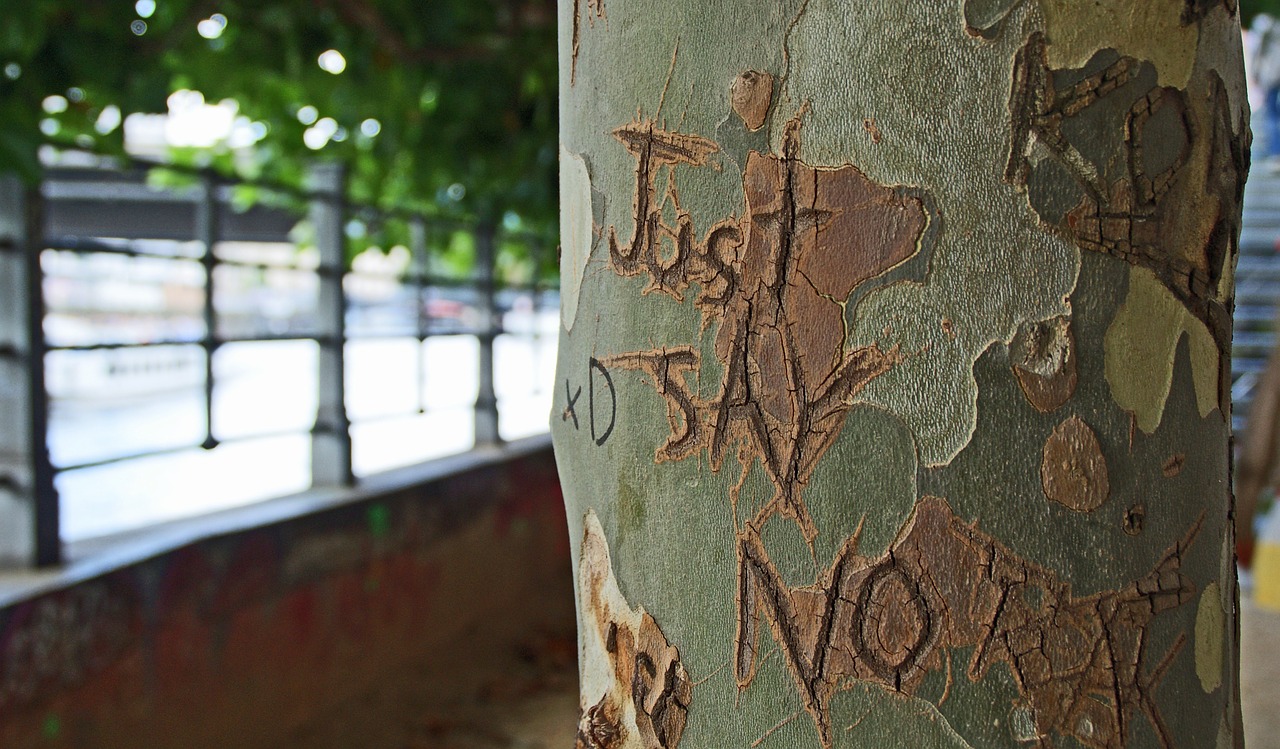
Tree with just say no

Just say no.

No should be easy to say.

No should be the easiest word in the English language for all of us to say. Look at any three-year-old and you will see them saying NO repeatedly all day long. Their parents are good at saying this and other negative things also.

So with all this practice from our earliest years in saying the word NO you would think that adults would have no problem saying NO to each other – but they do. Saying no to unwanted things can improve your mental health and happiness.

There are good reasons we need to work on and practice the ability to say NO.

1. Some people expect to be told no.

In functional families, people are able to say no some of the time. Realistic people expect to be told no. So if you get in the habit of always saying yes, people in your life may be surprised to find that you have been doing things you never wanted to do.

You have the right to say No to a great many things in life. Outside the legal and moral things we expect people to do, most things are open to people choosing for themselves what to include and what to exclude from their life.

The opportunity to say NO is one of those fundamental freedoms we all should be able to practice.

2. We have to teach others how to treat us.

For some people, it is all about them and they will keep going until you say no. Some of them will not take NO for an answer even when you say NO. They have to be taught that you mean NO when you say NO.

You will encounter some people in life who are not familiar with the word NO. They do not seem to have heard it much growing up and it comes as a surprise to them that others might not be on this earth to serve them.

Many people will ask you for things or to do things in the course of your life. Giving into everything they all ask of you results in your living other people’s lives and never having one of your own.

3. Standing up for our boundaries.

People without boundaries end up with a whole lot of other people’s garbage dumped on them. In all of our relationships, it is important to establish boundaries between us and others. There is you and there is me. I do not have to agree with you on everything for us to get along.

People who insist you do, think, and say what they want, are into controlling others. Without good boundaries, you will find you are living their life not yours.

People who do not understand when you say NO are not real friends. Lovers who try to remake you to fit their needs and wants have only themselves in their hearts.

Family members may find it difficult to accept your NO’s. They get used to you doing for them or going along with what they want.

4. Setting an example for our children.

The only way children learn appropriate behavior is to be taught. Parents get the first crack at teaching those lessons. If you don’t teach your kids the meaning of the word No they can grow up to be selfish adults who have conflict-filled lives.

You do not spoil children by giving them too much praise or love. They get spoiled by not learning right and wrong and the values of self-control.

That should not be an argument to treat children as slaves, bent to your will. Your job as a parent, like it or not, is to help them grow up into healthy adults who can have a happy life without you. Do that and they just might want you in their lives after they are grown.

We don’t always get what we want in life and there is value to learning that others can say no to us. But your kids also need to know that they have that right too, some of the time anyway. If they never saw you draw a line and protect your boundaries then they may grow up to be like you.

Many children who grew up in dysfunctional homes create another unhealthy home. If they see you unable to say no they may become a person who can’t say NO or they may become a person who forces others to agree with them. Either of those lifestyles will cause them a lot of unhappiness.

The word NO, like every other word in the language, has times it needs to be used, and times we should not use it. Have you practiced the proper use of the word NO?

Use your NO word in healthy ways.

Staying connected with David Joel Miller

Seven David Joel Miller Books are available now!

My newest book is now available. It was my opportunity to try on a new genre. I’ve been working on this book for several years, but now seem like the right time to publish it.

Story Bureau.

Story Bureau is a thrilling Dystopian Post-Apocalyptic adventure in the Surviving the Apocalypse series.

Baldwin struggles to survive life in a post-apocalyptic world where the government controls everything.

As society collapses and his family gets plunged into poverty, Baldwin takes a job in the capital city, working for a government agency called the Story Bureau. He discovers the Story Bureau is not a benign news outlet but a sinister government plot to manipulate society.

Bumps on the Road of Life. Whether you struggle with anxiety, depression, low motivation, or addiction, you can recover. Bumps on the Road of Life is the story of how people get off track and how to get your life out of the ditch.

Dark Family Secrets: Doris wants to get her life back, but small-town prejudice could shatter her dreams.

Casino Robbery Arthur Mitchell escapes the trauma of watching his girlfriend die. But the killers know he’s a witness and want him dead.

Planned Accidents  The second Arthur Mitchell and Plutus mystery.

Letters from the Dead: The third in the Arthur Mitchell mystery series.

What would you do if you found a letter to a detective describing a crime and you knew the writer and detective were dead, and you could be next?

Sasquatch. Three things about us, you should know. One, we have seen the past. Two, we’re trapped there. Three, I don’t know if we’ll ever get back to our own time.

For these and my upcoming books; please visit my Author Page – David Joel Miller

Want the latest blog posts as they publish? Subscribe to this blog.

For videos, see: Counselorssoapbox YouTube Video Channel