
Unknown's avatar

About David Joel Miller

David Miller is a California Licensed Marriage and Family Therapist, Clinical Counselor, faculty member at a local college, certified trainer and writer.

Stages of change part two – contemplation

By David Joel Miller, MS, Licensed Therapist & Licensed Counselor.

Change

Change.
Photo courtesy of Pixabay.com

Contemplation, thinking about your problem is the second stage of change.

Last time we began our discussion of the stages of change by describing how someone might be confronted with a situation where others think you have a problem, a need to change, even before we recognize that something is a problem. We called that stage of change Pre-contemplation.

Lots of people end up in the therapist’s office, court, child custody mediation, a Drunk driver program, or substance abuse treatment who never thought they had a problem. Sometimes they are sent with an ultimatum, do this treatment or else. Sometimes it is a spouse or a boss who says change or else. Sometimes it is too late and the or else has taken effect.

Often they resist thinking that they have a problem despite being required to go to some type of treatment. An interesting thing happens too many of these people, sooner or later. They see other people confronting their problems and those people’s lives are getting better. This is especially powerful in group settings where a group member gets a new job or relationship, someone gets to see their kids again or gets a license back, or someone loses a lot of weight.

Sometimes this mental change can occur after they read a book on solving a particular problem and they start to consider if they might need to change. Once the willingness to think about change occurs they have reached step two in the process of change model.

Step 2: Contemplation

In this stage, the person who is on the road to change is gathering information. That does not mean they agree they have a problem, they may, they may not, but they are open to looking at the facts. So let me continue my weight loss story from our last episode.

I get home and I ask my roommate “Have I gained any weight?” She giggles politely. Maybe it was more like a hysterical laugh. So I go looking for the scale that used to be in my bathroom. Not there. I check in the closet, under the bed, I find it on a top shelf in the garage. I weigh myself. That can’t be. I don’t weigh that much! Do I?  This scale must be broken, that’s why I put it in the garage right?

The next day at work I weigh myself on the certified scale. It gives me a bigger number than my garage scale. This can’t be right. I go to another department and try their scale. It gives me a bigger number yet. I go back to the first scale and reweigh myself. Now the truth hits me. I have put on weight. Not a little, but a lot. The weight gain is getting harder to deny.

Some people get this moment of truth when the judge sentences them. Some when their spouse leaves them or the family doesn’t want them around. For some people, it may be the DUI. Some people get to this realization the second or third time their parole officer sends them to a drug program. Maybe they realize it after the fiftieth job interview that does not result in a job. Could it be me? Do I lack the skills? Do I have a problem?

Whatever it takes eventually those who change get to this point. I am hoping that for you all you need is a little number on a scale. Whatever it is we both have a choice at this point. Change or go on the same course as before.

I could get off the scale at this point and just ignore or accept the fact I am now heavier, maybe even fat, or I can do something about it. I am no longer contemplating. But what will I do next?

Do you have any stories about the changes you have made? Want to share them? You can make a comment if you chose.

Check back next blog for the next installment about how people change.

Other posts on this topic can be found at Pre-contemplation, Contemplation, Preparation, Early Action, Late Action, Maintenance, relapse, recovery, triggers, support system, more on support systems, Resiliency

Staying connected with David Joel Miller

Seven David Joel Miller Books are available now!

My newest book is now available. It was my opportunity to try on a new genre. I’ve been working on this book for several years, but now seem like the right time to publish it.

Story Bureau.

Story Bureau is a thrilling Dystopian Post-Apocalyptic adventure in the Surviving the Apocalypse series.

Baldwin struggles to survive life in a post-apocalyptic world where the government controls everything.

As society collapses and his family gets plunged into poverty, Baldwin takes a job in the capital city, working for a government agency called the Story Bureau. He discovers the Story Bureau is not a benign news outlet but a sinister government plot to manipulate society.

Bumps on the Road of Life. Whether you struggle with anxiety, depression, low motivation, or addiction, you can recover. Bumps on the Road of Life is the story of how people get off track and how to get your life out of the ditch.

Dark Family Secrets: Doris wants to get her life back, but small-town prejudice could shatter her dreams.

Casino Robbery Arthur Mitchell escapes the trauma of watching his girlfriend die. But the killers know he’s a witness and want him dead.

Planned Accidents  The second Arthur Mitchell and Plutus mystery.

Letters from the Dead: The third in the Arthur Mitchell mystery series.

What would you do if you found a letter to a detective describing a crime and you knew the writer and detective were dead, and you could be next?

Sasquatch. Three things about us, you should know. One, we have seen the past. Two, we’re trapped there. Three, I don’t know if we’ll ever get back to our own time.

For these and my upcoming books; please visit my Author Page – David Joel Miller

Want the latest blog posts as they publish? Subscribe to this blog.

For videos, see: Counselorssoapbox YouTube Video Channel

.

Stages of Change or how do we change? Pre-Contemplation

By David Joel Miller, MS, Licensed Therapist & Licensed Counselor.

Change

Change.
Photo courtesy of Pixabay.com

Change.

In a previous blog, I wrote about New Year’s Resolutions and how to get out of them. Now occasionally someone argues with me on this and says – no – really – I do want to change. I like to hear that. We, counselors, and therapists are in the business of helping people to change. I like to think of this as the happy life business. Lots of what is here is written for counselors, but if you are interested in change for yourself or others, please read on and see how we think it is that people really change.

Most people who change are able to transform their life by a gradual process, not a one-time resolution. Now I know that there is such a thing as a religious or spiritual conversion and also that some people do make resolutions and as a result change. I would suggest that most of the time that conversion or resolution is part of a process of change. They may make a change of direction but the person needs to do some work on getting to the new behaviors they want.

Every year for New Year’s or other occasions millions of people make a resolution that they will change themselves. Some plan to lose weight, some want to stop smoking or give up drugs. Lots of things they might want to change. Come back a year later and most of them will still be the way they were when they made that resolution. But a few people will really have changed. Why is it that some people are able to carry through and make the change while most people can’t? What happened to the ones that succeeded? These questions resulted in some studies of how people change and at last three guys wrote a book on how all things get changed. The book was “Changing for Good” and the authors were Prochaska, Norcross, and DeClemente. As a result of this book and others, substance abuse counselors, and many therapists are taught the Stages of Change model and they use it to help clients understand how to change.

So here is an example I tell my classes of how someone might change.

One year I attend a reunion and I run into an old friend. He comments on how much weight I have gained since he saw me last. I tell him no, I weigh the same thing I did in High School, well almost, but I am not gaining weight. He shakes his head and changes the subject.

Later that evening I run into an old girlfriend. She tells me she almost didn’t recognize me. “You have gotten so BIG! She exclaims. She is just jealous I think. Look at that skinny little wimp she is with, bet he has an eating disorder or something. I am definitely not gained any weight. I do not have a problem. And even if I have gained a little weight, so what, why would I care, I have no plans to change me.

Later in the evening, someone else remarks about my weight. This suit does seem a little tight. The tight fit is what is making me look fat. Ever since I moved to the desert my clothes have been shrinking. Even the ones in the closet that I don’t wear seem smaller recently. Some of you are thinking here that I am in denial. Maybe so.  The stages of change model calls this Pre-contemplation.

Stage 1: Pre-Contemplation

At this point, I am not thinking about making a change. People around me see a problem but so far I don’t. Now you could argue with me at this point and insist I get on a diet and lose weight. Lots of spouses do that. But if I don’t yet see that I have a problem all your lecturing me about being in denial of my problem will only make me mad.

Substance abuse counselors in the old days used to spend a lot of time arguing with clients, trying to break down denial. So did weight loss and stop smoking professionals. And the result most of the time was that clients stopped listening. So the thing you might do if you were faced with someone who did not think he had a problem would be, provide them with information. If you are reading this and you are already thinking you might need to change something, then you are already past the first of the seven steps that lead to real lasting change.

Often people reach the point of needing to change because of some traumatic experience. Until something happens we don’t even think about the need for change. Lots of people are suddenly confronted with a problem, most try to find a way to avoid change. Divorces or breakups, job loss, forced career changes, arrests and incarceration, and even medical problems can all require people to consider the need for change in their life.

One client told me he did not have a problem. This is typical in pre-contemplation. He just likes to have fun. How can you argue with a fun-loving guy? His wife, soon to be ex, she thinks he has a problem. His last employer told him he had a problem. So did his parole agent and a judge or two. But he was sure he didn’t have a problem.

With any problem, it seems to be human nature to try to find a way to cope without having to change. So we go through all kinds of mental gymnastics to try to not have a problem. Addictions to drugs, alcohol, food, or other substance are especially prone to go unrecognized. Some people also spend lives in bad relationships, sometimes we call them co-dependent or enablers, sometimes they just say they love too much.

People also can become entangled in activities, the gamble till. There is no money left and then borrow or steal money to try to win it all back. Some people are addicted to the process of pulling the lever or turning cards. Other people are addicted to being in a relationship. They would rather be in a bad relationship than none at all. Sex can be an addiction also. Recently we are seeing a rash of problems caused by electronic media. People spend all their time and money on a pornography site, even when it starts to affect their health or their relationships. Some people become addicted to gaming or high adrenalin activities.

So how do you know if the thing you are involved in has moved from you just like to have fun to an out of control life? Counselors have three ways to decide if this is a problem or not.

1. Does it affect your job or income? Has this activity you like to do cause you to lose jobs or promotions? Does it get you in trouble at work? Has it negatively impacted your career? Then this might be a problem.

2. Has the activity you are doing interfered with your relationship with family and friends? Once you start losing friends this is a problem. Especially if you find you are making new friends who agree with you that you’re drinking or drugging is no problem and then they ask you to pay for their drug use. See an issue here?  If both your ex’s thought your fun activity was a problem that should give you a clue. And if your family starts avoiding you and doesn’t want you around anymore you may have a problem.

3. If what you have been doing is starting to bother you. If you feel sad all the time or experience guilt when you do that activity, then it just might be a problem. Professionals call this subjective distress. It is easy to see when it involves depression, anxiety, and loneliness.

One way to understand this is that if multiple people suggest to you that you have a problem, weight loss in this example, then maybe you should check it out and see what they are talking about. At that point, you are ready for the second step in the process of change.

Next time we will talk about our model’s second stage of change – Contemplation.

Other posts on this topic can be found at Pre-contemplation, Contemplation, Preparation, Early Action, Late Action, Maintenance, relapse, recovery, triggers, support system, more on support systems, Resiliency

Staying connected with David Joel Miller

Seven David Joel Miller Books are available now!

My newest book is now available. It was my opportunity to try on a new genre. I’ve been working on this book for several years, but now seem like the right time to publish it.

Story Bureau.

Story Bureau is a thrilling Dystopian Post-Apocalyptic adventure in the Surviving the Apocalypse series.

Baldwin struggles to survive life in a post-apocalyptic world where the government controls everything.

As society collapses and his family gets plunged into poverty, Baldwin takes a job in the capital city, working for a government agency called the Story Bureau. He discovers the Story Bureau is not a benign news outlet but a sinister government plot to manipulate society.

Bumps on the Road of Life. Whether you struggle with anxiety, depression, low motivation, or addiction, you can recover. Bumps on the Road of Life is the story of how people get off track and how to get your life out of the ditch.

Dark Family Secrets: Doris wants to get her life back, but small-town prejudice could shatter her dreams.

Casino Robbery Arthur Mitchell escapes the trauma of watching his girlfriend die. But the killers know he’s a witness and want him dead.

Planned Accidents  The second Arthur Mitchell and Plutus mystery.

Letters from the Dead: The third in the Arthur Mitchell mystery series.

What would you do if you found a letter to a detective describing a crime and you knew the writer and detective were dead, and you could be next?

Sasquatch. Three things about us, you should know. One, we have seen the past. Two, we’re trapped there. Three, I don’t know if we’ll ever get back to our own time.

For these and my upcoming books; please visit my Author Page – David Joel Miller

Want the latest blog posts as they publish? Subscribe to this blog.

For videos, see: Counselorssoapbox YouTube Video Channel

My plans for the end of the world

Planet Earth

Earth.

As we transition from the year 2011 to the year 2012 many of you are recalling the news that this year is slated for the end of the world. Now those of you familiar with the old prophecies should be relieved to know that they did not predict an end to the earth! What was predicted was an end to some entrenched social and political systems. For my way of thinking that will come none too soon. The last few years we have had way too much bad news and it is time for us to start planning to do some things differently.

Back in the sixties, we wanted to change the world. That didn’t go so well and what we found was the only thing we could really change was ourselves. So for 2012, I will work on being the change I hope for, changing myself. On difficult days I will be content to just change my socks. I am not expecting much in the way of political change, we shall see, we shall see – about that. What happens in my house, my office and my town are, after all, more important most of the time than anything done in a capital somewhere.

As you saw by my last post I am not big on resolutions. In the past that just set me up for disappointment. So here are some of the things I plan to do during the next year while waiting and hoping for some improvement in the human condition. Mostly I plan to start small.

Through the year I will make an effort to try to be of service to as many people as I can. Mostly I will do that by doing the work I have been doing for a while now and hoping that sometimes I will be rewarded for my efforts with that green energy we call money and other times maybe the reward will be the good feeling that comes from helping others. Occasionally we are blessed to get both. Anyone interested in joining me in this effort? If we all do our best then should the world come to an end we can feel good about our efforts. If the end of the world fails to materialize, as it always does, then well – there is always next year and in the meantime, we can feel good about ourselves.

Over the next year, my plan is to write posts for this blog at least twice a week. Some weeks there will be more. Last year there were about 40 posts, part of my learning curve. Next year we will aim for a hundred or more. Since it is not polite to fill anyone’s inbox with blog posts I will endeavor to restrain myself and post no more than once a day. That sound fair? The key word here is “try”, as I find that restraining my urge to share is almost as difficult as getting the ideas to write about.

My posts are mostly things that counselors and therapists might talk about, current trends and topics. I do plan to write the posts in ways that will be of interest to consumers or clients so there is a minimum of references and citations. Just enough sources will be included to show whose ideas I am exploring here. If I leave out a source you are interested in please let me know and I will dig it up for you when possible.

In case any of those infectious journalists stumble in here, this blog is not meant to be journalism, not sure any of it is really news. It is meant to be opinionated, mine especially but reader’s opinions are valued also. Think of this page more like letters to the editor and the opinion page than page one. I hope you will all enjoy the next year of this blog and feel free to participate.

Most of the topics cover mental health, substance abuse, parenting, and the journey toward having a happy life. Sometimes I feel the need to get political, sometimes there will be things I just find humorous. Most of the time, humorous and political turn out to be the same thing.

The topics currently on the agenda for blog posts, which I will try to mix up to be of interest to as many people as possible are:

1. Change and how we do it

2. Recovery and resiliency

3. Bipolar disorder and some of the newer research in that area

4. Behavior modification and ways to help kids grow up happy

5. The process of writing this blog and the other writing I am doing

Anything else you think needs to be added to this list? Thanks for reading this blog and here is wishing you a happy life and a joyful year.

David Miller. LMFT, LPCC

12 ways to Sabotage New Year’s resolutions

By David Joel Miller, MS, Licensed Therapist & Licensed Counselor.

the future

Living the Future
Photo courtesy of Pixabay.com

There are hundreds of articles out there about how to keep New Year’s resolutions. This isn’t one of them. This is about getting out of the ones you already made.

Lots of people make New Year’s resolutions, we feel we have to. But then the next morning we wish we had never said that. Here are some easy ways to make sure that your New Year’s resolution ends up in the dust and ensure that no one blames you for not living up to your promises.

1. Set huge impossible large goals. Despite not exercising for the last  60 years or so and having given up my photograph efforts in the late 1970s, this year I plan to make a film chronicling my success at winning twelve different gold medals in sports I had not previously played. Who could blame me for not keeping that one? The key here is to not plan to do anything, just plan to somehow have achieved the goal without effort.

2. Do not write down your goals or tell anyone. Writing things down leaves evidence. You might be tempted to look at your goals during the year. If you can’t remember what you planned to do how can it be your fault? Telling someone only expands the conspiracy. If you don’t tell, they won’t ask. People who blab their resolutions fell obliged to work on them.

3. Hang out with the losers. If you hang out with successful people you might emulate them. Want to avoid weight loss? Hang out at the donut shop or a buffet; better yet look up a donut buffet.

4. Resolve to change someone else. This is a favorite one that works every time. Plan to change your children or your spouse. Who could blame you if your family does not change? It was certainly your ex’s fault or maybe the fault of those rotten kids, wherever they are these days.

5. Embrace boredom. If it is fun don’t do it. Make resolutions to do boring, painful things not something you might actually get to like if you tried it. Nothing will squash a resolution faster than a good reason to avoid it in the first place.

6. Bet the farm on this one. If you are going to not do something, don’t do something big. Make your resolution so huge that your family might end up homeless if you did not carry through. Who could argue with you giving up your dream for the safety of your family? Doing a series of small things might actually be doable and then you would be stuck with a string of successes. Nothing ends your streak of failures like a small unsuspected success.

7. Test yourself constantly. This works well for alcoholics, who test themselves by buying alcohol and hanging out in bars. If your resolution had to do with food, go shopping and fill the house with your favorite foods. Then check the cupboard or the fridge often just to reassure yourself you have not eaten them – yet. Test yourself often enough you are sure to fail.

8. Don’t worry about being emotional. Watch sad movies and cry. Pick lots of fights. Argue with everyone you can. After an emotional day like that, you are sure to not have the energy needed to work on any stupid resolution. Happiness is incompatible with failure. Laughter can ruin a well thought out sorry-for-yourself binge. Stay moody.

9. Stop sleeping. Stay up all night every night and then sleep all day. Worry about your exercise plan, make a list of things you can’t buy. Lack of sleep will make you irrational but who can blame a half-crazed person for shopping online all night.

10. Give up all friends. Nothing so ensures your failure at resolutions as being totally isolated from all human contact. Quit your job, fight with your spouse till they leave, and hang up on your friends. People who are all alone should not be expected to be a success at anything, right?

11. Don’t eat. Being really eat-a-bear hungry can make you grouchy enough to not only stop trying but to be able to tell anyone still talking to you to put that resolution where the moonshine doesn’t- whatever.

12. If you tried before and failed don’t try again. Some people keep trying. If they keep that up they risk an eventual success. Smokers have an edge here. Most need to try to quit five to seven times so they get to talk about their try’s three or four times before giving up. Be careful though if you try too many times you might just end up making that change.

Well, I hope that this was helpful to all of you who are trying to avoid carrying through on your New Year’s resolutions. You could use this at other times of the year for any other change you are avoiding. Despite all my good advice some of you will try to make and keep New Year’s resolutions. Those of you who are successful will probably have passed through the series of steps we call “Stages of Change.” I see some of my former students smiling at that. They knew I couldn’t slip by mentioning the “Stages of Change.”

Spoiler alert – In a future blog I plan to write about how it is that people who attempt changes really do go about doing it successfully. Some of you are anticipating me and are inferring that real change rarely comes from one time resolutions and may involve a series of steps which we counselors like to term “Stages of Change.” If you prefer making resolutions and then not keeping them, avoid those blog posts.

Staying connected with David Joel Miller

Seven David Joel Miller Books are available now!

My newest book is now available. It was my opportunity to try on a new genre. I’ve been working on this book for several years, but now seem like the right time to publish it.

Story Bureau.

Story Bureau is a thrilling Dystopian Post-Apocalyptic adventure in the Surviving the Apocalypse series.

Baldwin struggles to survive life in a post-apocalyptic world where the government controls everything.

As society collapses and his family gets plunged into poverty, Baldwin takes a job in the capital city, working for a government agency called the Story Bureau. He discovers the Story Bureau is not a benign news outlet but a sinister government plot to manipulate society.

Bumps on the Road of Life. Whether you struggle with anxiety, depression, low motivation, or addiction, you can recover. Bumps on the Road of Life is the story of how people get off track and how to get your life out of the ditch.

Dark Family Secrets: Doris wants to get her life back, but small-town prejudice could shatter her dreams.

Casino Robbery Arthur Mitchell escapes the trauma of watching his girlfriend die. But the killers know he’s a witness and want him dead.

Planned Accidents  The second Arthur Mitchell and Plutus mystery.

Letters from the Dead: The third in the Arthur Mitchell mystery series.

What would you do if you found a letter to a detective describing a crime and you knew the writer and detective were dead, and you could be next?

Sasquatch. Three things about us, you should know. One, we have seen the past. Two, we’re trapped there. Three, I don’t know if we’ll ever get back to our own time.

For these and my upcoming books; please visit my Author Page – David Joel Miller

Want the latest blog posts as they publish? Subscribe to this blog.

For videos, see: Counselorssoapbox YouTube Video Channel

Recovery defined

By David Joel Miller, MS, Licensed Therapist & Licensed Counselor.

Ball recovery

Recovery and Resiliency.
Photo courtesy of Pixabay.com

What exactly is recovery?

Should we describe someone as “In recovery,” “recovering” or recovered? What about resilience. Is it in any way related to recovery? This month SAMHSA (Substance Abuse and Mental Health Services Administration) suggested a working definition for recovery.

The word recovery is commonly used when talking about substance abuse. Recently mental health has tried to incorporate wellness and recovery language into mental health programs. But it has long been clear that not everyone agrees about what is meant by recovery.

Trying to define recovery has always been a challenge.  Not the dictionary definition, which is relatively straightforward but not simple. Some common dictionary definitions of recovery include 1 A return to health 2 Return to a normal state 3 Gaining back something that was lost. The hard part was to explain what recovery meant when related to the issues of mental health and substance abuse.

Many people describe themselves as recovering. By that they mean they are struggling with a chronic progressive disease like alcoholism or drug addiction. They do not believe you are ever cured of a chronic disease condition and continue to remind themselves that at any moment they could experience a recurrence if they were to relax their vigilance.

Some people prefer the term “in recovery.” They believe that recovery is not a passive thing that happens to them but something that requires their active participation. They need to climb on board the recovery train and move towards their goal.

Some old-time AA members describe themselves as “recovered” and they point to the title page to the book “Alcoholics Anonymous” which states that the book is “the story of how many thousands of men and women have recovered from Alcoholism.” They further point out the book say that “we are not cured” but “have recovered from a hopeless state of mind and body.”  The thought that anyone could ever be fully recovered scares other people. They point out that accepting being recovered might lead someone to become careless and think that there is not more work to do on themselves.

SAMHS has suggested the following as a working definition of recovery:

A process of change through which individuals improve their health and wellness, live a self-directed life, and strive to reach their full potential.

SAMHSA delineates four major dimensions that support a life in recovery, Health, Home, Purpose, and Community.

A resiliency researcher tried to explain the difference between recovery and resiliency as – Recovery is coming back from negative consequences and resiliency as the ability to continue to function despite traumas.

A short way to think of this might be – Recovery is the process of getting back to where you were, regaining your life and Resiliency is handling life on life’s terms.

Staying connected with David Joel Miller

Seven David Joel Miller Books are available now!

My newest book is now available. It was my opportunity to try on a new genre. I’ve been working on this book for several years, but now seem like the right time to publish it.

Story Bureau.

Story Bureau is a thrilling Dystopian Post-Apocalyptic adventure in the Surviving the Apocalypse series.

Baldwin struggles to survive life in a post-apocalyptic world where the government controls everything.

As society collapses and his family gets plunged into poverty, Baldwin takes a job in the capital city, working for a government agency called the Story Bureau. He discovers the Story Bureau is not a benign news outlet but a sinister government plot to manipulate society.

Bumps on the Road of Life. Whether you struggle with anxiety, depression, low motivation, or addiction, you can recover. Bumps on the Road of Life is the story of how people get off track and how to get your life out of the ditch.

Dark Family Secrets: Doris wants to get her life back, but small-town prejudice could shatter her dreams.

Casino Robbery Arthur Mitchell escapes the trauma of watching his girlfriend die. But the killers know he’s a witness and want him dead.

Planned Accidents  The second Arthur Mitchell and Plutus mystery.

Letters from the Dead: The third in the Arthur Mitchell mystery series.

What would you do if you found a letter to a detective describing a crime and you knew the writer and detective were dead, and you could be next?

Sasquatch. Three things about us, you should know. One, we have seen the past. Two, we’re trapped there. Three, I don’t know if we’ll ever get back to our own time.

For these and my upcoming books; please visit my Author Page – David Joel Miller

Want the latest blog posts as they publish? Subscribe to this blog.

For videos, see: Counselorssoapbox YouTube Video Channel

Why your child won’t behave

By David Joel Miller, MS, Licensed Therapist & Licensed Counselor.

Sad child

Sad.
Photo courtesy of Pixabay.com

Your child misbehaves.

The number one complaint that brings parents and children to most child mental health clinics is the complaint “my kid won’t behave, won’t mind, won’t do what I tell him to, or some variation of this theme. This is so common a complaint that I am tempted to tell a lot of families “Of course he won’t mind you, he is a child and you are his parent.” But that doesn’t solve the problem, and parents, most of the time, want their children to mind.

The occasional parent who could care less if their child behaved – well those parents come in too, referred by the school or the police. The symptom checklist almost always includes things like lies, steals, argues with adults, hits, and so on. Usually, the parent wants us to find a way to get their child to behave. Sometimes they include in the symptoms “does not listen to adults, does not pay attention to what he is doing.” This could be ADHD, sometimes it is, but most of the time, the truth be told, the child is ignoring the adult. So what do most parents do about this situation and what should they do?

Children rarely grow out of bad behavior.

Lots of parents with poorly behaved preschoolers take the obvious path and do nothing. Their thinking is that the child will grow out of bad behavior. They often do grow out of it – the question is which way do they grow? Uncorrected, undisciplined, (read this as untrained not as unpunished) they grow out of it by turning into something worse, bossy disrespectful kids who tell the parents what to do. Why is it the universal nature of things for so many kids to grow disrespectful as they get older?

On simple reason for this issue is that growth in and of its self creates conflict.  The baby who can’t walk does not get into very many things, the toddler does. As children grow up they try out new things, sometimes parents like the things their child tries, but other times the child does something really dangerous or irritating. Now when the kid does something wrong there are a few ways this can go. The worst one is for the parent to do nothing, give the child the impression that whatever they do is OK with you and you could care less. If you don’t care about what your child does why should she?

Throughout the child’s life, maybe the parent’s also, the child always wants to do things they are not yet old enough or ready enough to do. Their urges are always way out in front of their skill level. Very young kids don’t get it when you tell them “don’t do that” you need to get up and make sure they stop doing that.

Your relationship with the child matters.

One important determinant of how well-behaved your child will be is how close you are to each other. In technical terms, we call this attachment. The time to start being close to your children is when they are very young. If you have a close relationship with your infant or toddler they are much more likely to want to obey and please you when they get older. Don’t worry about spoiling your child. Just because you show love and caring will not make your child spoiled. The better the parent-child relationship is the easier discipline will be.

Even if you and your child did not attach as closely as you might now wish don’t give up. One way to improve the parent-child bond is to play with your children. Some parents got the idea that playing was a time-waster that only children got to do. That is wrong. Some form of play and fun is good for humans regardless of age. Play is valuable, especially playing games with rules because it teaches the child the ability to learn rules. Rules change from game to game and they also change depending on where you are and your role in life. Kids who are good at learning new games appear to be good at learning to adapt to new situations.

Separating is natural.

Most kids will go through periods when they push their parents away. Sometimes they need to define who they are as a person separate from their parents. Other times they feel the need to align with friends and reduce their involvement with the parents. Don’t let these episodes of pushing you away be an end to your relationship. Try to stay connected and watch for a time when your child shows an interest in reconnecting.

Now some children are more resistant to discipline than others. Sometimes the parents do everything they can, play with their child, work on good attachment, praise them for successes, and still, there are discipline problems. At that point, parents turn to professionals and the professionals recommend some form of behavioral modification.

Many people misunderstand behavioral modification. They have only two tools, rewards and punishments. So there is a temptation for the rewards to turn into outright bribes. And the punishments get increasingly stringent, often to the point of abuse. Behavioral modification has lots of techniques beyond the stick and the carrot.

In future blog posts, we will talk more about modifying behavior, your child’s and your own. I also want to talk some more about recovery and resiliency. This brings us right up to the current moment.

Soon it will be New Year and lots of people will be making resolutions. How do you make resolutions you will be able to keep? How do you avoid making impossible to keep resolutions? Before we can talk about changing our children we need to talk about how we change ourselves. How does that process of change work? Stay tuned for more on changing to have a happy, resilient life.

Staying connected with David Joel Miller

Seven David Joel Miller Books are available now!

My newest book is now available. It was my opportunity to try on a new genre. I’ve been working on this book for several years, but now seem like the right time to publish it.

Story Bureau.

Story Bureau is a thrilling Dystopian Post-Apocalyptic adventure in the Surviving the Apocalypse series.

Baldwin struggles to survive life in a post-apocalyptic world where the government controls everything.

As society collapses and his family gets plunged into poverty, Baldwin takes a job in the capital city, working for a government agency called the Story Bureau. He discovers the Story Bureau is not a benign news outlet but a sinister government plot to manipulate society.

Bumps on the Road of Life. Whether you struggle with anxiety, depression, low motivation, or addiction, you can recover. Bumps on the Road of Life is the story of how people get off track and how to get your life out of the ditch.

Dark Family Secrets: Doris wants to get her life back, but small-town prejudice could shatter her dreams.

Casino Robbery Arthur Mitchell escapes the trauma of watching his girlfriend die. But the killers know he’s a witness and want him dead.

Planned Accidents  The second Arthur Mitchell and Plutus mystery.

Letters from the Dead: The third in the Arthur Mitchell mystery series.

What would you do if you found a letter to a detective describing a crime and you knew the writer and detective were dead, and you could be next?

Sasquatch. Three things about us, you should know. One, we have seen the past. Two, we’re trapped there. Three, I don’t know if we’ll ever get back to our own time.

For these and my upcoming books; please visit my Author Page – David Joel Miller

Want the latest blog posts as they publish? Subscribe to this blog.

For videos, see: Counselorssoapbox YouTube Video Channel
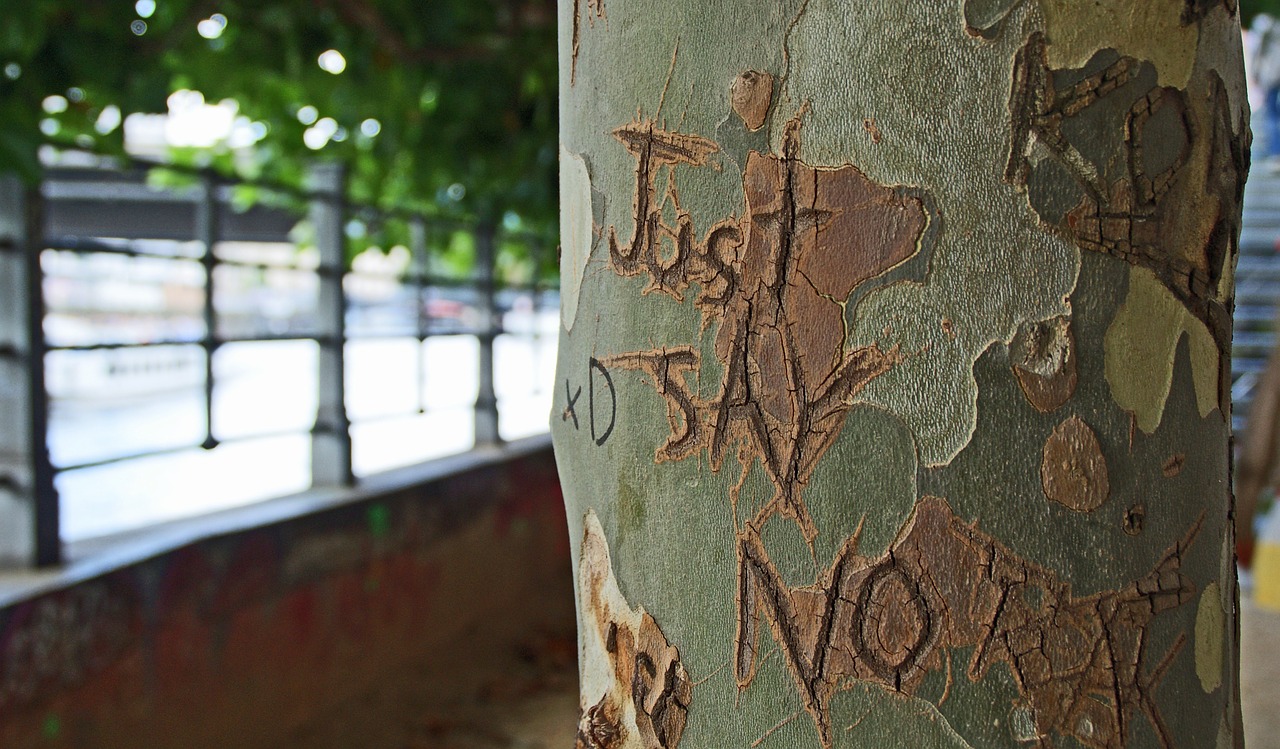
NO, NO, NO – Learning NO!

By David Joel Miller, MS, Licensed Therapist & Licensed Counselor.

Tree with just say no

Just say no.

Saying No.

Despite its short size the word NO is one of the most difficult words in the English language to understand. Ask any school teacher and they would swear that most of their students had never heard the word before. Parents spend the first couple of years of their child’s life trying to teach the child the meaning of the word NO. Then they spend the next few decades wishing they had never taught the child that word. Aside from the obvious benefit of stopping a child’s unwanted behavior, are there any reasons a parent should ever teach their child NO? If they should teach the child this word, are there any rules to stop the child from practicing this new word on their parents?

Some parents avoid using the word – NO, altogether. This word is taboo in their house. You can spot their children in any mall in America. They seem to have heard that we are not supposed to say the “N” word anymore. Do you think people are getting confused by this? Some people seem to have no problem teaching their children the other N-word but they forget to teach them NO. There is nothing worse than an adult with a limited vocabulary. Make sure NO is in your child’s lexicon.

Parents are forewarned – you have to say NO to your child so they can say NO also. Parents don’t often like it when kids say NO to things the parents have told them to do. We expect them to say NO to negative things like drugs and dangerous friends later on in life. So yes, they need to know the NO word, and what it means. Please, parents, don’t leave this task to the child’s teacher. By then your child is in trouble, and they probably will find it much harder to learn NO in a jail cell than in your home.

So teach them the No word. But don’t stop there. They will need to practice using this word. At first, they will get this vocabulary lesson wrong. They will think the NO word means the parent shouldn’t do something or that they don’t have to do what parents said. Encourage them to say NO to themselves. “No, I shouldn’t do that.” Learning to say NO to themselves helps them establish self-control.  But learning NO won’t be enough.

You also need to teach your child YES. If everything they ask for or say is greeted with a NO they become negative people or worse yet they start ignoring you when you say NO. No is meaningless without YES. Just for the record very young kids develop parental deafness if you say NO too often. So expand the vocabulary lesson. Try “don’t do that,” “that is dangerous,” “stop” and other synonyms. And try other languages.

Now by other languages, we are not talking German or French, but you could try that if you want. Most parents, mothers, in particular, use nonverbal language. In mommy speak this is called “the look.” You can also communicate the same message using “the voice.” Rather than yelling ever louder, there is a limit to how loud you can go – try talking in a – slow – low tone of voice. Most kids quickly get the idea that “the voice” means they are about to get in deep trouble.

A well-connected child, one who got praised for pleasing their parents would rather get a spanking than “the look” or “the voice.” So much the better, you get your point across and save your hand and the visit from the child protective services folks.

On that subject, some parents substitute spankings for teaching their child the – NO word. This is not a good idea. What you teach your child is not the word and the idea of “NO” but the idea of “to get what you want hit.” A teenager can hit really hard, as parents who have mistakenly thought that hitting could change behavior have learned. Teach them the “NO” word.  It is less painful all around.

One caution about saying “NO,” too often or too loudly. This word is like a flashlight; use it a little and it sheds some light on the subject, leave it in use too long and it stops working. Use NO only when it is really needed and use substitutes often. Other options with young children are “it will make you sick” or “you will poke your eye out.”

Some behavior books like Sears and Sears in The Discipline Book relate all this teaching of NO to very young children. You would think that it would be harder to teach it to young kids and it should get easier as they get older. That would be so wrong. For some reason two and three-year-olds pick up the word NO quickly. By thirteen most kids have lost the ability to learn that word altogether. So start young but don’t give up. With older kids, you may need some other techniques to convince them NO means NO. Teenage girls especially need to learn this, otherwise, how will they be able to teach it to their boyfriends?

So here is hoping that your child will be a vocabulary expert, knowing and using the word “NO” and all its synonyms correctly. More to come on changing kid’s behavior, resiliency, and recovery.

Staying connected with David Joel Miller

Seven David Joel Miller Books are available now!

My newest book is now available. It was my opportunity to try on a new genre. I’ve been working on this book for several years, but now seem like the right time to publish it.

Story Bureau.

Story Bureau is a thrilling Dystopian Post-Apocalyptic adventure in the Surviving the Apocalypse series.

Baldwin struggles to survive life in a post-apocalyptic world where the government controls everything.

As society collapses and his family gets plunged into poverty, Baldwin takes a job in the capital city, working for a government agency called the Story Bureau. He discovers the Story Bureau is not a benign news outlet but a sinister government plot to manipulate society.

Bumps on the Road of Life. Whether you struggle with anxiety, depression, low motivation, or addiction, you can recover. Bumps on the Road of Life is the story of how people get off track and how to get your life out of the ditch.

Dark Family Secrets: Doris wants to get her life back, but small-town prejudice could shatter her dreams.

Casino Robbery Arthur Mitchell escapes the trauma of watching his girlfriend die. But the killers know he’s a witness and want him dead.

Planned Accidents  The second Arthur Mitchell and Plutus mystery.

Letters from the Dead: The third in the Arthur Mitchell mystery series.

What would you do if you found a letter to a detective describing a crime and you knew the writer and detective were dead, and you could be next?

Sasquatch. Three things about us, you should know. One, we have seen the past. Two, we’re trapped there. Three, I don’t know if we’ll ever get back to our own time.

For these and my upcoming books; please visit my Author Page – David Joel Miller

Want the latest blog posts as they publish? Subscribe to this blog.

For videos, see: Counselorssoapbox YouTube Video Channel

Warning – Gremlins are hiding in the send button!

By David Joel Miller, MS, Licensed Therapist & Licensed Counselor.

Computer

Internet.
Photo courtesy of Pixabay.com

Why do emails suddenly change after you click send?

Mine keeps doing that. I am getting worried. I need to find a solution to this issue. The email message looks perfect. Nothing underlined in red. Not even a smidgen of green or purple. But let me click send and the whole message changes color and the misspelled words appear. What could be causing this?

I thought there must be something wrong with my computer. So I began my search. It took a while but now I have the proof. My suspicions have been confirmed. There is something wrong with my computer. I don’t want to scare you but this could happen to you also.

It does not appear to be a computer virus. I have checked for all the usual symptoms. No part of my computer’s anatomy is hot to the touch. There are no noxious fluids leaking from any orifice. These are the usual signs of illness in family members and I checked them all first.

Now I know that computers are not flesh and blood but it is reassuring to know that I have ruled out that possibility, still, the problem persists.

When my cat gets sick I take her to the vet. The veterinarian was no help with the computer problem. His commuter is doing the same thing mine is. He referred me to a specialist.

An x-ray of the computer failed to detect anything hiding inside that did not belong. The specialist was baffled. At least that is what I think his email said. Much of it was misspelled and run together. His computer seems to have caught the virus. Can you catch an email virus by sending an email? Checking – Checking.

Carefully I have reviewed my email list. There seem to be some really sick people on the list.

Now I am not talking about clients, I expect them to have problems. But the sickest people on my email list were colleagues. I am especially fearful of anyone with a Ph.D. I have placed their email addresses in quarantine but the problem continues.

If it was just an occasional misspelled word I could cope with it. But the transposed letters have caused some embarrassment, especially when I send them to my boos. He was especially unhappy with once sentence that was supposed to read – not- and the gremlin changed to – Nut. People are also upset with things that come out like “some time of a problem.”  The one where I said I was “thinging about you,” also caused some problems.

Now I have always had difficulty with initial sonsonant counds. Ever since I first learned the story of Finder Cella and the Sgly isters and the Chince Parming mhe seets at the dancy fress ball. Some people call these spoonerisms, others call them mtupid sistakes. But my computer problem seems to be worse than that.

Other people’s computers are speaking a language like “newspeak.” They have words like U for you and LOL for launch our litigation – or something like that. I might be able to cope with learning a new language to be able to email but my computer just is not fat consistent.

I type out the word You – that is clearly what I mean. It looks right – I click send – and now it says ou or Tou or even Uou. Who keeps changing the letters?

Whne I typ nto it comes out not and ot is transposed inot to. It is al merry confusing.

For a while, I thought it might be the mouse. I got one of those new wireless ones. Ever since I got it the cat has taken to sitting on top of the computer and watching the mouse. They yesterday the mouse disappeared. The cat is looking awfully proud of herself but the self-transposing letters continue. I am chalking it up to gremlins.

A quick search of the internet shows that I am not the only one who has suffered an infection of gremlins. Apparently, American Motors Corporation (AMC) had some Gremlin connection from 1970 to 1978. I didn’t read the whole article but I doubt that that Gremlin and the one in my computer are in any way connected.

Still, I thought the severity of this problem required me to warn you.

So should you receive an email from me, or read a blog post in which the letters seem to have been rearranged to make them more nonsensical than usual, you will know it was not my fault. The gremlin did it.

I hope this gremlin warning made you smile. Happiness it one of the greatest cures for much of what ails us. So what makes you happy? How might you achieve a happy life? Till next time.

Staying connected with David Joel Miller

Seven David Joel Miller Books are available now!

My newest book is now available. It was my opportunity to try on a new genre. I’ve been working on this book for several years, but now seem like the right time to publish it.

Story Bureau.

Story Bureau is a thrilling Dystopian Post-Apocalyptic adventure in the Surviving the Apocalypse series.

Baldwin struggles to survive life in a post-apocalyptic world where the government controls everything.

As society collapses and his family gets plunged into poverty, Baldwin takes a job in the capital city, working for a government agency called the Story Bureau. He discovers the Story Bureau is not a benign news outlet but a sinister government plot to manipulate society.

Bumps on the Road of Life. Whether you struggle with anxiety, depression, low motivation, or addiction, you can recover. Bumps on the Road of Life is the story of how people get off track and how to get your life out of the ditch.

Dark Family Secrets: Doris wants to get her life back, but small-town prejudice could shatter her dreams.

Casino Robbery Arthur Mitchell escapes the trauma of watching his girlfriend die. But the killers know he’s a witness and want him dead.

Planned Accidents  The second Arthur Mitchell and Plutus mystery.

Letters from the Dead: The third in the Arthur Mitchell mystery series.

What would you do if you found a letter to a detective describing a crime and you knew the writer and detective were dead, and you could be next?

Sasquatch. Three things about us, you should know. One, we have seen the past. Two, we’re trapped there. Three, I don’t know if we’ll ever get back to our own time.

For these and my upcoming books; please visit my Author Page – David Joel Miller

Want the latest blog posts as they publish? Subscribe to this blog.

For videos, see: Counselorssoapbox YouTube Video Channel

They’re misbehaving – again

By David Joel Miller, MS, Licensed Therapist & Licensed Counselor.

People fighting

Bad behavior.
Photo courtesy of pixabay

Lots of conversations are going on about kids and their behavior, for good reason.

We see some mighty atrocious behavior every day. Sometimes the poor behavior is by teens, other times it is by their parents. It would be easy to blame the kids acting up on their parents, but that isn’t always the case. Good parents sometimes have poorly behaved children, and when that happens the parents start asking about how do I get my kids to behave. Just for the record, there is also a connection between children’s behavior and resiliency later in life.

Studies of resiliency – that ability to bounce back from trials or not be harmed by them report that relationships, especially with parents, have a big influence on future resiliency. One sometimes overlooked part of this parental influence is the way parents use discipline. Now don’t get excited just yet. The researchers use the word discipline in a different way that a lot of other people do. By discipline, they don’t just mean punishment. They also mean rewards and praise and all the things you do to tell the child when they are doing the right thing.

One analogy is that you don’t shape a garden plant only by pruning. You need to do some staking and directing in the way you want the plant to grow. Some adults think the way to make a child fit the mold they envision for them is to break them into pieces and then pour the parts into the mold. This does not work. It inspires resistance and rebellion and in the more severe cases becomes downright abusive. We might think of discipline more like sanding down the rough edges of a child’s personality so they are more socially acceptable. There are certain natural tendencies; some kids are more active than others, some like licorice, etc. You can’t train all the personality out of a child. But then who would want to?

Now some parents think the way to have a good relationship with their child is to let the child do pretty much what the child wants. This does not generally make for a good relationship. Kids who have no or minimal rules don’t learn to follow what they are told. In short, the parents have no control over the child.  You might think this would lead to the child having more control over them but in most cases, it results in just the opposite. As adults, these people often say they are afraid they will not be able to control themselves. If your parent could not control you maybe you are uncontrollable. Kids need limits and structure so they will learn to stay inside the limits. They need parents to teach them how to control themselves and make good decisions. Kids need parents to teach them self-control.

Now one mistake new parents make is to try to teach lessons the child is not ready to learn. Coaches do not begin by teaching advanced skills, they start with the basics. In learning to play chess you are not taught multi-move openings – you start with how the pieces move. But parents often try to teach the proper use of silverware before they have taught the child not to climb on the table. This makes for upsetting dining out for the family and the people at the next booth.

Now the earlier you start training a child in good behavior the easier it is. I am not one who thinks that a person is ever too old to learn socially acceptable behavior but if you don’t teach it to your child someone else – like his parole agent, may need to step in and teach them.

One trap parents fall into is to yell, the worse the child gets the louder and longer the parent yells. This results in a condition called “parental deafness” this is similar to another medical syndrome called “married-man deafness syndrome” which I have written about elsewhere, only parental deafness develops at a much younger age. For a good description of “parental deafness,” you might want to check out “The Discipline Book” by Sears and Sears. They talk a lot about the way to teach a young child to behave. Most of the time I see older people, teens, and even adults who were cheated out of their lessons on behavior at a young age and now need some remedial work on behaving.

So the conclusion is: Children who are taught socially acceptable behavior at a young age are more able to control their own behavior at a later point in their life. And good self-control is one factor in being able to recover from the bumps in life’s road.

In future blogs, I plan to write more about behavior, resiliency, and what to do if you were absent the day these lessons were taught. We should also look at some of the things you can do if you are responsible for some remedial education on behavioral control. So what do you think about discipline, behavior, and its relationship to resilience?

Staying connected with David Joel Miller

Seven David Joel Miller Books are available now!

My newest book is now available. It was my opportunity to try on a new genre. I’ve been working on this book for several years, but now seem like the right time to publish it.

Story Bureau.

Story Bureau is a thrilling Dystopian Post-Apocalyptic adventure in the Surviving the Apocalypse series.

Baldwin struggles to survive life in a post-apocalyptic world where the government controls everything.

As society collapses and his family gets plunged into poverty, Baldwin takes a job in the capital city, working for a government agency called the Story Bureau. He discovers the Story Bureau is not a benign news outlet but a sinister government plot to manipulate society.

Bumps on the Road of Life. Whether you struggle with anxiety, depression, low motivation, or addiction, you can recover. Bumps on the Road of Life is the story of how people get off track and how to get your life out of the ditch.

Dark Family Secrets: Doris wants to get her life back, but small-town prejudice could shatter her dreams.

Casino Robbery Arthur Mitchell escapes the trauma of watching his girlfriend die. But the killers know he’s a witness and want him dead.

Planned Accidents  The second Arthur Mitchell and Plutus mystery.

Letters from the Dead: The third in the Arthur Mitchell mystery series.

What would you do if you found a letter to a detective describing a crime and you knew the writer and detective were dead, and you could be next?

Sasquatch. Three things about us, you should know. One, we have seen the past. Two, we’re trapped there. Three, I don’t know if we’ll ever get back to our own time.

For these and my upcoming books; please visit my Author Page – David Joel Miller

Want the latest blog posts as they publish? Subscribe to this blog.

For videos, see: Counselorssoapbox YouTube Video Channel

Which foods have joined a group?

By David Joel Miller, MS, Licensed Therapist & Licensed Counselor.

Food

Food.
Photo courtesy of Pixabay.com

When did Chocolate become a food group? I like that idea. At one point in time, during World War II there were seven groups. Eventual three groups got kicked out when the foods formed a pyramid. For a while, there were just four foods in the group.

What are those four food groups again?

I thought I knew the four food groups, apparently not. This food science major told me that the four main food groups are – this is important now – are you ready? Sugar, salt, fat, and chocolate. This was good to know as I daily consume lots of these items. She explained that these are the items manufacturers add to make food taste better. Why can’t good tasting also be healthy?

One of my clients told me they were making more money these days and could afford to buy all the four food groups now. They are now eating Beef, Pork, Fish, and Chicken.

There are vegans among us. They suggest that there are a variety of ingredients to eat that will increase our health while being humane and healthy. Most of these ingredients are substances I can’t spell or pronounce.

The Plant Protection Society says many species of plants are endangered. The way to preserve them – eat more animals! I just can’t win.

Somewhere along the road to this millennium the powers that be tried to change the four food groups I learned back in school into a taller, shorter, fatter, pyramid. In the process, a lot of people seem to have gotten confused. I am one of those people. The intent, I am guessing, was to convince us that we should eat more of some food groups than others. This worked well for me, I started eating more chocolate.  Then my pyramid typed over.

Worse yet some of the foods on my pyramid have been indicted for assaulting our health. Remember when eggs were bad?  And what about Coffee – is it a food group? I wish it was. For a long time, coffee was on the most wanted list, we were not supposed to drink it. Didn’t they tell us it stunted our growth? I drank a lot of it but my waist grew anyway. Then we heard that coffee had received a presidential pardon because of its efforts in fighting cancer. So far homeland security has not weighed in on the status of coffee. Is it a legal alien?

Well, whatever food groups you chose to engage with this holiday season, try to make peace with them. You will have to live with the things you eat this year throughout most of next year. From looking down at my waist, foods from several decades past still like me and are along for the ride.

Here is wishing you a happy, healthy, and enjoyable year to come.

Staying connected with David Joel Miller

Seven David Joel Miller Books are available now!

My newest book is now available. It was my opportunity to try on a new genre. I’ve been working on this book for several years, but now seem like the right time to publish it.

Story Bureau.

Story Bureau is a thrilling Dystopian Post-Apocalyptic adventure in the Surviving the Apocalypse series.

Baldwin struggles to survive life in a post-apocalyptic world where the government controls everything.

As society collapses and his family gets plunged into poverty, Baldwin takes a job in the capital city, working for a government agency called the Story Bureau. He discovers the Story Bureau is not a benign news outlet but a sinister government plot to manipulate society.

Bumps on the Road of Life. Whether you struggle with anxiety, depression, low motivation, or addiction, you can recover. Bumps on the Road of Life is the story of how people get off track and how to get your life out of the ditch.

Dark Family Secrets: Doris wants to get her life back, but small-town prejudice could shatter her dreams.

Casino Robbery Arthur Mitchell escapes the trauma of watching his girlfriend die. But the killers know he’s a witness and want him dead.

Planned Accidents  The second Arthur Mitchell and Plutus mystery.

Letters from the Dead: The third in the Arthur Mitchell mystery series.

What would you do if you found a letter to a detective describing a crime and you knew the writer and detective were dead, and you could be next?

Sasquatch. Three things about us, you should know. One, we have seen the past. Two, we’re trapped there. Three, I don’t know if we’ll ever get back to our own time.

For these and my upcoming books; please visit my Author Page – David Joel Miller

Want the latest blog posts as they publish? Subscribe to this blog.

For videos, see: Counselorssoapbox YouTube Video Channel